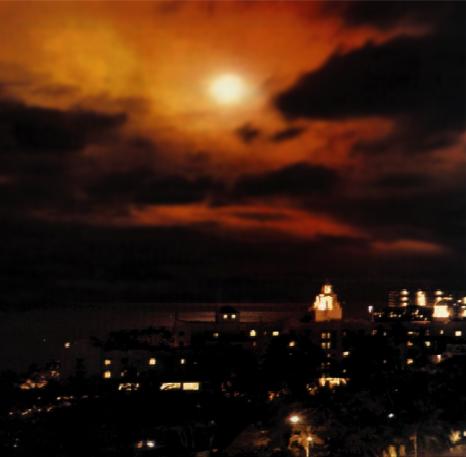
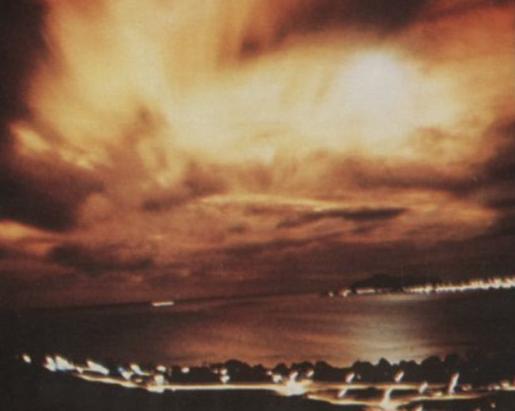
Above:Starfish as seen through heavy clouds from Honolulu, Oahu, Hawaiian islands, just over 1,300 km from the 1.4 Mt detonation at 400 km altitude; for the measured EMP waveforms from this and other tests see an earlier post. For a sumary of visible and thermal effects of all the tests see another earlier post. Below: Starfish fireball (together with ionised region below burst as seen looking upward through the atmosphere from a KC-135 aircraft flying above the clouds).
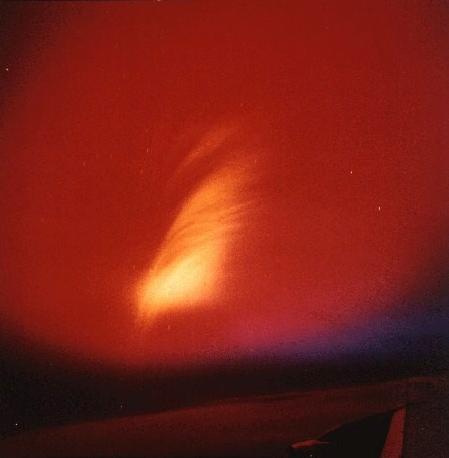
The picture above of the Starfish fireball is wrongly identified as just an aurora in some places on the internet. However, it is actually the debris fireball seen 3 minutes after detonation. There is air fluorescence from the atmosphere between the observer and the detonation (it is just an illusion that the glowing air appears above the fireball as well as below it, you have to remember that a large pancake shaped layer of glowing air below the fireball extends over the observer's field of view), which is excited by magnetic field-aligned radioactive fireball debris:
Above: this is the LA-6405 scientific analysis of the previous Starfish fireball photograph, showing how the fireball debris has become striated by the earth's magnetic field at 3 minutes. The debris, being ionised and thus electrically conductive, has to do more work to expand against the magnetic field (lines) than along them, so it expands preferentially along the magnetic field. However, some portion of the fireball energy is always used up expanding against the magnetic field, and this obviously creates the weak but lengthy late-time magneto-hydrodynamic (MHD) EMP discussed already. For more on the Starfish test, see the declassified preliminary report dated August 1962 online here, also DASA-1925 dated 1967 (declassified version online here), and a 1978 online report on the effects of Starfish on orbital satellites in 1962.
Credit: This illustration is taken from page 8 of Dr Herman Hoerlin's report, United States High Altitude Test Experiences, Los Alamos National Laboratory, LA-6405, 1976.
The Starfish test filmed from Johnston Island with a camera pointing upwards showed the outer debris fireball to be expanding at an initial rate of 2,000 km/second, and the debris had: 'separated into two parts ... the central core which expands rather slowly and ... an outer spherically expanding shell ... The diameter of the expanding shell is approximately 2 km at 500 microseconds ...' (AD-A955411, A 'Quick Look' at the Technical Results of Starfish Prime, August 1962.)
Within 0.04-0.1 second after burst, the outer shell - as filmed from Maui in the Hawaiian Islands (Oahu was 1,353 km from ground zero), had become elongated along the earth's magnetic field, creating an ellipsoid-shaped fireball. Visible 'jetting' of radiation up and southward was observed from the debris fireball at 20-50 seconds, and some of these jets are visible in the late time photograph of the debris fireball shown above.
‘Recently analyzed beta particle and magnetic field measurements obtained from five instrumented rocket payloads located around the 1962 Starfish nuclear burst are used to describe the diamagnetic cavity produced in the geomagnetic field. Three of the payloads were located in the cavity during its expansion and collapse, one payload was below, and the fifth was above the fully expanded cavity. This multipoint data set shows that the cavity expanded into an elongated shape 1,840 km along the magnetic field lines and 680 km vertically across in 1.2 s and required an unexpectedly long time of about 16 s to collapse. The beta flux contained inside the cavity was measured to be relatively uniform throughout and remained at 3 × 10¹¹ beta particles/cm2 s for at least 7 s. The plasma continued to expand upward beyond the fully expanded cavity boundary and injected a flux measuring 2.5 × 10¹⁰ beta particles/cm2 s at H + 34 s into the most intense region of the artificial belt. Measured 10 hours later by the Injun I spacecraft, this flux was determined to be 1 × 10⁹ beta particles/cm2 s.’ - Palmer Dyal, ‘Particle and field measurements of the Starfish diamagnetic cavity’, Journal of Geophysical Research, volume 111, issue A12, page 211 (2006).
'This experiment was designed to measure the interaction of expanding nuclear weapon debris with the ion-loaded geomagnetic field. Five rockets on STARFISH and two rockets on CHECKMATE were used to position instrumented payloads at various distances around the burst points. The instruments measured the magnetic field, ion flux, beta flux, gamma flux, and the neutron flux as a function of time and space around the detonations. Data was transmitted at both real and recorded times to island receiving sites near the burst regions. Measurements of the telemetry signal strengths at these sites allowed observations of blackout at 250 MHz ... the early expansion of the STARFISH debris probably took the form of an ellipsoid with its major axis oriented along the earth's magnetic field lines. Collapse of the magnetic bubble was complete in approximately 16 seconds, and part of the fission fragment beta particles were subsequently injected into trapped orbits. ...
‘At altitudes above 200 kilometres ... the particles travel unimpeded for several thousands of kilometres. During the early phase of a high-altitude explosion, a large percentage of the detonation products is ionized and can therefore interact with the geomagnetic field and can also undergo Coulomb scattering with the ambient air atoms. If the expansion is high enough above the atmosphere, an Argus shell of electrons can be formed as in the 1958 and 1962 test series. ... If this velocity of the plasma is greater than the local sound or Alfven speed, a magnetic shock similar to a hydro shock can be formed which dissipates a sizable fraction of the plasma kinetic energy. The Alfven velocity is C = B/(4*{Pi}*{Ion density, in ions per cubic metre})1/2, where ... B is the magnetic field ... Since the STARFISH debris expansion was predicted and measured to be approximately 2 x 108 cm/sec and the Alfven velocity is about 2 x 107 cm/sec, a shock should be formed. A consideration of the conservation of momentum and energy indicates that the total extent of the plasma expansion proceeds until the weapon plasma kinetic energy is balanced by the B2/(8{Pi}) magnetic field energy [density] in the excluded region and the energy of the air molecules picked up by the expanding debris. ... An estimate of the maximum radial extent of the STARFISH magnetic bubble can be made assuming conservation of momentum and energy. The magnetic field swept along by the plasma electrons will pick up ambient air ions as it proceeds outward. ...’
Conservation of momentum suggests that the initial outward bomb momentum, MBOMBVBOMB must be equal to the momentum of the total expanding fireball after it has picked up air ions of mass MAIR IONS:
MBOMBVBOMB = (MBOMB + MAIR IONS)V,
where V is the velocity of the combined shell of bomb and air ions. The expansion of the ionized material against the earth’s magnetic field slows it down, so that the maximum radial extent occurs when the initial kinetic energy E = (1/2) MBOMBVBOMB2 has been converted into the potential energy density of the magnetic field which stops its expansion. The energy of the magnetic field excluded from the ionized shell of radius R is simply the volume of that shell multiplied by the magnetic field energy density B2/(8{Pi}). By setting the energy of the magnetic field bubble equal to the kinetic energy of the explosion, the maximum size of the bubble could be calculated, assuming the debris was 100% ionized.
For CHECKMATE, they reported: ‘Expansion of the debris was mostly determined by the surrounding atmosphere which had a density of 4.8 x 10¹⁰ particles/cm3. Further details of high altitude bursts are discussed here.
The report AD-A955411, A 'Quick Look' at the Technical Results of Starfish Prime, August 1962, states that the test was planned for 400 km altitude to test a theory that an ionised 'pancake' of air would be caused 80 km over ground zero as a 'precursor shot' to block enemy ABM radar from accurately plotting the paths of subsequent ICBM's over the target area.
This prediction failed completely, because the major beta ray and bomb debris pancake occurred not over ground zero, but 600 km north of ground zero due to the charged radiations following the magnetic field lines as they descended. The altitude of this main pancake of ionised air was 120-150 km, not 80 km. Because the slope of the Earth's magnetic field lines over Johnston Island were about 28 degrees off horizontal, the beta pancake should have been predicted to be: (height of burst - height of pancake)/(sin 28 degrees) ~ 600 km.
It shows the poor level of physical understanding existing in 1962, because this was not predicted (they had apparently just tried to extrapolate from observations of the Teak test in 1958 which was at only 77 km altitude). Anyway, the pancake 600 km north of ground zero began to form at 70 milliseconds after the Starfish test. The magnetic field line running through the burst at 28 degrees [reference: R.A. Berg et al., A Starfish Happening, Lockheed Missiles and Space Co., March 1967, DASA-1925, AD-A955681, c2, p22] off vertical reached an altitude of 900 km above the magnetic equator and it also carried some beta radiation and debris initially upward to the south, where it followed the magnetic field line to its maximum and then back down into the atmosphere, creating the aurora seen from Tongatapu.
'Bursts below around 100km altitude produce relatively well defined fireball regions which rise and expand rapidly, examples being the Orange and Bluegill events.
'Detonations at higher altitudes [100-200 km] are in the "UV (ultraviolet radiation) fireball" regime; the debris blast wave expands and sweeps up air which becomes very hot. This then radiates UV, which is readily absorbed by the cold air in front of the blast wave, resulting in ionised air which is approximately transparent to further UV radiation from the blast wave. These bursts are therefore characterised by two "fireballs" - the debris air blast wave expansion is preceded by a radiation/ionisation front. The radiation front will be up/down asymmetric since mean free paths are longer in the less dense airabove the detonation altitude. An example is the Checkmate event where both fronts are clearly visible in the photograph taken from Johnston Island [for large time-labelled Checkmate film stills, see here and here]:
Above: CHECKMATE detonation horizontal view (seen from a distant aircraft) compared to the view looking upwards from Johnston Island. It was detonated during the Cuban missiles crisis: 'Observers on Johnston Island saw a green and blue circular region surrounded by a blood-red ring formed overhead that faded in less than 1 minute. Blue-green streamers and numerous pink striations formed, the latter lasting for 30 minutes. Observers at Samos saw a white flash, which faded to orange and disappeared in about 1 minute.' (Defense Nuclear Agency report DNA-6040F, AD-A136820, p. 241.)
'Detonations above the [100-200 km burst altitude] UV fireball regime are characterised by so-called "patch deposition"; the expanding debris compresses the geomagnetic field lines because the expansion velocity is greater than the Alfven speed at these altitudes. The debris energy is transferred to air ions in the resulting region of tightly compressed magnetic field lines. Subsequently the ions, charge-exchanged neutrals, beta-particles etc escape up and down the field lines. Those particles directed downwards are deposited in patches at altitudes depending on their mean free paths. These particles move along the magnetic field lines, and so the patches are not found directly above ground zero. Uncharged radiation (gamma-rays, neutrons and X-rays) is deposited in layers which are centered directly under the detonation point. The Starfish event (1.4 megatons at 400 km) was in this altitude regime:
'Detonations at thousands of kilometres altitude are contained purely magnetically. Expansion is at less than the local Alfven speed, and so energy is radiated as hydromagnetic waves. Patch depositions are again aligned with the field lines.' - Atomic Weapons Establishment internet page, Schematic summaries of some of the principal physics phenomena.
Above: 'Geomagnetically trapped MeV beta-particles generated by a high altitude nuclear burst can pose a serious threat to space-based systems, especially satellites.
'The particles may be trapped in the magnetosphere because the geomagnetic field strength is nonuniform (the field is approximately dipolar, therefore decreasing away from the Earth's surface); particles moving along a field line towards Earth will experience a retarding force due to simultaneous conservation of their magnetic moment and energy, which may eventually lead to "reflection". Such a magnetic field configuration is termed a "magnetic mirror".
'Early experiments in controlled thermonuclear fusion physics were carried out on "mirror machines" which were magnetic bottles based on the same principal. Beta-particles trapped in the geomagnetic field may bounce back and forth along the magnetospheric field lines, never reaching the dense atmosphere below. The radiation is not confined to the injection longitude, but spreads around the Earth due to the magnetic field gradient and curvature drifts which are well known in plasma particle kinetics. This is exactly analagous to the mechanism trapping natural Van-Allen belt radiation, the differences lying only in the charged particle injection mechanism and their typical energies.
'A Monte-Carlo model has been developed to predict the space radiation flux following a high altitude nuclear explosion. The following images show sample code outputs; the first three figures are views from above the North pole of the Earth (represented as a circle). The progress of radiation around the Earth over several minutes is apparent in the contour plots. [The accompanying illustration is labelled for debris radius of 500 km and a burst at 399 km - the precise burst altitude of Starfish - and shows the electron belt stretching a third of the way around the Earth's equator after 3 minutes, and completely surrounding the earth at 10 minutes after burst. The averaged beta particle radiation flux in the belt is about 2 x 10¹⁴ electrons per square metre per second at 3 minutes after burst but falls to a quarter of that at 10 minutes.]
'... the level will eventually drop off since some particles are confined to reflect close to the equator, never reaching high latitudes. Also the atmosphere effectively mops up particles that reflect below an altitude where the air density becomes appreciable. The radiation belt evolves with time, taking between days and months to return to the ambient state as particles are gradually scattered by atmospheric and magnetospheric effects.' - Atomic Weapons Establishment, Nuclear Effects Group - Artificial Radiation Belt Modelling
The Atomics Weapons Establishment also has a time-motion film of the Monte Carlo simulation of the evolution and decay of the radiation belt from Starfishhere. This remarkable film is logarithmically scaled so you get to see the way the intensities vary above the Earth's surface from 100 seconds to nearly 100 years after the burst. As the time goes on, the radiation belt pushes up to higher altitudes and becomes more concentrated over the magnetic equator.
For the first 5 minutes, the Starfish radiation belt has an altitude range of about 200-400 km and reaches from 27 degrees south of the magnetic equator to 27 degrees north of it. At 1 day after burst, the radiation belt height has increased to the 600-1,100 km zone, and the average flux is 1.5 x 10¹² electrons/m2/sec. At 4 months the altitude for this average flux (plus or minus a factor of 4) has increased to 1,100-1,500 km, and it is covering a smaller latitude range around the magnetic equator, from about 20 degrees north to about 20 degrees south. At 95 years after burst, the remaining electrons will be concentrated 2,000 km above the magnetic equator in a shell only 50 km thick, covering a latitude range of only plus or minus 10 degrees from the equator.
Glasstone and Dolan explain how test data showed these effects in The Effects of Nuclear Weapons 1977, pp. 45 et seq.: 'The geomagnetic field exerts forces on charged particles, i.e., beta particles (electrons) and debris ions, so that these particles are constrained to travel in helical (spiral) paths along the field lines. Since the earth behaves like a magnetic dipole, and has north and south poles, the field lines reach the earth at two points, called "conjugate points," one north of the magnetic equator and the other south of it. Hence, the charged particles spiraling about the geomagnetic field lines will enter the atmosphere in corresponding conjugate regions. It is in these regions that the auroras may be expected to form.
'For the high-altitude tests conducted in 1958 and 1962 in the vicinity of Johnston Island, the charged particles entered the atmosphere in the northern hemisphere between Johnston Island and the main Hawaiian Islands, whereas the conjugate region in the southern hemisphere region was in the vicinity of the Samoan, Fiji, and Tonga Islands. It is in these areas that auroras were actually observed, in addition to those in the areas of the nuclear explosions.
'Because the beta particles have high velocities, the beta auroras in the remote (southern) hemisphere appeared within a fraction of a second of those in the hemisphere where the bursts had occurred. The debris ions, however, travel more slowly and so the debris aurora in the remote hemisphere, if it is formed, appears at a somewhat later time. The beta auroras are generally most intense at an altitude of 30 to 60 miles, whereas the intensity of the debris auroras is greatest in the 60 to 125 miles range. Remote conjugate beta auroras can occur if the detonation is above 25 miles, whereas debris auroras appear only if the detonation altitude is in excess of some 200 miles.
'For bursts at sufficiently high altitudes, the debris ions, moving along the earth's magnetic field lines, are mostly brought to rest at altitudes of about 70 miles near the conjugate points. There they continue to decay and so act as a stationary source of beta particles which spiral about the geomagnetic lines of force. When the particles enter a region where the strength of the earth's magnetic field increases significantly, as it does in the vicinity of the conjugate points, some of the beta particles are turned back (or reflected). Consequently, they may travel back and forth, from one conjugate region to the other, a number of times before they are eventually captured in the atmosphere.
'In addition to the motion of the charged particles along the field lines, there is a tendency for them to move across the lines wherever the magnetic field strength is not uniform. This results in an eastward (longitudinal) drift around the earth superimposed on the back-and-forth spiral motion between regions near the conjugate points. Within a few hours after a high-altitude nuclear detonation, the beta particles form a shell completely around the earth. In the Argus experiment, in which the bursts occurred at altitudes of 125 to 300 miles, well-defined shells of about 60 miles thickness, with measurable electron densities, were established and remained for several days. This has become known as the "Argus effect." Similar phenomena were observed after the Starfish Prime and other high-altitude nuclear explosions.'
'The degrading effects of increased ionospheric ionization on commercial and aircraft communications-mainly in the LF, MF, and HF frequency ranges—extended over the whole Pacific Ocean area. They lasted for many days after the three megaton-range [high altitude] explosions [Teak, Orange, and Starfish]. They were less severe—in some cases even beneficial-for VHF and VLF frequencies, thus providing guidance for emergency situations.
'The formation of an artificial radiation belt of such high electron fluxes and long lifetimes as occurred after the Starfish event was unexpected; so were the damages sustained by three satellites in orbit [the Ariel, Traac, and Transit 4B satellites failed; Cosmos V, Injun I and Telstar suffered only minor degradation, moderate solar cell damage by electrons].
'However, the vast amount of knowledge gained by the observations of the artificial belts generated by Starfish, Argus, and the Russian high-altitude explosions [notice that America had data on the Russian tests back in 1976, when this report was written] far outweighed the information which would have been gained otherwise. A few extrapolations are made to effects on manned space flight under hypothetical circumstances...'
Page 26 states: 'for a satellite in a polar circular earth orbit, the daily dose would have been at the very least 60 rads in a heavily shielded vehicle at Starfish time plus four months'.
Judging by the Atomic Weapons Establishment computer simulation discussed above, at 4 months after Starfish this radiation, the radiation belt was at 1,100-1,500 km altitude, and it covered a latitude range around the magnetic equator, from 20 degrees north to 20 degrees south. Because NASA launches rockets from near the equator to gain the speed of earth's spin, they would be exposed to to this radiation. Obviously a space rocket going to the moon will only spend seconds in the radiation belt, and at a 60 rads/day this will be trivial, but astronauts in capsules in low earth orbits, where the spacecraft remained in the radiation belts for a long time, would receive more substantial doses of radiation. I'll discuss this subject of radiation in space in a later post. There's a lot more cosmic radiation on the moon than on earth, for instance, because there is no atmosphere. The earth's atmosphere has the same mass cover shielding as being behind 10 metres of water. Radiation is a general hazard in outer space.
In December 1992, the U.S. Defence Nuclear Agency spent $288,500 on contracting 200 Russian scientists to produce a 17-chapter analysis of effects from the Soviet Union’s nuclear tests, which included vital data on three underwater nuclear tests in the arctic, as well three 300 kt high altitude tests at altitudes of 59-290 km over Kazakhstan. In February 1995, two of the military scientists, from the Russian Central Institute of Physics and Technology, lectured on the electromagnetic effects of nuclear tests at Lawrence Livermore National Laboratory. The Soviet Union had first suffered electromagnetic pulse (EMP) damage to electronic blast instruments in their 1949 test. Their practical understanding of EMP damage eventually led them, on Monday 22 October 1962, to detonate a 300 kt missile-carried thermonuclear warhead at an altitude of 300 km (USSR test 184). That was at the very height of the Cold War and the test was detected by America: at 7 pm that day, President John F. Kennedy, in a live TV broadcast, warned the Soviet Union’s Premier Khrushchev of nuclear war if a nuclear missile was launched against the West, even by an accident: ‘It shall be the policy of this nation to regard any nuclear missile launched from Cuba against any nation in the Western hemisphere as an attack by the Soviet Union on the United States, requiring a full retalitory response upon the Soviet Union.’ That Russian space missile nuclear test during the Cuban missiles crisis deliberately instrumented the civilian power infrastructure of populated areas, unwarned, in Kazakhstan to assess EMP effects on a 570 km long civilian telephone line and a 1,000 km civilian electric power cable! This test produced the worst effects of EMP ever witnessed (the more widely hyped 1.4 Mt, 400 km burst STARFISH EMP effects were trivial by comparison, because of the weaker natural magnetic field strength at Johnston Island). The bomb released 1025 MeV of prompt gamma rays (0.13% of the bomb yield). The 550 km East-West telephone line was 7.5 m above the ground, with amplifiers every 60 km. All of its fuses were blown by the induced peak current, which reached 2-3 kA at 30 microseconds, as indicated by the triggering of gas discharge tubes. Amplifiers were damaged, and lightning spark gaps showed that the potential difference reached 350 kV. The 1,000 km long Aqmola-Almaty power line was a lead-shielded cable protected against mechanical damage by spiral-wound steel tape, and buried at a depth of 90 cm in ground of conductivity 10-3 S/m. It survived for 10 seconds, because the ground attenuated the high frequency field, However, it succumbed completely to the low frequency EMP at 10-90 seconds after the test, since the low frequencies penetrated through 90 cm of earth, inducing an almost direct current in the cable, that overheated and set the power supply on fire at Karaganda, destroying it. Cable circuit breakers were only activated when the current finally exceeded the design limit by 30%. This limit was designed for a brief lightning-induced pulse, not for DC lasting 10-90 seconds. By the time they finally tripped, at a 30% excess, a vast amount of DC energy had been transmitted. This overheated the transformers, which are vulnerable to short-circuit by DC. Two later 300 kt Soviet Union space tests, with similar yield but low altitudes down to 59 km, produced EMPs which damaged military generators.
The mechanism for why electrons "reflect" at "mirror points" is actually that the electrons follow magnetic field lines which converge near poles, bringing electrons together into a smaller space so the electric charge density increases.
These regions of high electric charge density near the poles act as "mirrors" by the simple Coulomb backscatter mechanism: like charges repel.
In other words, when electric charges get near the pole, the magnetic field lines converge together, so that all the electric charges travelling along those magnetic field lines also converge into a smaller volume of space. This makes the charge density increase until it is strong enough to repel approaching particles back they way that they came (Coulomb "reflection" or "mirroring", which is similar to the Coulomb reflection of alpha particles by positive nuclei which Rutherford's assistants used in their famous experiment of backscatter from gold foil, or you get a similar kind of effect when you fire low energy beta particles at metals, where some percentage of the beta particles are scattered back towards the source by Coulomb repulsion of atomic electrons).
A fairly clear page that illustrates all the motions of charges in Earth's magnetic field is, particularly how mirroring occurs above poles, is:
All the charged radiation also loses some energy when it gets reflected at mirror points. If the altitude of the mirror points for the magnetic field lines in question is low in the strong charge density near the poles, then the mirror points may be within the atmosphere so that particles hit air molecules and give off auroral radiations, instead of being reflected back. The Van Allen belts are continually being replenished by charged particles from the solar wind and other charged radiation from space.
The person who first analysed the mechanism of a magnetic field trapping radiation in space was the Greek elevator engineer Nicholas Christofilos.
He invented and patented a synchrotron for high energy particle physics research, which was initially ignored by physicists, then he realised that electrons will be trapped in a fairly similar way in space by the Earth's magnetic field.
He didn't predict that such radiation belts already exist in space, and instead wanted to test his theory by putting a source of electrons into space. He impressed Edward Teller who got the American government to fund Operation Argus, sending 3 nuclear bombs into space in 1958, to see if the radiation would be trapped by the Earth's magnetic field.
While Argus was still being planned, Van Allen discovered the natural belts because he had a geiger counter in the first American space satellite, Explorer I. The count rate initially went up to the maximum rate measurable, then fell to zero, indicating that the tube was saturated (fully ionized) by such intense radiation that it could no longer give out individual pulses. The later Explorer satellites had to utilise shielded geiger counters that were less sensitive.
Explorer IV in summer of 1958 mapped out the artificial radiation belts created by the high altitude Argus nuclear tests.
Sorry, I didn't understand the "mirroring" mechanism at work at the poles. I thought it was just Coulomb repulsion due to the abundance of electric charges where the magnetic field lines are converging near the poles.
Even a single electron spiralling around a magnetic field line will be reflected at a mirror point (without any requirement for other charges to be concentrated there):
"The fact that the magnetic force is perpendicular to magnetic field lines means that when a particle spirals around a cone of converging field lines, that force is always slightly tilted backwards (drawing).
"By the laws of motion, any force can always be resolved into the sum of mutually perpendicular forces, each controlling the motion in its direction. The "radial force" perpendicular to the axis of the cone (drawing) keeps the ion or electron turning in a circle around that axis, and is balanced (as noted above) by the centrifugal force of that rotation.
"In addition, however, there will also exist a small force parallel to the axis, repelling the particle away from the tip of the cone. That added force gradually slows down the particle's advance down the axis and finally reverses it, causing it to "mirror" and bounce back."
Kenshi Hirata, 26, accountant at Mitsubishi Shipbuilding Company, Hiroshima (Trumbull pp. 25, 61, and 119): “‘through an open window what looked like a golden lightning flash ... had blown up out of the earth. The weird light was everywhere. I immediately thought of an air-raid, and hurled myself prostrate in the passage.’ Hirata’s quick action probably saved him serious injury, if not his life. ... Because it was the middle of summer, which is exceptionally hot in southern Japan, most of the people of Hiroshima were very thinly clad that morning, so they had less than ordinary protection against burns, Hirata observed. ... [Back in Nagasaki] ‘I shouted to my aged father ... ‘Lie face downward!’ In the immediate moment I was expecting that terrific explosion blast and roar.’ ... Kenshi and his father were unharmed. ‘But in two or three minutes ... I saw people running out of their houses, holding their hands over injuries on their heads, faces, and bodies. Most of these were wounds caused by flying pieces of glass.”
Tsutomu Yamaguchi, 29, Mitsubishi ship designer who died in 2010, aged 93 (Trumbull pp. 28 and 109): “‘Suddenly there was a flash like the lighting of a huge magnesium flare,’ Yamaguchi recalls. The young ship designer was so well drilled in air-raid precaution techniques that he reacted automatically. He flung his hands to his head, covering his eyes with his fingers and stopping his ears with his two thumbs. Simultaneously he dropped to the ground, face down. ... ‘As I prostrated myself, there came a terrific explosion’ ... [The left side of his face and arm facing the fireball were burned, and he returned to Nagasaki, experiencing the second nuclear explosion on the sixth-floor of the headquarters office of Mitsubishi.] Spelling out the danger of flying glass, he urged them to keep windows open during an air-raid alert, and at the instant of the flash to seize at once upon any shelter available ... the second A-bomb confirmed young Yamaguchi’s words, exploding in a huge ball of fire about a mile away. Yamaguchi’s lecture ... was not lost upon his colleagues. With the young designer’s words still fresh in their minds, they leaped for the cover of desks and tables. ‘As a result,’ said Yamaguchi, ‘my section staff suffered the least in that building. In other sections there was a heavy toll of serious injuries from flying glass’.”
Shigeyoshi Morimoto, 46, maker of kites for air defense of Japanese ships, used his Hiroshima experience to take cover in Nagasaki after seeing the flash, before the windows were blasted in. Tsuitaro Doi, 47, was on his Hiroshima hotel bed, a thin floor mattress called a “futon” when he saw the explosion flash (Trumbull pages 42 and 106-7): “I quickly rolled over and covered my head with the futon ... The floor of the room and my futon were covered with tiny bits of shattered glass. I noticed that I had a slight cut on one arm, and another on the leg, where I wasn’t covered. ... [He returned home to Nagasaki] “Doi was telling his wife in detail about the bomb. ‘If you ever see that flash,’ he said, ‘immediately prostrate yourself on the floor, or the ground if you are outside. ...’ As he was saying these words, the windows lighted as if giant searchlights had been turned directly into the house. ... Mrs Doi startled, jumped to her feet impulsively and turned to run out of the house. Doi grabbed her and pulled her and the baby down as the blast wave shattered all the glass in the little cottage and ripped off the wood and paper sliding doors. As the flimsy house steadied Doi opened his eyes, and saw that the interior of the room was a wreck. But neither he nor his wife nor the baby was hurt.”
Shinji Kinoshita, 50, was hit by falling roof slabs in a Hiroshima warehouse but returned home to Nagasaki and was just outside the door of his family home when the bomb fell (Trumbull p105): “he was momentarily blinded by a flash that seemed to cover the sky. Like the other survivors of the Hiroshima attack, Kinoshita realized at once what the strange, blinding light meant, and reacted without a second’s hesitation. He threw himself face first on the ground, at the same time shouting into the house, ‘Cover yourself with futons!’”
Masao Komatsu, 40, was hit by falling beam in a Hiroshima warehouse and was on board a train in Nagasaki when the bomb fell (Trumbull, p101): “the interior of the coach was bathed in a stark, white light. Komatsu immediately dived for the floor. ‘Get down!’ he screamed at the other passengers. Some recovered sufficiently from the daze of the blinding light to react promptly to his warning. Seconds later came the deafening crack of the blast, and a shock wave that splintered all the windows on both sides of the train. The passengers who had not dived under the seats were slashed mercilessly from waist to head by glass flying at bullet speed.”
Takejiro Nishioka, 55, publisher of Nagasaki’s leading newspaper in 1945 who became Governor of the Nagasaki Prefecture in 1957. In Hiroshima on business on 6 August 1945, he survived the first nuclear explosion and noted the delay of the blast wave after the visible flash. When he returned to Nagasaki he was not allowed to publish the facts, and only survived by diving into an air raid shelter when he saw the flash after a single B-29 appeared over the city. He explained (Trumbull, p92):
“I had observed in Hiroshima that when the flash came, there would be a few seconds before it was followed by the blast wave ... I have often bitterly regretted the law that gagged me as a newspaperman, and forced me to confine my communications to the governor’s ear alone.”
Japan only permitted civil defense advice against nuclear attack to be published after the second nuclear attack on Nagasaki, which was too late. Even at ground zero, the blast wave was delayed after the first flash because of the height of burst, so quick reactions could limit exposure to flying glass. Proof of the efficiency of duck and cover advice against the blast wind and flying debris was given by Nagasaki’s police chief Mizuguchi, who had been told Nishioka’s advice by the Nagasaki governor and had passed it to his first-grade middle school student son, who was with three friends in Daikoku-Machi street, Nagasaki, when the flash occurred (Trumbull pp. 114-5):
“The police chief’s son remembered his father’s warning at once. Hauling his friend with him by the hand, he dashed for a shelter on the pavement ... The two boys in the shelter were saved; the other two, who stayed on the street, seemed to vanish ... Mizuguchi’s wife, at the same moment, happened to be standing just outside their house, under the eves, with a baby in her arms. The instant she saw the flash, she recalled her husband’s words of the night before and rushed back into the house. She opened a closet and, with the baby still in her arms, crowded inside and pulled shut the sliding door. ... The room, and the area outside the house, was covered with innumerable sharp, pointed slivers of shattered glass. Clearly, she had escaped serious injury by shutting herself in the closet. ...
“Nishioka was bitterly upbraided by Hiromasa Nakamura, chief of the foreign affairs sections of the Nagasaki Prefectural Office, for not briefing other government officials on the happenings at Hiroshima and the efficacy of bomb shelters. ... ‘I could only tell him that I was indeed anxious to tell everyone in Nagasaki what I had learned, but that if I had done so, I would have been liable for violation of the law against spreading ‘wild rumors’, and could have been arrested and convicted.”
Weapons effects exaggerations against civil defense are escalated by successive journalists and editors, who increase circulation against ever increasing noise levels from rival journals by publishing lying scare mongering which is “justified” by the allegedly moralistic pseudo-ethical assumption that “the ends justify the means”. Environmentalists who worship subjective, fashionable groupthink like a religion scream and conflate natural cancers with the effects of radiation. Like a Gordian Knot, any attempt to pull apart this scam “orthodoxy” just hardens the dogma, because its proponents do not believe in it on the basis of hard objective science, but just as an emotional, ethical, moralistic piece of patronising high-horse politics. As Glasstone pointed out in the 1950 Effects of Atomic Weapons, it is like the gas effects fear-mongering exaggerations propaganda before WWII (which claimed that gas would destroy civilization and lied that there was no defense).
The 1935 effectively pro-Nazi “pacifist” conspiracy between Labour and Conservatives to pander to popular British pro-disarmament pacifist media sentiments
“There is no security in armaments and we shall be no party to piling them up.”
– Labour Party Leader of the Opposition Clement Attlee, 1935 (two years after Hitler took power and began rearming Germany; quotation from Gilbert and Gott, The Appeasers, 1967). Troubled by the failure of unilateral disarmament to save millions of lives in WWII, Attlee 12 years later as Prime Minister ordered the stockpiling of the first British nuclear weapons to deter WWIII from starting.
“Supposing I had gone to the country and said that Germany was rearming and that we must rearm ... I cannot think of anything that would have made the loss of the election from my point of view more certain.”
– Conservative Prime Minister Stanley “the bomber will always get through” Baldwin, who won the 1935 general election with a large majority by lying to get votes for popular pacifism, denying Winston Churchill’s unpopular “warmongering” claims that Hitler was rearming Germany and must be deterred effectively (speech in House of Commons, 12 November 1936). (Some pro-Baldwin historians – not Winston Churchill – claim Baldwin was referring to an earlier non-existing election than 1935, but this makes no difference to the lying.)
An early example of “ends justify the means” exaggeration of weapons effects is Will Irwin’s 1921 book, The Next War, exaggerating gas war into the end of civilization to “justify” 1920s disarmament. This was followed by a chorus of others, before appeasers like Chamberlain stepped in to “guarantee peace in our time” by shaking Hitler’s hand (while Britain only rearmed at a fraction of the rate of Germany, so as “not to risk another war”). Instead, this increased the danger of war:
“These weapons often appear mysterious and sinister to the general public. I think that much of the responsibility for this feeling falls on our government which, by placing great restriction on the public discussion of these weapons by military officers, has fostered this miasma of ignorance. ... the government perpetuates the mysteriousness of these weapons by its restrictions. Until I retired as Commanding General, U.S. Army Chemical Corps Research and Development Command, I was under such restrictions. ... An uninformed public will not support urgently needed research and development on these weapons, nor will it be prepared psychologically for their use against us. ... Only knowledge of these weapons will make them less terrifying.
“In 1959, after hearings on research in CBR (Chemical, Biological, and Radiological Warfare), the Committee on Science and Astronautics of the U.S. House of Representatives stated that. ‘There is an urgent need for greater public understanding of the dangers and uses of CBR if proper support is to be given to our defenses and countermeasures’. ... The attitude of our government not only prevents the public from learning of these weapons: it is also greatly responsible for the failure of our military personnel to learn about them. ... The military, in our country, are not a caste apart, but simply an extension of the civilian populace.”
- Brigadier General J.H. Rothschild, Tomorrow’s Weapons, McGraw-Hill, N.Y., 1964, pp. xi-xiii.
Rothschild explains on page 1 that his June 1959 Harper’s Magazine article arguing for greater defense against chemical and biological weapons was opposed by letters of protest “against war itself”. He then explains on page 2 that chemical and biological weapons are not uniquely invisible. Bullets are also invisible while flying through the air. On page 3 he adds that in WWI only 2% of gassed American Expeditionary Force casualties died, compared to 25.8% of non-gas casualties, adding: “Exposed to one of the nerve gases, available since World War II, the casualty will either die or recover completely. Though a person under the effects of the nerve gases looks as though he is suffering greatly, men who have been accidentally exposed to them, and have recovered, say that they do not remember suffering at all. This is at great variance with the experience of casualties resulting from bullets, shell fragments, flame throwers, and land mines.”
Matthew Meselson, reviewing Rothschild’s book using sophistry on page 35 of the October 1964 Bulletin of the Atomic Scientists, fell into a false argument, claiming that the use of chemical weapons in WWII would have caused them to be used in the Korean War with “additional casualties.” In fact, the use of chemical weapons in WWI did not cause them to be used in WWII, and the use of nuclear weapons in WWII did not cause them to be used during the Cold War. Furthermore, because America kept to “conventional” weapons during the Korean War, it had to drop 635,000 tons of explosives and napalm bombs on Korea, more than in the entire Pacific theatre during WWII, ruining Korea’s cities, with immense casualties and suffering. Escalating to demoralise the enemy, as in August 1945, may stop wars and so stop further physical use of the feared weapon.
Biologist J. B. S. Haldane summarised the psychology of denial and duplicity in claiming gas warfare “unthinkable” in his 1925 book Callinicus: “First are a number of out-and-out Pacifists, who object to all war, and apparently hope to make it more difficult ... With them are associated a group of sentimentalists who appear to me definitely to be the Scribes and Pharisees of our age. ... They salve their consciences for such behaviour by attacking, in the name of their God or their ideals, every novelty ... In particular they are distinguished by a ferocious opposition to, and contempt for, any attempt at the solution of human problems by honest and simple intellectual effort.”
Attacks on civil defense are akin to attacking home fire insurance, hospitals, ambulances, seatbelts, lifeboats, and other damage reducing precautions on the false allegation that they deflect attention from utopian accident prevention, or that they are “inefficient” and “the survivors would envy the dead”. The “false sense of security” and “recklessness” historically is shown to occur not with civil defense, but with a lack of civil defense, leading to either appeasement or a maximum amount of damage, escalating the problems.
Above: the overcrowding of wood-frame buildings in 1945 Hiroshima was such that 42 percent of the ground areas in the main firestorm areas was covered with wooden buildings containing charcoal braziers, paper screens, and bamboo furnishings. This compared to 45 percent ground coverage by buildings in the central wooden medieval part of Hamburg which suffered a firestorm in July 1943. (Source: secret USSBS report The Effects of the Atomic Bomb on Hiroshima, Japan, May 1947, volume 2. This originally secret volume is not the misleading 1946 pamphlet, which omits all vital data.) U.S. Strategic Bombing Survey, never-published full May 1947 report 92 on Hiroshima, volume 2, typeset edition pages 126-8 (quoted on pages 176 and 98 of Hiroshima: Ground Zero 1945):
“Structural damage by blast to multistory, steel- and reinforced concrete-frame structures did not extend beyond 2,000 feet from GZ. The buildings within this radius sustained an average of 12 percent structural damage. The average for all the buildings of this type in Hiroshima was 8 percent.”
These are modern city buildings. The burned out areas in old photos are congested (a roof to ground area averaging 42% in firestorm areas) wood frame houses. On page 98, Hiroshima: Ground Zero 1945 quotes the secret 1947 USSBS Hiroshima report, vol 1, pp 13-14 (typeset edition):
“... six persons who had been in reinforced-concrete buildings within 3,200 feet of air zero stated that black cotton blackout curtains were ignited by radiant heat ... but a large proportion of over 1,000 persons questioned was in agreement that a great majority of the original fires was started by debris falling on kitchen charcoal fires, by industrial process fires, or by electric short circuits.”
The electric power was rapidly cut off by the overload, so sustained heat came from charcoal fires in Hiroshima's houses (due to breakfast, i.e. 8:15 local time).
Above: overcrowded wood frame housing containing charcoal braziers on the edge of the damaged area in Hiroshima (U.S. National Archives photo). How many cities in the world which contain this type of overcrowded wooden housing with charcoal braziers are targets for nuclear terrorism today? Note also that formerly secret measurements of the specific activity of fallout show that only about 1% of the crater volume becomes lofted fallout dust, most of which falls back rapidly: nuclear tests in the 1950s thus confirmed that there is no significant nuclear winter (cooling) from the cratered dust lofted as fallout. This claim relies on the carbon soot from large-scale firestorms (not just fires) which are supposed to inject a stable, non-humid, layer of hydroscopic carbon soot to altitudes where it can be warmed and achieve stable stable buoyancy, blocking out sunlight from lower altitudes. This contravenes the facts concerning the black rain in Hiroshima, which rapidly precipitated the soot. Robock's poorly researched but politically correct (peer-reviewer passed) Climactic Consequences of Regional Nuclear Conflicts (Atmos. Chem. Phys., v7, pp. 2003–2012, 2007) maintains the nuclear disaster delusion by ignoring all factual data on firestorm dust from Hiroshima and Nagasaki:
Before quoting the firestorm details from the secret Hiroshima report, it is worth pointing out that all nuclear weapons stockpiled today are much smaller yield MIRV (multiple independently targeted re-entry vehicles) than the heavy fallout weapons tested in the 1950s. Most are relatively little more powerful than the Hiroshima and Nagasaki weapons. Professor Freeman Dyson debunked the popular myths in his 1985 book Weapons and Hope (Harper and Row, New York, pp. 33-41):
“In 1957 ... Nevil Shute Norway published On the Beach, a description of mankind wiped out by radiological warfare [he had also previously published guesswork speculations about war in Britain in his April 1939 novel, What Happened to the Corbetts, which incorrectly speculated that bombing would cause a lack of clean water and cause that diseases like cholera to spread]. Norway's poignant translation of apocalyptic disaster into the everyday voices of real people caught the imagination of the world. His book became an international best-seller and was made into a successful film. The book and the film created an enduring myth, a myth which entered consciously or subconsciously into all subsequent thinking about nuclear war. ... Almost all the details are wrong: radioactive cobalt would not substantially increase the lethality of large hydrogen bombs; fallout would not descend uniformly over large areas but would fall sporadically in space and time; people could protect themselves from the radioactivity ...
“The first generation of hydrogen bombs which were tested in 1952 and 1954 had yields running from ten to fifteen megatons. They were, from a modern point of view, absurdly and inconveniently large. ... By the time I paid my first visit to Los Alamos, in the summer of 1956, hydrogen bombs of the twenty-megaton class were already considered technologically obsolete; all the experts I spoke to were working on smaller bombs with lower yields. ... The race toward smaller bombs has been driven by ... the cruise missile and the MIRV (Multiple Independently-targeted Reentry Vehicle). ... As soon as cruise missiles and MIRVs are available, high-yield weapons rapidly become obsolete. ... The central paradox of the arms race is the discrepancy between public perception and reality. The public perceives the arms race as giving birth to an endless stream of weapons of ever-increasing destructiveness and ever-increasing danger. ... In the 1950s there was indeed a race to produce weapons of mass destruction ... Since then the arms race has been running strongly in other directions, away from weapons of mass destruction toward weapons of high precision. ... One consequence of the computer revolutions has been the replacement of big hydrogen bombs by the MIRV and the cruise missile.”
The Effects of the Atomic Bomb on Hiroshima, Japan, secret, unpublished three-volume May 1947 report
The Effects of the Atomic Bomb on Hiroshima, Japan, USSBS report 92, volume 2 (typeset May 1947 edition, secret)
Volume one, page 14: “the city lacked buildings with fire-protective features such as automatic fire doors and automatic sprinkler systems”, and pages 26-28 state the heat flash in Hiroshima was only “capable of starting primary fires in exposed, easily combustible materials such as dark cloth, thin paper, or dry rotted wood exposed to direct radiation at distances usually within 4,000 feet of the point of detonation (AZ).” Page 85 of volume one explains why so many people were outdoors in Hiroshima at 8:15 on 6 August 1945:
“Conditions on Morning of Attack. The morning of 6 August 1945 was clear with a small amount of clouds at high altitude. Wind was from the south with a velocity of about 4.5 miles per hour. Visibility was 10 to 15 miles. An air-raid ‘alert’ was sounded throughout Hiroshima Prefecture at 0709 hours [the weather survey B-29 aircraft flying one hour ahead of the nuclear bomber]. ‘All-clear’ was sounded at 0731 hours. The following circumstances account in part for the high number of casualties resulting from the atomic bomb:
(1) Only a few persons remained in the air-raid shelters after the ‘all-clear’ sounded.
(2) No ‘alert’ was sounded to announce the approach of the planes involved in the atomic-bomb attack.
(3) The explosion occurred during the morning rush hours when people had just arrived at work or were hurrying to their places of business. This concentrated the population in the center of the city ...”
Volume two examines the ignition of clothing by the thermal radiation flash in Hiroshima:
Page 24: “Scores of persons throughout all sections of the city were questioned concerning the ignition of clothing by the flash from the bomb. ... Ten school boys were located during the study who had been in school yards about 6,200 feet east and 7,000 feet west, respectively, from AZ [air zero]. These boys had flash burns on the portions of their faces which had been directly exposed to rays of the bomb. The boys’ stories were consistent to the effect that their clothing, apparently of cotton materials, ‘smoked,’ but did not burst into flame. ... a boy’s coat ... started to smoulder from heat rays at 3,800 feet from AZ.”
Page 28: “Wood poles as far as 10,000 feet in a southerly direction from AZ [air zero] and 13,000 feet in a northerly direction were flash-burned but the burns, generally not much more than a discoloration of the wood, were in all cases only on the side of the pole facing AZ. ... it is logical to conclude that wood (ignition temperature approximately 450 F) was not raised to its ignition temperature, except possibly in its most easily ignitable condition, such as dry-rotted. Surface spalling or roughening of granite by heat was observed near GZ and as far as 2,400 feet from AZ. This condition was only noticeable where the granite was directly exposed to rays from the bomb (surfaces facing AZ but shielded from it were not spalled) indicating that extremely high temperatures lasted only a fraction of a second. Asphalt road surfaces and asphalt-painted surfaces also were flash-burned, distinct shadows of objects being cast upon them, which again indicated that the radiated heat from the bomb created a temperature which was high but of short duration. ... Blisters as much as one-sixteenth inch high were raised on exposed tile at GZ (2,000 feet from AZ), decreasing in size as the distance from AZ increased until they were barely visible at 4,400 feet from AZ (4,000 feet from GZ).”
Page 34: “The fire wind seems to have reached its maximum velocity about 2 to 3 hours after the bomb explosion, following which it began to diminish in intensity. ... the heavier rain began about 3,500 feet west of GZ and extended westward about 5,000 feet. Light rain was reported to have fallen near the center of the city. ... Rain fell almost exclusively in the northwest area of the city ... accounted for by the light natural wind from the southeast which blew particles of hot carbon northwestward to a cooler area where moisture condensed about them and fell as rain.”
Page 44: “A special effort was made to determine the probable cause of initial ignition in buildings in which there was fire and the reason for non-ignition in buildings in which there was no fire. By observation and by interrogation of persons who were in or near the buildings when the bomb detonated it was established that the probable causes of initial ignition in 40 of the 58 fire-resistive [not wood frame] buildings in which there was fire were as follows: 8 by heat radiation from the bomb (primary fire); 3 by blast disturbance of telephone or chemical laboratory equipment (secondary fire); and 29 by fire spread from exposing buildings.”
Page 45: “Direct Ignition by the Atomic Bomb. ...
“(1) Each of the eight fire-resistive buildings in which primary fire was reported had unprotected windows facing AZ. Black cotton black-out curtains or light-weight paper, or both, were reported to have ignited initially in most of these buildings. All buildings in Hiroshima whose windows were not equipped with steel-roller shutters, which were considered light-proof, were required to have black-out curtains. Among the eight buildings which had primary fires, the farthest from AZ was Building 64 [Hiroshima Communications Hospital] at 5,300 feet [from AZ, or 4,900 feet from GZ].
“(2) A doctor who was in the first story of Building 64, a hospital 5,300 feet from AZ, stated that he discovered fire in the second story 10 minutes after the detonation, but was unable to identify the source. ... Cotton black-out curtains were drawn across the second-story windows only. ... Contents in the second story were totally damaged by fire, but in the first story only a few pieces of wooden furniture near the windows in the south wall facing AZ were scorched ...”
Page 70: “Direct Ignition by the Atomic Bomb. None of the 8 non-combustible buildings which had [contents] fire in them was reported to have had its contents ignited by radiated heat from the bomb. All except 3 (Buildings 46, 78, and 81) of the 12 non-combustible buildings had at least some unprotected wall openings facing AZ at the time of detonation of the bomb. The contents of these 3 buildings were shielded from direct radiated heat from the bomb by a blank wall, closed fire shutters, or another building. ...
Pages 74-75: “Combustible Construction. a. General. ... combustible buildings were load-bearing, brick-wall structures with wooden floors or roof, or both; steel-frame structures with wooden purlins and studs ... It was established that the probable cause of initial ignition in 23 of the 41 buildings which had fire was as follows: 3 by secondary fire (electrical equipment, stoves and industrial furnaces), and 20 by fire spread from exposing buildings. ... No eyewitness testimony was obtained to the effect that any one of the 41 fire-damaged combustible buildings was ignited directly by flash heat from the bomb.
“b. Direct Ignition by the Atomic Bomb. Although none of the 41 fire-damaged combustible buildings was reported to have been ignited by radiated heat from the bomb, it is considered probable that the contents of a few of the buildings which had unshielded wall openings facing AZ and which were within 4,000 feet of AZ were ignited in this manner. Since wooden poles and other exposed wood, even near GZ, were only flash burned by the bomb, it seems unlikely that exposed wood outside or inside buildings was ignited directly. ...
“c. Ignition by Secondary Fire. It was established that the initial ignition in three combustible buildings (3 [Hiroshima Electric Company’s Yagurashita Substation 900 feet from GZ], 37 [Takano Bath House 4,200 feet from GZ], and 72 [Toyo Light Alloy Company 6,200 feet from GZ]) was probably by secondary fire. These comprise 13 percent of the cases in which the probable cause was determined in this class of building. Building 3, an electric substation, was ignited by short circuits in electric generating and transforming equipment after the blast had collapsed the combustible roof. ... Building 37, a public bath house, was ignited by a hot stove after the blast had collapsed the combustible roof so that it fell on the stove. The combustible debris and contents were completely consumed. Building 72, an aluminum foundry, was ignited by a hot stove ...”
Page 88: “Ignition of the City. ... Only directly exposed surfaces were flash burned. Measured from GZ, flash burns on wood poles were observed at 13,000 feet, granite was roughened or spalled by heat at 1,300 feet, and vitreous tiles on roofs were blistered at 4,000 feet. ... six persons who had been in reinforced-concrete buildings within 3,200 feet of air zero stated that black cotton blackout curtains were ignited by radiant heat ... dark clothing was scorched and, in some cases, reported to have burst into flame from flash heat [although as the 1946 USSBS report admits, most immediately beat the flames out with their hands without sustaining injury, because the clothing was not drenched in gasoline, unlike peacetime gasoline tanker road accident victims] ... but a large proportion of over 1,000 persons questioned was in agreement that a great majority of the original fires was started by debris falling on kitchen charcoal fires, by industrial process fires, or by electric short circuits. Hundreds of fires were reported to have started in the centre of the city within 10 minutes after the explosion. Of the total number of buildings investigated [135 buildings are listed] 107 caught fire, and in 69 instances, the probable cause of initial ignition of the buildings or their contents was as follows: (1) 8 by direct radiated heat from the bomb (primary fire), (2) 8 by secondary sources, and (3) 53 by fire spread from exposed [wooden] buildings.”
Page 110: “The most common failure of wood-frame buildings was buckling of the relatively slender columns ... This resulted usually either from a mass displacement of the building away from the blast, or from panel walls being blown in and carrying the columns along.”
Pages 126-8: “Structural damage by blast to multistory, steel- and reinforced concrete-frame structures did not extend beyond 2,000 feet from GZ. The buildings within this radius sustained an average of 12 percent structural damage. The average for all the buildings of this type in Hiroshima was 8 percent.”
Page 96 gives the mean destructive distance for multistory steel and reinforced concrete frame (both earthquake and non-earthquake resistant) buildings at 700 feet, compared to 9,200 feet for Japanese (wood-pole constructed) wooden houses. The damaged areas are proportional to the square of the radius, so although the Japanese wooden houses were only destroyed out to a radius about 13 times greater than modern city buildings, they were destroyed over an that was 173 times greater. Thus, for a similar bomb yield and altitude, the number of damaged buildings in a modern city would be 173 times less than in Hiroshima on 6 August 1945.
“The atomic bomb detonated at Hiroshima, although it was an extremely powerful blast weapon, caused relatively little structural damage to the 81 important bridges. Scattered throughout the entire city, the bridges, 260 to 15,600 feet from ground zero (GZ), connected islands to islands and islands to the mainland, forming an adequate and efficient bridge system. ... impressive evidence of the ability of the bridges to resist the forces of the Hiroshima atomic bomb (air-burst at 2,000 feet0 was found in the facts that (1) 10 of 19 timber bridges studied were undamaged, (2) 10 of 15 concrete bridges had no damage, and (3) 14 of 23 steel bridges were undamaged.”
This is illustrated by the survival of the nuclear target point, the distinctive T-shaped Aioi bridge at the intersection of the Ota and Motoyasu Rivers (located 1,000 feet from ground zero due to the Hiroshima bombing error). Volume three at page 40 explains: “This bridge of plate-girder design received physical damage of a spectacular and interesting nature but it continued to carry unrestricted highway, pedestrian, and street railway traffic. The longitudinal steel girders suffered no great structural damage although a slight lateral deformation indicated that they had been highly stressed.” Bridge 20 over the Motoyasu River at 2,900 feet from ground zero retained clear “shadows” of non-scorched asphalt cast by the hand railings, one of the pieces of evidence which allowed geometric determination of the burst location and altitude.
EMP effects in Hiroshima may have been masked by blast and fire damage, as indicated in volume three, pages 191-6: “Of the 7 substations of the Chugoku Electric Co., the Sendamachi substation and steam-electric plant at 7,700 feet from GZ were heavily damaged by fires which spread to the area. The Otemachi substation, 2,400 feet from GZ, was heavily damaged by blast and fires started by the short-circuited equipment. The Dambara, Misasa, and Eba substations were only slightly damaged at distances from GZ of 5,500 feet and beyond. ... Analysis of the Damage. The Hiroshima substation, 15,000 feet from GZ, was undamaged by blast as a direct effect, but the tremendous overload created by the short-circuited damaged electrical equipment in the city of Hiroshima tripped the circuit breakers in the substation and immediately interrupted all electrical services in the Hiroshima area.”
Above: the reason why there is statistically reliable data on high doses of radiation from Hiroshima and Nagasaki is simply the fact that many people - far from being instantly vaporized along with all buildings near ground zero - survived all of the nuclear explosion effects within the Hiroshima firestorm in the Bank of Japan and Geibi Bank Company, and extinguished fires 2-3 hours after the nuclear explosion when firebrands (burning cinders) were blown through broken windows from the wooden areas firestorm surrounding these modern concrete city buildings. The photos above are from the U.S. Department of Defense DCPA Attack Environment Manual 1973, chapters 3 and 8, which documents the successful firefighting in modern buildings within the Hiroshima firestorm. The diagram on the right shows substantial radiation protection factors in modern city buildings from fallout radiation. Amateur fire-fighting in the Hiroshima nuclear attack is more applicable to modern cities today which contain fire-sprinkler systems in vulnerable buildings and fewer wooden houses:
Above: buildings protect against thermal burns and fire ignition by the simple shadowing effect. The badly injured people in Hiroshima in many documented survivor accounts of serious burn and flying glass injuries had moved into a position (behind windows or outdoors) with a direct radial line to the fireball, to watch the B-29 bomb carrying aircraft.
Above: conventional warfare dropped 240 kilotons of bombs on Germany in the month of March 1945 alone, equivalent to 15 times the 16 kt Hiroshima nuclear bomb, i.e., one Hiroshima every 2 days during March 1945.
Note that in both WWI and WWII the vast majority of the weapons and explosives used were manufactured during the war itself, so prior disarmamant would not have assured that no weapons were used. One assumption in most disarmament propaganda is that a war is an instant all-out blitz; this assumption was made prior to WWI and was proved false, and again before WWII and was proved false again. The whole of the second-strike capability of hardened silos and hidden submarines designed by RAND Corporation strategists in the late 1950s was specifically aimed at removing any temptation for such a short knock-out war. This second-strike system remains and takes away any rational incentive to launch a surprise all-out attack. This is why, as President Obama stated, the major risk from nuclear weapons is a limited nuclear attack due to terrorism and rogue states. A nuclear attack will have a similar effect to large WWII air raids, but the effects will be easier to mitigate than V2 warheads, if people are informed about the reality of nuclear weapons effects phenomenology, and duck before the blast wave arrives, stamp out fires, and take cover from fallout. EMP will often rapidly disconnect the electrical fire risk by activating circuit breakers in substations, as at the Nevada test site after EMP pick up in long cables which carried thousands of amps from close-in locations out to the control point 30 miles away (not only to the 2 psi overpressure range gives in Glasstone and Dolan, which confuses the range to which cables pick up EMP with the range to which currents can be carried by cables). This is made clear in B. J. Stralser's secret 30 April 1961 E.G. and G. report Electromagnetic effects from nuclear tests.
What went wrong with civil defense during the Cold War era was the move towards hubris, arrogance, patronising, dependence upon authority, and increasing secrecy over the basis of the evidence for widely mocked and attacked civil defense countermeasures against nuclear, chemical and biological weapons. Instead of focussing on making the lessons of Hiroshima clear for all to understand, these lessons went unpublished or were actually classified secret. The failure of the government to effectively and scientifically answer and demolish false propaganda attacks in the media against civil defense undermines national security when the chips are down:
“The only way to win a war is to escalate it one way or another above what the enemy can endure. If we feel that we cannot win without unacceptable risk we have no business fighting in the first place.
“There are just two checks on escalation. One is the waning of motivation for fighting the war in the first place. A long grinding war of attrition on the ground might achieve this ... The second check on escalation is to so overwhelm your enemy with such heavy and rapid destruction that he loses all hope of winning. Then surrender is an attractive choice when compared to inevitable defeat or certain death. This, of course, is the way we brought Japan to terms in 1945. It was unnecessary to invade with infantry and fight a ground war. We seem to have forgotten this fact. Even though Japan had four million troops under arms with two million guarding her shores, not a shot was fired. We invaded with fourteen hundred military administrators, by air. Not a life was lost in this invasion.
“The Japanese had been highly motivated to wage war against us. Kamikaze tactics and no-surrender policies were typical. Yet a realization that Japan simply could not win and the certainty that continued resistance meant mounting devastation caused her to toss in the sponge. ... In the final analysis, hundreds of thousands of lives were saved and dozens of cities spared ... In Korea ... there were three and a half million military casualties on both sides during three years of drawn-out war. Over a million civilians were killed ...”
- General Curtis E. LeMay, America is in Danger, pages 307-9.
In a surprise attack, conventional weapons give practically no time for defensive countermeasures, unlike the bright flash prior to the blast arrival over most of the damaged area in a nuclear explosion, which acts as a warning. With nuclear weapons, there is an automatic warning prior blast and fallout arrival over the wide areas of destruction, which gives time for most people to take effective countermeasures and was used by people who experienced the Hiroshima nuclear explosion before travelling to Nagasaki and surviving the second nuclear explosion. As explained by Professor Joseph O. Hirschfelder, “The Effects of Atomic Weapons”, Bulletin of the Atomic Scientists, August-September 1950, vol. VI, no. 8-9, pp. 236-40 and 285-6 (quotation from page 238):
Noel-Baker, athlete and Quaker disarmer typical of the ideologues exaggerating weapons effects and denying facts about the efficiency of civil defence countermeasures today, later won a Nobel Peace prize and become a Lord, but his fear-mongering and scare-mongering lies about civil defence actually helped to enable Hitler to murder millions by cultivating appeasement. I have yet to find any historian who addresses the ideology whereby lies about civil defence for utopian dreams of disarmament are compared to Adolf Hitler's or Joseph Stalin's ideological lies of eugenics or Marxism; all are ideologies where "the ends justify the means" and since the ends are not achieveable in the real world, all of these ideologies which rely on lying fear-mongering about the alleged evils of weapons, minority races, or genuine democracy. He failed to achieve peace and his lying ideology against civil defense actually made the war risks and the war dangers of the world worse, by removing support for Churchill and allowing public empathy to side with Hitler, even to the point of the British football team being forced to give the Nazi salute at a game in Germany. Support for appeasement was due in large part to the anti-civil defense groupthink polemics which played up WWI effects, but Noel-Baker did not do this by accident or genuine error, because he was still continuing the same inaccurate anti-civil defense polemics in 1980 to deny any possibility of civil defense being of value under any circumstances, again by examining only the worst and least probable possibility, despite this being proved in WWII to be a contrived, unbalanced piece of sophistry. This is like denying the value of hospitals, seat-belts or life-boats by the trick of only considering worst-case eventualities where they are of minimal utility. House of Lords Home and Civil Defence Debate on 5 March 1980 (Hansard, vol 406 cc260-386):
But this is another falsehood of the same type as his 1927 BBC broadcast on gas: as WWII indicated (where gas was not used against Britain or Germany), by reducing the scale of the disaster if a terrorist or accidental nuclear explosion should occur, civil defense could help avoid escalation to a massive war by minimizing the effects even within war itself, stabilizing the political situation.
“In May 1929, the Women’s International League for Peace and Freedom sponsored a conference in Frankfurt on ‘modern methods of warfare and the protection of civil populations’. ... While the overall objective of the proceedings was to enhance pleas for disarmament, individual participants did so by calling attention to the stakes of future wars ... conference speakers emphasized that ‘the worst of the past gives little idea of what would be the horrible reality of a future war,’ one where ‘the civil population ... will be massacred by gas bombs from thousands of aeroplanes ...’”
– Professor Susan R. Grayzel, At Home and Under Fire, Cambridge University Press, 2011, pp149-50 (citing Getrud Woker, “The Effects of Chemical Warfare,” in Les methodes modernes de guerre et la protection des populations civiles / Chemical Warfare: An Abridged Report of Papers Read at an International Conference at Frankfurt, London, 1930, p45).
“Most of the books and pamphlets on the subject seem to me to be of the nature of propaganda ... a great many opponents of the Government state that such things as gas-masks and gas-proof rooms are completely useless, that London could be wiped out in a single air raid ... a frightful responsibility rests on those who expose British children to such a death in order to score a point ... In 1915 ... I was at that time a captain in a British infantry battalion and was brought out of the trenches to St. Omer, where I assisted my father in the design of some of the first gas masks. ... one would be safe in a phosgene concentration of one part per thousand, of which a single breath would probably kill an unprotected man. Hence in practice such a mask is a very nearly complete protection. ... These gases can penetrate into houses, but very slowly. So even in a badly-constructed house one is enormously safer than in the open air. ... even if a new gas is produced, it is very unlikely that it will get through our respirators. ... Now all the poisonous gases and vapours used in war are heavier than air, so it is thought that they would inevitably flood cellars ... But within a short time it would be mixed with many times its volume of air. Now air containing one part in 10,000 of phosgene is extremely poisonous. But its density exceeds that of air by only one part in 4,000.”
- Professor J. B. S. Haldane, A.R.P., 1938.
“Ever since the Armistice, three classes of writers have been deluding the long-suffering British public with lurid descriptions of their approaching extermination in the next war ... pure sensationalists, ultra-pacifists, and military experts. ... they do want to get their manuscript accepted for the feature page of the Daily Drivel or the Weekly Wail. In order to do that, they must pile on the horrors thick ... The amount of damage done by such alarmists cannot be calculated, but is undoubtedly very great. ... It is significant that they concentrate almost unanimously on poison gas, and that the dangers of high explosive and incendiary bombs are seldom stressed. The reason, of course, is obvious – poison gas has a much greater news value. It is still a new and mysterious form of warfare, it is something which people do not understand, and what they do not understand they can readily be made to fear. ... Millions of people, perhaps, have been impressed by the authority and reputation of Mr H. G. Wells into believing that this picture represents the plain truth.”
- Professor James Kendall (a 1917 Chemical Warfare Liaison Officer), Breathe Freely! The Truth About Poison Gas, G. Bell & Sons, London, 1938, pp. 11-13.
“... in spite of the tremendous scale of the violations it still took the Germans five years, from January 1933 when Hitler came in to around January 1938, before they had an army capable of standing up against the French and the British. At any time during that five-year period if the British and the French had had the will, they probably could have stopped the German rearmament program ... one of the most important aspects of the interwar period [was] the enormous and almost uncontrollable impulse toward disarmament ... As late as 1934, after Hitler had been in power for almost a year and a half, [British Prime Minister] Ramsey McDonald still continued to urge the French that they should disarm themselves by reducing their army by 50 per cent, and their air force by 75 per cent. In effect, MacDonald and his supporters urged one of the least aggressive nations in Europe to disarm itself to a level equal with their potential attackers, the Germans. ... Probably as much as any other single group I think that these men of good will can be charged with causing World War II. [Emphasis by Kahn.]. ... At no time did Hitler threaten to initiate war against France and England. He simply threatened to ‘retaliate’ if they attacked him. ... an obvious prototype for a future aggressor armed with H-bombs ”
- H. Kahn, On Thermonuclear War, 1960, pp. 390-1 and 403.
Future President John F. Kennedy's college thesis, Why England Slept, Sidgwick & Jackson, London, 1962 (first published 1940), pages 7, 169, 170 and 179:
Page 7: “What had England been doing while Hitler was building up this tremendous German Army?... To say that all the blame must rest on the shoulders of Neville Chamberlain or of Stanley Baldwin is to overlook the obvious. As the leaders, they are, of course, gravely and seriously responsible. But, given the conditions of democratic government, a free press, public elections, and a cabinet responsible to Parliament and thus to the people, given rule by the majority, it is unreasonable to blame the entire situation on one man or group.”
Page 169: “... I believe, as I have stated frequently, that leaders are responsible for their failures only in the governing sector and cannot be held responsible for the failure of a nation as a whole ... I believe it is one of democracy’s failings that it seeks to make scapegoats for its own weaknesses.”
Page 170: “Herbert Morrison, the able British Labour Leader ... was being criticised in 1939 for co-operating with the Government ... ‘At the beginning I got plenty of abuse from the irresponsibles because I said that Labour administrators must play their full part in A.R.P. [Air Raid Precautions, i.e. civil defense], which was denounced as a fraud and a plot... to create war psychology. For Labour local authorities to co-operate with state departments in this task was treachery ... no A.R.P. could possibly be effective’.”
Page 179: “... the dictator is able to know exactly how much the democracy is bluffing, because of the free Press, radio, and so forth, and so can plan his moves accordingly.”
Kennedy stuck to his guns with civil defense. After the first Russian nuclear weapon test, he wrote a public letter to President Truman warning of the risk of an "atomic Pearl Harbor", published in the New York Times of 10 October 1949. Kennedy also attended the 22-26 June 1959 nuclear war congressional hearings which featured Herman Kahn on civil defense, and Kennedy used the supposed missile gap as the basis for his Presidential election campaign (which in the even only appeared in about 1975 when the USSR achieved parity and went on bankrupting itself by churning out more missiles). Kennedy set up the public fallout shelter allocation in 1961. All of this goes back to his time in the American Embassy in 1939 and the research he did into the connection between British civil defense apathy in the 1930s and appeasement (even encouragement) of fear exploiting Nazi thugs. He could see that aggressors are all alike: they are all self-deluded, they all have an ideology, and they all use fear-mongering lies.
Professor Susan R. Grayzel, At Home and Under Fire: Air Raids and Culture in Britain from the Great War to the Blitz (Cambridge University Press, 2012) finds that (p176): “a variety of voices reflected on the enormous destructive potential of air power in interwar Britain, and many determined to prevent the imagined horrors of the next war from coming true. Several important constituent bodies of the nation – including key segments of women, trades unionists, and members of the state itself – worked fervently for disarmament and to challenge efforts to accept aerial and perhaps even chemical attacks as somehow inevitable in a future war.”
Pro-disarmament propaganda which was based entirely on exaggeration of weapons and war effects (ignoring the real dangers of ideologies like racist eugenics and ethnic cleansing) and denials of civil defense efficiency went largely unopposed until 1938, partly due to official secrecy to keep both the enemy and the public ignorant (while they were being sold exaggerations by the media). To be heard, disarmament activists had the temerity to falsely dismiss all countermeasures, to exaggerate the scale of potential attacks, and to ignore the fact that countermeasures were a tried and tested solution (unlike disarmament without civil defense, i.e. complete vulnerability). Public apathy allowed doom exaggerations to be mainly supported or allowed to circulate without correction. How many newspapers, popular historians, or TV stations stand up and publish the facts on nuclear weapons and Hiroshima today? None. Civil defense has never had any backing and has always been violently opposed by ideologies which prefer war. When Noel-Baker claimed to have an "authority" which proved a consensus of gas war experts who knew gas had no countermeasure, he was simply lying to the nation. In any case, his claim that science is determined by a religious type consensus, was again lying to the nation, because science is distinguished from political agreements by its factual evidence rather than its fashionable popularity and the number of votes its adverts gain. Never mind how "unpopular" or "unfashionable" it is for a gas mask or duck and cover evasive action to protect the public, it is fact:
Some myths debunked: 1. nobody was "vaporized": people are 70% water which has far too high a specific heat capacity and latent heat of vaporization even at ground zero, 2. fallout and neutron induced activity were insignificant compared to the initial nuclear radiation doses, because of the height of burst, 3. the long term effects of radiation were trivial compared to the natural cancer rate in an unexposed control group, and genetic effects were insignificant, 4. conventional weapons killed more people and resulted in more deaths and suffering because conventional wars lasted for years: the "blunt knife" is more dangerous overall, because it is likely to slip and cause injuries, because you need to use more force on a blunt knife to achieve any given result, 5. shallow underground bursts avert collateral damage around bunkers, while retaining credible deterrence. Downwind fallout can be washed or brushed off, and nuclear radiation is attenuated by buildings, 6. nuclear weapons with individually larger areas of effects are actually easier to protect against than an immense number of conventional weapons, because the blast wave is delayed for a longer period of time after the bright visible flash over most of the damaged area: fashionable lying "films" falsely superimpose the sound on the flash to "discredit" civil defense, one of the most sinister deceptions. The same applies to fallout: the further an effect has to travel, the longer it takes to arrive, so there is time to evacuate or to take cover in a safe building. Conventional weapons failed to deter two world wars, which explains why Cold War nuclear weapons were relied upon for deterrence. Anti-civil defense propaganda for nuclear disarmament politics is reducing not only deterrence but public safeguards against nuclear terrorism. Nuclear disarmament will put the clock back to the pre-nuclear era of conventional world wars. Nuclear safeguards and inspections will simply drive proliferation further underground, or risk war in themselves (just as 1930s efforts to oppose proliferation risked starting a war).
Modern buildings in modern cities do not suffer firestorms.
“The only way to win a war is to escalate it one way or another above what the enemy can endure. If we feel that we cannot win without unacceptable risk we have no business fighting in the first place.
“There are just two checks on escalation. One is the waning of motivation for fighting the war in the first place. A long grinding war of attrition on the ground might achieve this … The second check on escalation is to so overwhelm your enemy with such heavy and rapid destruction that he loses all hope of winning. Then surrender is an attractive choice when compared to inevitable defeat or certain death. This, of course, is the way we brought Japan to terms in 1945. It was unnecessary to invade with infantry and fight a ground war. We seem to have forgotten this fact. Even though Japan had four million troops under arms with two million guarding her shores, not a shot was fired. We invaded with fourteen hundred military administrators, by air. Not a life was lost in this invasion.
“The Japanese had been highly motivated to wage war against us. Kamikaze tactics and no-surrender policies were typical. Yet a realization that Japan simply could not win and the certainty that continued resistance meant mounting devastation caused her to toss in the sponge. … In the final analysis, hundreds of thousands of lives were saved and dozens of cities spared … In Korea … there were three and a half million military casualties on both sides during three years of drawn-out war. Over a million civilians were killed ...”
- General Curtis E. LeMay, America is in Danger, pages 307-9.
General Curtis Emerson LeMay (1906-90) developed and led the B-17 and B-24 incendiary bombing missions first in Europe and then B-29 missions in the Pacific during World War II, including control of incendiary raids and the two nuclear attacks. In the Cold War he headed the Berlin airlift of 1948, was the founder of SAC (the Strategic Air Command), and from 1961-5 was Chief of Staff of the USAF, retiring after arguments with Defense Secretary Robert McNamara over the Vietnam War. LeMay advised declaring war on North Vietnam (which McNamara refused to do) and the escalatory winning tactics that had proved successful against Japan without requiring a ground invasion of Japan in 1945. McNamara instead initially used the failing flexible response efforts to try to encourage negotiation with the least possible force, and later a gradual rather than overwhelming vertical escalation which simply resulted in media criticism for the killing of civilians with no positive result. While LeMay requested the bombing of North Vietnam harbors, but McNamara preferred to leave them untouched and bomb insurgent camps and supply routes within Vietnam, claiming that LeMay’s scheme would kill Soviet Union advisers in supply ships in the harbors of North Vietnam, escalating the war horizontally, destabilizing Europe.
General Curtis E. LeMay’s 5 June 1968 book America is in Danger (Funk and Wagnalls, New York) is still valid today, and it predicted on page 307 that America was going to lose in Vietnam, if McNamara’s graduated response war policy continued. The book jacket clearly summarizes LeMay’s case: “America is in danger. … We find ourselves in a purely defensive role, unable to make our will felt even in a conflict with a backward jungle country. … Our strategic nuclear superiority has given us much diplomatic strength in the past. Do we still have that strength? … I think not. That is why America is in grave danger. … Assessing the strategic situation, General LeMay argues that our former policy of overwhelming nuclear superiority proved itself during the crises in Berlin, Taiwan, and Cuba, and produced twenty years of relative peace. Yet the current Administration has opted for a new and untested posture that permits, even encourages parity with Russia.”
On pages viii-ix LeMay explains that the worst wars are caused by dogmatic censorship in democracy:
“The equivocal manner in which we are waging the war in Southeast Asia [Vietnam] is a direct result of the bankrupt nature of a deterrent policy. … ‘defense intellectuals’ go unchallenged simply because the experienced professional active duty officers are officially prohibited from entering into public debate. … In 1916 while war in Europe was raging, President Woodrow Wilson banished from Washington a few officers at the Army War College who had the temerity to plan for war. … I. S. Block, ‘proved’ statistically in a popular book The Future of War, and in numerous speeches, that war was an economic impossibility [Norman Angell’s Great Illusion in 1908 deluded Britain into viewing war as economically absurd, but was still awarded a Knighthood and a Nobel Peace Prize after WWI, since facts are always distorted to fit in to a hardened ideology]. His disciples (among whom was David Starr Jordan) were still plugging this doctrine in America in the face of the Battles of the Marne and the Somme.
“Just a few months before Sarajevo in 1914, David Starr Jordan, President of Stanford University and a renowned naturalist, said, ‘It is apparently not possible for another real war among the nations of Europe to take place.’ … Before World War II the military profession was again pre-empted by the ‘defense intellectuals.’ … The Kellogg-Briand Pact of 1928 had outlawed law in principle. The Washington Disarmament conferences of the 1930s, if not arriving at a treaty had at least condemned ‘offensive’ weapons. … There was no one who could tell America that wars cannot be won with defensive weapons. … In the Army Air Corps we developed the B-17 Flying Fortress almost clandestinely. … Thirteen were ordered in 1937 and with them we worked out the tactics and strategies which carried the war to Germany and Japan …”
On pages xiii-xiv, LeMay points out that in any war, be it Japan or Vietnam, there is no certain quantitative prediction possible of the effect of weapons on the will of the enemy to resist or surrender, and this factor must be either omitted or faked in all computer “predictions”:
“We computerized every activity susceptible to machine analysis long before most businesses or other government agencies … What we did not do was to force non-quantifiable data into a quantified mold in order to feed it to the machines. … when defense intellectuals attempt, in deadpan seriousness, to quantify the effect that x number of casualties will have on the government or the will to resist, they are entering the Land of Oz. Some countries have succumbed, as France did in 1940, with minor casualties. Carthage and Paraguay (in 1870) show that other countries never give up, no matter what the casualties. … Such unknowns in the strategic equation are anathema to the quantifier.”
LeMay elaborates this on page 77:
“An enraged country may go to war against impossible odds, with no logical change of victory. This is another example of weakness in the concept of deterrence – the possibility of the illogical reaction. Thus did Paraguay fight against an overwhelming alliance of Brazil, Argentina, and Uruguay in 1864. So did little Serbia stand up to the great Austria-Hungarian Empire in 1914. And thus did England and France declare war on Germany in 1939 … Almost any country can be pushed too far, as was Hungary in 1956. It then feels compelled to fight regardless of the consequences. Patrick Henry’s remark ‘give me liberty or give me death’ is not an isolated human decision.”
LeMay’s points out that Defense Secretary McNamara’s failure in the Vietnam War was due to the abuse of science, in fiddling computer model assumptions about the political response to the enemy to military coercion. LeMay on page 89 shows that this failure of analysis in Vietnam also applies to general nuclear war deterrence planning, e.g. McNamara’s 1967 Posture Statement: “To deter deliberate nuclear attack upon the United States … ability to inflict an unacceptable degree of damage …” Here the word “unacceptable” is a subjective function of the emotional state of mind of the enemy.
Anti-nuclear war propaganda like Kubrick’s pseudoscience film Dr Strangelove is attributed by LeMay on pages 8-12 to ideologues (the pseudo-pacifists, the pseudo-moralistic crusaders, and the well-meaning media whose lying “anti-war” propaganda lay behind previous wars):
“This large peace-time military establishment has allowed many scaremongers to capitalize on the traditional anti-military American attitudes and thus sell books and movies. … It is like yelling fire in a crowded theatre. Some … is encouraged by our enemies to weaken faith in our military leadership and thus to undermine our resolve or capability for self-defense. Some of it, of course, is a perfectly legitimate concern over how a large, perpetual military establishment will change our system of values, society, and government. … One must keep in mind the communist technique of ‘boring from within.’ … History illustrates that the first act of a dictator is to distort and suppress the news. Free speech and press permit the truth to be aired and opposing opinions to be expressed. … The world is moving too fast today, particularly in technology, for us to be tied to a monolithic organization which stifles all thought outside its own party line of hackneyed solutions. … One of the greatest dangers in a military estimate of any situation is to believe, through party-line strategic concepts, that you know what the enemy will or will not do. We knew that Japan would not attack Pearl Harbor, our best-defended outpost. … We knew that the Soviet Union would not put nuclear intermediate range ballistic missiles in Cuba. … We must – but do not – have a defense organization which permits controversy, which permits the ‘unthinkable’ condition to be debated freely, which permits the screwball idea to come forth, and which tolerates the maverick officer. The Andrew Jacksons, the Zachary Taylors, the Ulysses S. Grants, the George Deweys, the Alfred Thayer Mahans, the Billy Mitchells, are not nurtured in orthodoxy. They are not products of a party line.”
In a chapter on the “Proliferation of Nuclear Weapons” LeMay explains on page 204 that although “Every large war, of course, is sparked by some relatively minor event, as the murder at Saravejo in 1914 or the Nazi march into Poland in 1939”, ignition sparks are not the fuel. The straw that breaks the camel’s back is not the sole or even the major problem:
“The small countries of Austria, Czechoslovakia, or Poland most certainly cannot be accused of ‘catalytic’ behavior during these tense times. Should Poland have succumbed for the sake of world peace? The small country argument is sometimes related to the ‘statistical’ theory. As more countries get the bomb, goes the reasoning, something is likely to happen that will cause a bomb to go off. … This fear should be laid to rest. The number of nuclear bombs and warheads have already proliferated to the thousands and the first accidental nuclear explosion has yet to occur. … For example, on December 8, 1964, a B-58 Hustler bomber with a ‘nuclear device’ in its bomb bay caught fire at Bunker Hill Air Force Base, Indiana … no radioactive contamination occurred. Of the four bombs dropped from a B-52 off Palomares, Spain, as a result of a refueling collision in 1966 … there was some relatively harmless contamination caused by two which broke up. A nuclear bomb is a highly complicated device and many sequential steps must be taken to light it off. … At worse, the chemical high explosive components of a bomb might detonate from fire and scatter some nuclear material which could cause a small area to become mildly and harmlessly radioactive, as in Spain. Nothing of this sort is liable to lead to a nuclear war.”
On pages 242-260, in his chapter on “Counterinsurgency and the War in Vietnam”, LeMay points out:
“It is a war waged simultaneously on many fronts and in many forms. It is a cold war and a hot war, and economic war and a political war, a propaganda war and an ideological war. It is waged by the communists according to their own timetable and on battlefields of their choosing. … By 1965 we were bombing North Vietnam and landing combat troops to engage with the Viet Cong. Yet the South Vietnamese army was shot with desertions and down to one-third strength. Equipment worth millions of dollars from the United States was finding its way into Viet Cong hands. … It is a war of flexible response not designed to win but rather to punish, and to punish only enough to bring the Hanoi government to the conference table. … It is a war where our powerful Navy allows foreign ships to supply the enemy with war materials. … It is a war where we allow the one principal harbor – the harbor through which the large majority of enemy supplies must flow – to remain undamaged. … This is the war of flexible response and graduated deterrence applied for the first time. This is the war concocted by the arms controllers of the Kennedy-Johnson Administrations to prevent, they believed, the feared nuclear holocaust. The consequences of such a cruel non-war will be heartache, frustration, and death, rather than a reasonable political settlement. We must change our strategy. …
“The long, drawn-out conflict has created dissension, disillusion, and dispute in America. It has seemed to foster a greater sense of determination and purpose in North Vietnam. … Oriental stoicism and patience make North Vietnam willing to extend the struggle from generation to generation, or so they say, to have a ‘protracted war’. … we are fighting with the commodity most precious to us … the lives of men. And what is our objective? To negotiate. … Our continued pleas for peace and talks can only leave an impression of irresolution, which encourages North Vietnamese resistance. … we dribbled in reinforcements, taking one half-measure after another in the ‘graduated’ manner of flexible response, pursuing a peculiar strategy which said, in effect, ‘Fight the enemy on his own terms.’ … we must fight the war from our position of strength, not theirs. We must fight it at the lowest cost to ourselves and at the greatest cost to the enemy. … Probably the weirdest aspect of this Alice-in-Wonderland war is that we have dropped more explosive on Vietnam than we did on Germany in World War II. … It is not air power that is wanting. It is the wrong employment of air power. … The sanctuary we have granted to the port of Haiphong is one of the strangest anomalies in the history of warfare. During the past two years 827 ships have brought munitions and supplies to North Vietnam. Of these ships, 267 were Russian, 258 were Red Chinese, 94 were from Eastern European countries, and 210 were ships of our alleged allies and foreign air recipients. … There are so many ways we could close that port! We could blockade it. We could bomb it to rubble. We could mine it. We could sink a ship in the entrance channel.”
The American gradual response doctrine in Vietnam backfired and built up resistance and hardness in North Vietnam. When finally the bombing intensity was increased, the people were by then well accustomed to bombing and inured to bombing. Vietnam is the textbook example of what happens when you try to fight a politically correct war: not only do you lose militarily, but you also cause more destruction and suffering in the process of losing and then suffer more savage propaganda from the “peace” movement for having done so. In his chapter on “Limited War”, LeMay explains how Einstein’s equation can be used to intimidate an enemy thus actually preventing the usual massacre:
“Modern delivery systems make it possible to achieve great accuracy in placing weapons on target, and technology has made it possible to tailor the size of the nuclear yield to fit the situation [dial a yield]. The basic target system for nuclear weapons, as in all conflict, is the enemy’s military capability … The introduction of appropriate-sized nuclear weapons should insure an early termination of hostilities, reduce casualties among American and friendly forces, and limit, not expand, the amount of economic disruption and destruction … As to the question of escalation to general nuclear war, it would seem that this is a matter which should concern the Communists more than it does the United States … With United States superiority, the crossing of any threshold of escalation presents an outcome progressively worse for the Communists. Lacking a capability to fight and win a full-fledged war with the United States, they are obliged, in their own interests, to keep any war at a low level of intensity. …
“The idea of controlled escalation is not valid when we are confronted by an irrational enemy. A country bent on suicide cannot be stopped short of that. …
“1. Success in limited war is contingent upon maintaining a superior general war capability.
“2. Escalation must be feared most by the power with the weaker general war capability. …
“Unless we start to win the wars we get into, we may find ourselves overextended around the world on several frontiers, fighting equivocal wars. To maintain such vast military forces America would become an armed camp with all our sons being drafted for these endless foreign wars. God forbid! The 1984 of George Orwell would be here. America could then offer little more to its citizens than communism does to its comrades.”
In a chapter on “Military Superiority” at pages 273-309, LeMay explains that fashionable arms control and weapons parity is a dangerous policy because it encourages aggression and coercion by the enemy:
“The desire to reduce the huge expenditure for armed forces and armaments is universal. Measures to reduce the risk of war or its destructive nature are crucial matters to all. … Why have physical scientists taken up arms control with such consummate zeal? Some scientists have suggested that there is a guilt complex at work. The physical scientists unleashed the horrible genie of nuclear energy and now they feel morally responsible for putting the genie back into the bottle. The Bulletin of the Atomic Scientists [which responded with a damning review of LeMay’s book, written by Dr Ralph Lapp, ignoring the military lessons about war and quibbled about the yields of some Russian missiles] has beat this drum for almost two decades. Activists … set out to change the national ethos by making nuclear war so horrible to contemplate that national defense with nuclear weapons would be considered immoral and unthinkable. … This anti-nuclear movement is a highly charged, emotional ‘cause’ which has attracted many other groups. The peace organizations have joined with vim. Yet so have many able and well-intentioned politicians, diplomats, and businessmen. … These are all people with a crusading zeal to do away with nuclear weapons and save the world from nuclear war. … They conceive of nuclear weapons to be the greatest evil in the world, and this thought seems to becloud all judgement, knowledge, and sometimes even loyalties. …
“The accidental war concept was popularly launched by the novel Red Alert [by Peter George in 1958, which was made into Stanley Kubrick’s 1964 film Dr Strangelove, or How I Learned to Stop Worrying and Love the Bomb using cobalt bomb propaganda against LeMay, Kahn and Teller], a horror story describing a war started by a crazed SAC commander. … Soon after the story was published in 1958, it was ordered that tactical pilots would be medically examined for possible mental abnormalities. The connection seems obvious. Fail-Safe by Burdick and Wheeler was a later thriller of similar plot. This impossible yarn related how a condenser blew in communications equipment, causing a bomber force to fly past its fail-safe point and attack Moscow. Such a ridiculously inaccurate story, deliberately twisting the whole concept of fail-safe which simply meant that if any part of the system failed the system was safe, was passed off by the authors as an authentic possibility, even a probability. Said the authors, ‘it represents a competent estimate of the technical and scientific factors involved in the ‘fail-safe’ system. …
“War is never ‘cost-effective’ in terms of dollars and blood. People are killed. To them the war is total. You cannot tell bereaved wives, children, and parents that today’s war in Vietnam, for example, is a counter-insurgency exercise into which the United States is putting only a limited effort. Death is final, and drafted boys should not be asked to make this ultimate sacrifice unless the Government is behind them 100 percent. If we pull our punches how can we explain it to their loved ones? … Our losses so far in Vietnam exceed those of the War of 1812, the Mexican War, and the Spanish-American War combined. Are we paying this price simply to help a friendly country stop outside aggression, or are we actually fighting expanding communism? … we should never engage in a small war unless we are prepared to fight and win a large war. This is fundamental. … The only way to win a war is to escalate it one way or another above what the enemy can endure. If we feel that we cannot win without unacceptable risk we have no business fighting in the first place.
“There are just two checks on escalation. One is the waning of motivation for fighting the war in the first place. A long grinding war of attrition on the ground might achieve this … The second check on escalation is to so overwhelm your enemy with such heavy and rapid destruction that he loses all hope of winning. Then surrender is an attractive choice when compared to inevitable defeat or certain death. This, of course, is the way we brought Japan to terms in 1945. It was unnecessary to invade with infantry and fight a ground war. We seem to have forgotten this fact. Even though Japan had four million troops under arms with two million guarding her shores, not a shot was fired. We invaded with fourteen hundred military administrators, by air. Not a life was lost in this invasion.
“The Japanese had been highly motivated to wage war against us. Kamikaze tactics and no-surrender policies were typical. Yet a realization that Japan simply could not win and the certainty that continued resistance meant mounting devastation caused her to toss in the sponge. … In the final analysis, hundreds of thousands of lives were saved and dozens of cities spared … In Korea … there were three and a half million military casualties on both sides during three years of drawn-out war. Over a million civilians were killed ...”
On pages 104-5, LeMay recommends ABM, pointing out that enemy nuclear missile warheads are vulnerable to initial nuclear radiation and X-ray ablation extending over immense distances in the vacuum of space by a defensive nuclear explosion, so they are shot down without having to “hit a bullet with a bullet”. On page 106, LeMay points out that on 10 November 1966 Defense Secretary McNamara publicly admitted that Russia was employing these ABM systems around Moscow and Leningrad. The three 300 kt Russian Operation K nuclear tests at altitudes of 290, 150 and 59 km on 22 and 28 October and 1 November 1962, respectively, were ABM system proof tests. Unlike American high altitude nuclear tests (where EMP damage on Hawaii was discovered purely by accident), Russia specifically instrumented burned power transmission lines and telephone lines for EMP damage research before setting off these nuclear tests. Russian unveiled its Griffon ABM in 1963 and “The Galosh ABM was displayed in a Moscow parade in November, 1964.”
Despite this proof-tested Russian ABM accomplishment which would have shot down rogue nuclear missiles falling on Moscow, America never protected its cities by ABM systems. Civil defense is also derided in democracies by utopian ideologies who are rewarded Nobel Peace Prizes for censoring out the facts.
“Appeasement seldom works in the long term ... appeasement will not prevent every possible attack.”
Irving L. Janis, Victims of Groupthink, Houghton Mifflin, Boston, 1972
Janis, civil defense research psychologist and author of Psychological Stress (Wiley, N.Y., 1958), Stress and Frustration (Harcourt Brace, N.Y., 1971), and Air War and Emotional Stress (RAND Corporation/McGraw-Hill, N.Y., 1951), begins Victims of Groupthink with a study of classic errors by “groupthink” advisers to four American presidents (page iv):
“Franklin D. Roosevelt (failure to be prepared for the attack on Pearl Harbor), Harry S. Truman (the invasion of North Korea), John F. Kennedy (the Bay of Pigs invasion), and Lyndon B. Johnson (escalation of the Vietnam War) ... in each instance, the members of the policy-making group made incredibly gross miscalculations about both the practical and moral consequences of their decisions.”
Joseph de Rivera's The Psychological Dimension of Foreign Policy showed how a critic of Korean War tactics was excluded from the advisory group, to maintain a complete consensus for President Truman. Schlesinger's A Thousand Days shows how President Kennedy was misled by a group of advisers on the decision to land 1,400 Cuban exiles in the Bay of Pigs to try to overthrow Castro's 200,000 troops, a 1:143 ratio. Janis writes in Victims of Groupthink:
“I use the term “groupthink” ... when the members' strivings for unanimity override their motivation to realistically appraise alternative courses of action.”(p. 9)
“... the group's discussions are limited ... without a survey of the full range of alternatives.”(p. 10)
“The objective assessment of relevant information and the rethinking necessary for developing more differentiated concepts can emerge only out of the crucible of heated debate [to overcome inert prejudice/status quo], which is anathema to the members of a concurrence-seeking group.”(p.61)
“One rationalization, accepted by the Navy right up to December 7 [1941], was that the Japanese would never dare attempt a full-scale assault against Hawaii because they would realize that it would precipitate an all-out war, which the United States would surely win. It was utterly inconceivable ... But ... the United States had imposed a strangling blockade ... Japan was getting ready to take some drastic military counteraction to nullify the blockade.”(p.87)
“... in 1914 the French military high command ignored repeated warnings that Germany had adopted the Schlieffen Plan, which called for a rapid assault through Belgium ... their illusions were shattered when the Germans broke through France's weakly fortified Belgian frontier in the first few weeks of the war and approached the gates of Paris. ... the origins of World War II ... Neville Chamberlain's ... inner circle of close associates ... urged him to give in to Hitler's demands ... in exchange for nothing more than promises that he would make no further demands.”(pp.185-6)
“Eight main symptoms run through the case studies of historic fiascoes ... an illusion of invulnerability ... collective efforts to ... discount warnings ... an unquestioned belief in the group's inherent morality ... stereotyped views of enemy leaders ... dissent is contrary to what is expected of all loyal members ... self-censorship of ... doubts and counterarguments ... a shared illusion of unanimity ... (partly resulting from self-censorship of deviations, augmented by the false assumption that silence means consent)... the emergence of ... members who protect the group from adverse information that might shatter their shared complacency about the effectiveness and morality of their decisions.”(pp.197-8)
“... other members are not exposed to information that might challenge their self-confidence.”(p.206)
Survival at high overpressures from nuclear bombs in Japan, by easy shielding of outdoor radiations
Source: L. Wayne Davis, “Prediction of Urban Casualties and the Medical Load from a High-Yield Nuclear Burst” (based on over 35,000 Hiroshima and Nagasaki case histories), Dirkwood Corporation paper DC-P-1060. By contrast, the widely circulated 1979 U. S. Office of Technology Assessment report, “The Effects of Nuclear War”, assumes that just 5-6 psi produces 50% mortality (the computer model this estimate is from ignores floor resistance, like an ice-skating rink in multistory buildings, thus assuming that the blast blows people out of high-rise buildings to be killed by gravity in the fall to the ground), compared to over 15 psi for people indoors at Nagasaki (people indoors were largely protected from blast-duration dependent wind drag effects, and longer duration blast reduces the vertically falling debris load on survivors by blowing debris horizontally, often reducing rather than increasing the overall hazard). Table 5 in the 1979 report “arbitrarily” assumes that 6.7 cal/sq. cm is lethal to people outdoors, whereas the Dirkwood report shows that 16 cal/sq. cm was lethal to 50% of personnel exposed outdoors in thin summer clothing in Hiroshima, and larger amounts are required for higher weapon yields. Clothing and shadows from buildings, trees, fences, and vehicles offered substantial protection. The U. S. Strategic Bombing Survey reports on Hiroshima and Nagasaki document how people were able to roll and beat out ignited dark colored clothing at very high thermal exposures, usually without sustaining serious burns. Once people are protected against the radiation, flying debris and wind drag by taking cover, Glasstone and Dolan’s 1977 “Effects of Nuclear Weapons” shows in Table 12.38 that an effective peak overpressure of 62 psi is required for 50% lethality from blast effects. Their Table 12.43 shows that the average mass of flying glass fragments decreases with increasing overpressure, from 1.45 grams at 1.9 psi to 0.13 grams at 5.0 psi, making protection against high velocity flying glass splinters and other debris possible. M. K. Drake, et al., “Collateral Damage”, Science Applications, Inc., Defense Nuclear Agency report DNA 4734Z, ADA071371, 1978, page 5-86: “For personnel inside structures, the probability of being hit by glass fragments decreases rapidly as a person moves laterally from behind a window. At 25 degrees from the edge of a window pane, the density of glass fragments is approximately one-tenth the density of fragments measured directly behind the window. ... This was extremely evident in injuries of British civilians during World War II. As the people learned to quit looking out of their windows during bomb raids, the number of glass casualties decreased dramatically.” (Like lightning before thunder, the painfully bright first flash of a nuclear explosion arrives ahead of the slower blast wave, proving a useful warning to duck and cover over large areas of destruction. Fallout consists of small particles which take time to arrive, allowing evacuation or improvised radiation shielding. Fallout predictions only failed during early 1950s tests due to inadequate knowledge of the fallout mechanism and inadequate weather predictions. Modern city buildings with modern fire-resistant furnishings are even less prone to ignition than black air-raid blackout curtains in wartime Hiroshima, which generally failed to start sustained fires. The Hiroshima firestorm was caused by thousands of overturned charcoal stoves in paper screen filled congested wooden housing areas, so overcrowded they were a peacetime fire risk, according to the U. S. Strategic Bombing Survey report. With no firestorms, there can be no nuclear winter. In Hiroshima, where there was a firestorm, sunshine was blocked out for 25 minutes as proved by the Hiroshima meteorological sunshine recorder data.)
2 comments:
The mechanism for why electrons "reflect" at "mirror points" is actually that the electrons follow magnetic field lines which converge near poles, bringing electrons together into a smaller space so the electric charge density increases.
These regions of high electric charge density near the poles act as "mirrors" by the simple Coulomb backscatter mechanism: like charges repel.
In other words, when electric charges get near the pole, the magnetic field lines converge together, so that all the electric charges travelling along those magnetic field lines also converge into a smaller volume of space. This makes the charge density increase until it is strong enough to repel approaching particles back they way that they came (Coulomb "reflection" or "mirroring", which is similar to the Coulomb reflection of alpha particles by positive nuclei which Rutherford's assistants used in their famous experiment of backscatter from gold foil, or you get a similar kind of effect when you fire low energy beta particles at metals, where some percentage of the beta particles are scattered back towards the source by Coulomb repulsion of atomic electrons).
A fairly clear page that illustrates all the motions of charges in Earth's magnetic field is, particularly how mirroring occurs above poles, is:
http://www.phy6.org/Education/wtrap1.html
All the charged radiation also loses some energy when it gets reflected at mirror points. If the altitude of the mirror points for the magnetic field lines in question is low in the strong charge density near the poles, then the mirror points may be within the atmosphere so that particles hit air molecules and give off auroral radiations, instead of being reflected back. The Van Allen belts are continually being replenished by charged particles from the solar wind and other charged radiation from space.
The person who first analysed the mechanism of a magnetic field trapping radiation in space was the Greek elevator engineer Nicholas Christofilos.
He invented and patented a synchrotron for high energy particle physics research, which was initially ignored by physicists, then he realised that electrons will be trapped in a fairly similar way in space by the Earth's magnetic field.
He didn't predict that such radiation belts already exist in space, and instead wanted to test his theory by putting a source of electrons into space. He impressed Edward Teller who got the American government to fund Operation Argus, sending 3 nuclear bombs into space in 1958, to see if the radiation would be trapped by the Earth's magnetic field.
While Argus was still being planned, Van Allen discovered the natural belts because he had a geiger counter in the first American space satellite, Explorer I. The count rate initially went up to the maximum rate measurable, then fell to zero, indicating that the tube was saturated (fully ionized) by such intense radiation that it could no longer give out individual pulses. The later Explorer satellites had to utilise shielded geiger counters that were less sensitive.
Explorer IV in summer of 1958 mapped out the artificial radiation belts created by the high altitude Argus nuclear tests.
Sorry, I didn't understand the "mirroring" mechanism at work at the poles. I thought it was just Coulomb repulsion due to the abundance of electric charges where the magnetic field lines are converging near the poles.
In fact, it is entirely different and very subtle indeed, see the illustrated section headed "Mirroring" at http://www.phy6.org/Education/wtrap2.html
Even a single electron spiralling around a magnetic field line will be reflected at a mirror point (without any requirement for other charges to be concentrated there):
"Mirroring
(drawing)
"The fact that the magnetic force is perpendicular to magnetic field lines means that when a particle spirals around a cone of converging field lines, that force is always slightly tilted backwards (drawing).
"By the laws of motion, any force can always be resolved into the sum of mutually perpendicular forces, each controlling the motion in its direction. The "radial force" perpendicular to the axis of the cone (drawing) keeps the ion or electron turning in a circle around that axis, and is balanced (as noted above) by the centrifugal force of that rotation.
"In addition, however, there will also exist a small force parallel to the axis, repelling the particle away from the tip of the cone. That added force gradually slows down the particle's advance down the axis and finally reverses it, causing it to "mirror" and bounce back."
Post a Comment