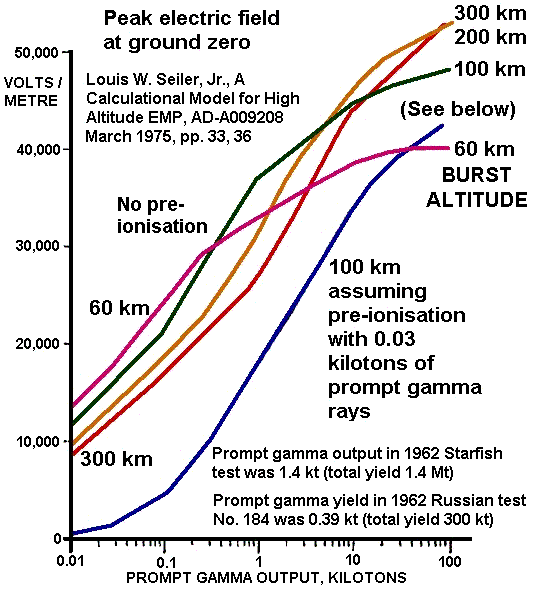
Above: the masters degree thesis by Louis W. Seiler, Jr., A Calculational Model for High Altitude EMP, report ADA009208, computes these curves for the peak EMP at ground zero for a burst above the magnetic equator, where the Earth's magnetic field is far weaker than it is at high latitudes (nearer the poles) where magnetic field lines converge (increasing the magnetic field strength). The discoverer of the magnetic dipole EMP mechanism, Longmire, states in another report that the peak EMP is almost directly proportional to the transverse component of the Earth's magnetic field across the radial line from the bomb to the observer. Seiler shows that the peak EMP is almost directly proportional to strength of the Earth's magnetic field: the curves above apply to 0.3 Gauss magnetic field strength, which is the weak field at the equator (the 1962 American tests over Johnston Island were nearer the equator). Over North America, Europe or Russia, peak EMP fields would be doubled those in the diagram above, due to the Earth's stronger magnetic field of around 0.5 Gauss, which deflects Compton electrons more effectively, causing more of their kinetic energy to be converted into EMP energy than in the 0.3 Gauss field over Johnston Island in the 1962 American tests. If you look at the curves above, you see that the peak EMP is only a weak function of the gamma ray output of the weapon (the peak EMP increases by just a factor of 5, from roughly 10 kV/m to 50 kV/m, as prompt gamma ray output rises by a factor of 10,000, i.e. from 0.01 to 100 kt); it is far less than directly proportional to yield. Seiler also shows that large two-stage thermonuclear weapons will often produce a smaller peak EMP than a single stage fission bomb, because of "pre-ionization" of the atmosphere by X-rays and gamma rays from the first stage, which ionize the air, making it electrically conductive so that free electrons and ions almost immediately short out the Compton current from the larger secondary stage, negating most the EMP that would otherwise occur.

Above: the declassified principles involved in enhanced EMP nuclear weapons are very simple and obvious. Materials are selected to maximize the prompt gamma radiation that comes from the inelastic scatter of high-energy fusion neutrons, while a simple radiation shield around the fission primary stage part of the weapon averts the problem of the shorting-out of the final (fusion) stage EMP by fission primary stage pre-ionization of the atmosphere (which prevents most EMP-producing Compton currents, due to making the air so electrically conductive that it immediately shorts out secondary stage Compton currents). In the Starfish Prime test, the warhead was simply inverted before launch, so the fusion secondary stage prevented pre-ionization of the atmosphere by absorbing downward X-rays and gamma rays from the primary stage! In the film taken horizontally from a Hawaiian mountain top (above the local cloud cover), you can clearly see the primary stage of the Starfish Prime weapon being ejected upwards, out of the top, by the immense blast and radiation impulse which has been delivered to it due to the bigger explosion of the secondary (thermonuclear) stage. The primary stage of the bomb flies upwards into space, expanding as it does so, while the heavier secondary stage remains almost stationary below it (photo sequence below).

Philip J. Dolan's Capabilities of Nuclear Weapons, DNA-EM-1 chapter 7, page 7-1 (change 1 page updates, 1978), report ADA955391, states that low yield pure fission bombs typically release 0.5% of their yield as prompt gamma rays, compared to only 0.1% in old high yield warhead designs with relative thick outer cases, like the 1.4 Mt STARFISH test in 1962. Furthermore, Northrop's 1996 handbook of declassified 1990s EM-1 data gives details on the prompt gamma ray output from four very different nuclear weapon designs, showing that the enhanced radiation warhead ("neutron bomb") releases 2.6% of its total yield in the form of prompt gamma rays, which is mainly because of the outer weapon casing which is designed to minimize radiation absorption, allowing as much as possible to escape. This gives an idea of the amount of enormous variation in the EMP potential of existing bomb designs. About 3.5% of the energy of fission is prompt gamma rays, and neutrons exceeding 0.5 MeV energy undergo inelastic neutron scatter with heavy nuclei (such as iron and uranium), leaving the nuclei excited isomers that release further prompt gamma rays.
Thus, low yield bombs at somewhat lower altitudes than 400 km can produce peak EMP fields that exceed those from the 1962 high altitude thermonuclear tests, while still affecting vast areas. Single stage (fission) weapons in some cases produce a larger EMP than high-yield two-stage thermonuclear weapons, mentioned above. Weapon designs that use a minimal tamper, a minimal shell of TNT for implosion, or a linear implosion system, and a minimal outer casing, can maximise the fraction of the prompt gamma rays which escape from the weapon, enhancing the EMP. Hence, a low yield fission device could easily produce a peak (VHF to UHF) EMP effect on above ground cables similar to the 1962 STARFISH test (although the delayed very low intensity MHD-EMP ELF effects penetrating through the earth into underground cables would be weaker, since the MHD-EMP is essentially dependent upon the total fission yield of the weapon not prompt radiation output; MHD-EMP occurs as the fireball expands and as the ionized debris travels along the magnetic field lines, seconds to minutes after detonation).
Naïvely, by assuming that a constant fraction of the bomb energy is converted into EMP, textbook radio transmission theory suggests that the peak radiated EMP should then be proportional to the square root of the bomb energy and inversely proportional to the distance from the bomb. But in fact, as the graph above shows, this assumption is a misleading, false approximation: the fraction of bomb energy converted into the EMP is highly variable instead of being constant, suppressing much of the expected variation of peak EMP field strength with bomb energy. For weapons with a prompt gamma ray yield of 0.01-0.1 kt, the peak EMP on the ground decreases as the weapon is detonated at higher altitudes, from 60 to 300 km. But for prompt gamma ray yields approaching 100 kt, the opposite is true: the peak EMP at ground zero then rises as the burst altitude is increased from 60 to 300 km. What happens here is due to a change in the effective altitude from which the EMP is generated. The fraction of prompt gamma rays absorbed by any thickness of air is constant, but large outputs of prompt gamma rays will allow substantial EMP generation to occur over larger distances than smaller outputs. Hence, high yields are able to ionize and generate EMP within a larger vertical thickness of air (a bigger "deposition region" volume) than smaller yields.
For sufficiently large yields, this makes the peak EMP on the ground increase while the burst altitude is increased, despite the increasing distance between the ground and the bomb! This is because a large prompt gamma output is able to produce substantial EMP contributions from a bigger volume of air, effectively utilizing more of the increased volume of air between bomb and ground for EMP generation. This increasing deposition region size for higher yields increases the efficiency with which gamma ray energy is turned into EMP energy. Weapons with a lower output of prompt gamma rays produce a smaller effective "deposition region" volume for EMP production, concentrated at higher altitudes (closer to the bomb, where the gamma radiation is stronger), which is less effective in producing ground-level EMP.

Above: this comparison of the prompt gamma ray deposition regions for space bursts of 1 and 10 megatons total yield (i.e., 1 kt and 10 kt prompt gamma ray yield, respectively) in the 1977 Effects of Nuclear Weapons explains why the peak EMP at ground zero varies as Seiler's graph shows. In all cases (for burst heights of 50-300 km) the base of the deposition region is at an altitude of 8-10 km, but the height of the top of the deposition region is a function of bomb yield as well as burst altitude. The deposition region radius marks the region where the peak conductivity of the air (due to ionization by the nuclear radiation) is 10-7 S/m; inside this distance the air is conductive and the EMP is being produced by transverse (magnetic field-deflected) Compton electron currents, and is being limited by the air conductivity rise due to secondary electrons. Beyond this radius, the EMP is no longer being significantly produced or attenuated by secondary electrons, and the EMP thus propagates like normal radio waves (of similar frequency). The greater the vertical thickness of the deposition region between the bomb and the surface for a given yield, the greater the EMP intensity. Thus, for the 1 megaton burst shown, the vertical height of the deposition region above ground zero reaches:
62 km altitude for 50 km burst height
84 km altitude for 100 km burst height
74 km altitude for 200 km burst height, and
67 km altitude for 300 km burst height
Hence, the 100 km burst height maximises the thickness of the prompt gamma ray deposition region above ground zero, and maximises the EMP for that 1 megaton yield. (For 1 megaton burst altitudes above 100 km, the inverse square law of radiation reduces the intensity of the prompt gamma rays hitting the atmosphere sufficiently to decrease the deposition region top altitude.) For the 10 megaton yield, the extra yield is sufficient to extend the size of the deposition region to much greater sizes and enable it to continue increasing vertically aboveground zero as the burst height is increased to 200 km, where it reaches an altitude of 85 km, falling to 79 km for 300 km burst altitude. The extra thickness of the deposition layer enables a greater EMP because the small fraction of the EMP generated in the lowest density air at the highest altitudes, above 70 km or so, suffers the smallest conduction current attenuation (EMP shorting by secondary electrons severely increases with increasing air density, at lower altitudes), so it boosts the total EMP strength at ground zero.

Honolulu Advertiser newspaper article dated 9 July 1962 (local time):
'The street lights on Ferdinand Street in Manoa and Kawainui Street in Kailua went out at the instant the bomb went off, according to several persons who called police last night.'
New York Herald Tribune (European Edition), 10 July 1962, page 2:
'Electrical Troubles in Hawaii'In Hawaii, burglar alarms and air-raid sirens went off at the time of the blast.'
EMP effects data is given in the Report of the Commission to Assess the Threat to the United States from Electromagnetic Pulse (EMP) Attack, CRITICAL NATIONAL INFRASTRUCTURES, April 2008:
Page 18: “The Commission has concluded that even a relatively modest-to-small yield weapon of particular characteristics, using design and fabrication information already disseminated through licit and illicit means, can produce a potentially devastating E1 [prompt gamma ray caused, 10-20 nanoseconds rise time] field strength over very large geographical regions.”
Page 27: “There are about 2,000 ... transformers rated at or above 345 kV in the United States with about 1 percent per year being replaced due to failure or by the addition of new ones. Worldwide production capacity is less than 100 units per year and serves a world market, one that is growing at a rapid rate in such countries as China and India. Delivery of a new large transformer ordered today is nearly 3 years, including both manufacturing and transportation. An event damaging several of these transformers at once means it may extend the delivery times to well beyond current time frames as production is taxed. The resulting impact on timing for restoration can be devastating. Lack of high voltage equipment manufacturing capacity represents a glaring weakness in our survival and recovery to the extent these transformers are vulnerable.”
Pages 30-31: “Every generator requires a load to match its electrical output as every load requires electricity. In the case of the generator, it needs load so it does not overspin and fail, yet not so much load it cannot function. ... In the case of EMP, large geographic areas of the electrical system will be down, and there may be no existing system operating on the periphery for the generation and loads to be incrementally added with ease. ... In that instance, it is necessary to have a “black start”: a start without external power source. Coal plants, nuclear plants, large gas- and oil-fired plants, geothermal plants, and some others all require power from another source to restart. In general, nuclear plants are not allowed to restart until and unless there are independent sources of power from the interconnected transmission grid to provide for independent shutdown power. This is a regulatory requirement for protection rather than a physical impediment. What might be the case in an emergency situation is for the Government to decide at the time.”
Page 33: “Historically, we know that geomagnetic storms ... have caused transformer and capacitor damage even on properly protected equipment.”
Page 42: “Probably one of the most famous and severe effects from solar storms occurred on March 13, 1989. On this day, several major impacts occurred to the power grids in North America and the United Kingdom. This included the complete blackout of the Hydro-Quebec power system and damage to two 400/275 kV autotransformers in southern England. In addition, at the Salem nuclear power plant in New Jersey, a 1200 MVA, 500 kV transformer was damaged beyond repair when portions of its structure failed due to thermal stress. The failure was caused by stray magnetic flux impinging on the transformer core. Fortunately, a replacement transformer was readily available; otherwise the plant would have been down for a year, which is the normal delivery time for larger power transformers. The two autotransformers in southern England were also damaged from stray flux that produced hot spots, which caused significant gassing from the breakdown of the insulating oil.”
Page 45: “It is not practical to try to protect the entire electrical power system or even all high value components from damage by an EMP event. There are too many components of too many different types, manufactures, ages, and designs. The cost and time would be prohibitive. Widespread collapse of the electrical power system in the area affected by EMP is virtually inevitable after a broad geographic EMP attack ...”
Page 88: “The electronic technologies that are the foundation of the financial infrastructure are potentially vulnerable to EMP. These systems also are potentially vulnerable to EMP indirectly through other critical infrastructures, such as the power grid and telecommunications.”
Page 110: “Similar electronics technologies are used in both road and rail signal controllers. Based on this similarity and previous test experience with these types of electronics, we expect malfunction of both block and local railroad signal controllers, with latching upset beginning at EMP field strengths of approximately 1 kV/m and permanent damage occurring in the 10 to 15 kV/m range.”
Page 112: “Existing data for computer networks show that effects begin at field levels in the 4 to 8 kV/m range, and damage starts in the 8 to 16 kV/m range. For locomotive applications, the effects thresholds are expected to be somewhat higher because of the large metal locomotive mass and use of shielded cables.”
Page 115: “We tested a sample of 37 cars in an EMP simulation laboratory, with automobile vintages ranging from 1986 through 2002. ... The most serious effect observed on running automobiles was that the motors in three cars stopped at field strengths of approximately 30 kV/m or above. In an actual EMP exposure, these vehicles would glide to a stop and require the driver to restart them. Electronics in the dashboard of one automobile were damaged and required repair. ... Based on these test results, we expect few automobile effects at EMP field levels below 25 kV/m. Approximately 10 percent or more of the automobiles exposed to higher field levels may experience serious EMP effects, including engine stall, that require driver intervention to correct.”
Page 116: “Five of the 18 trucks tested did not exhibit any anomalous response up to field strengths of approximately 50 kV/m. Based on these test results, we expect few truck effects at EMP field levels below approximately 12 kV/m. At higher field levels, 70 percent or more of the trucks on the road will manifest some anomalous response following EMP exposure. Approximately 15 percent or more of the trucks will experience engine stall, sometimes with permanent damage that the driver cannot correct.”
Page 153: “Results indicate that some computer failures can be expected at relatively low EMP field levels of 3 to 6 kilovolts per meter (kV/m). At higher field levels, additional failures are likely in computers, routers, network switches, and keyboards embedded in the computer-aided dispatch, public safety radio, and mobile data communications equipment. ... none of the radios showed any damage with EMP fields up to 50 kV/m. While many of the operating radios experienced latching upsets at 50 kV/m field levels, these were correctable by turning power off and then on.”
Page 161: “In 1957, N. Christofilos at the University of California Lawrence Radiation Laboratory postulated that the Earth’s magnetic field could act as a container to trap energetic electrons liberated by a high-altitude nuclear explosion to form a radiation belt that would encircle the Earth. In 1958, J. Van Allen and colleagues at the State University of Iowa used data from the Explorer I and III satellites to discover the Earth’s natural radiation belts (J. A. Van Allen, and L. A. Frank, “Radiation Around the Earth to a Radial Distance of 107,400 km,” Nature, v183, p430, 1959). ... Later in 1958, the United States conducted three low-yield ARGUS high-altitude nuclear tests, producing nuclear radiation belts detected by the Explorer IV satellite and other probes. In 1962, larger tests by the United States and the Soviet Union produced more pronounced and longer lasting radiation belts that caused deleterious effects to satellites then in orbit or launched soon thereafter.”
 Above: USSR Test ‘184’ on 22 October 1962, ‘Operation K’ (ABM System A proof tests) 300-kt burst at 290-km altitude near Dzhezkazgan. Prompt gamma ray-produced EMP induced a current of 2,500 amps measured by spark gaps in a 570-km stretch of 500 ohm impedance overhead telephone line to Zharyq, blowing all the protective fuses. The late-time MHD-EMP was of low enough frequency to enable it to penetrate the 90 cm into the ground, overloading a shallow buried lead and steel tape-protected 1,000-km long power cable between Aqmola and Almaty, firing circuit breakers and setting the Karaganda power plant on fire.
In December 1992, the U.S. Defence Nuclear Agency spent $288,500 on contracting 200 Russian scientists to produce a 17-chapter analysis of effects from the Soviet Union’s nuclear tests, which included vital data on three underwater nuclear tests in the arctic, as well three 300 kt high altitude tests at altitudes of 59-290 km over Kazakhstan. In February 1995, two of the military scientists, from the Russian Central Institute of Physics and Technology, lectured on the electromagnetic effects of nuclear tests at Lawrence Livermore National Laboratory. The Soviet Union had first suffered electromagnetic pulse (EMP) damage to electronic blast instruments in their 1949 test. Their practical understanding of EMP damage eventually led them, on Monday 22 October 1962, to detonate a 300 kt missile-carried thermonuclear warhead at an altitude of 300 km (USSR test 184). That was at the very height of the Cold War and the test was detected by America: at 7 pm that day, President John F. Kennedy, in a live TV broadcast, warned the Soviet Union’s Premier Khrushchev of nuclear war if a nuclear missile was launched against the West, even by an accident: ‘It shall be the policy of this nation to regard any nuclear missile launched from Cuba against any nation in the Western hemisphere as an attack by the Soviet Union on the United States, requiring a full retalitory response upon the Soviet Union.’ That Russian space missile nuclear test during the Cuban missiles crisis deliberately instrumented the civilian power infrastructure of populated areas, unwarned, in Kazakhstan to assess EMP effects on a 570 km long civilian telephone line and a 1,000 km civilian electric power cable! This test produced the worst effects of EMP ever witnessed (the more widely hyped 1.4 Mt, 400 km burst STARFISH EMP effects were trivial by comparison, because of the weaker natural magnetic field strength at Johnston Island). The bomb released 1025 MeV of prompt gamma rays (0.13% of the bomb yield). The 550 km East-West telephone line was 7.5 m above the ground, with amplifiers every 60 km. All of its fuses were blown by the induced peak current, which reached 2-3 kA at 30 microseconds, as indicated by the triggering of gas discharge tubes. Amplifiers were damaged, and lightning spark gaps showed that the potential difference reached 350 kV. The 1,000 km long Aqmola-Almaty power line was a lead-shielded cable protected against mechanical damage by spiral-wound steel tape, and buried at a depth of 90 cm in ground of conductivity 10-3 S/m. It survived for 10 seconds, because the ground attenuated the high frequency field, However, it succumbed completely to the low frequency EMP at 10-90 seconds after the test, since the low frequencies penetrated through 90 cm of earth, inducing an almost direct current in the cable, that overheated and set the power supply on fire at Karaganda, destroying it. Cable circuit breakers were only activated when the current finally exceeded the design limit by 30%. This limit was designed for a brief lightning-induced pulse, not for DC lasting 10-90 seconds. By the time they finally tripped, at a 30% excess, a vast amount of DC energy had been transmitted. This overheated the transformers, which are vulnerable to short-circuit by DC. Two later 300 kt Soviet Union space tests, with similar yield but low altitudes down to 59 km, produced EMPs which damaged military generators.

Above: the STARFISH (1.4 Mt, 400 km detonation altitude, 9 July 1962) detonation, seen from a mountain above the low-level cloud cover on Maui, consisted of a luminous debris fireball expanding in the vacuum of space with a measured initial speed of 2,000 km/sec. (This is 0.67% of the velocity of light and is 179 times the earth's escape velocity. Compare this to the initial upward speed of only 6 times earth's escape velocity, achieved by the 10-cm thick, 1.2 m diameter steel cover blown off the top of the 152 m shaft of the 0.3 kt Plumbbob-Pascal B underground Nevada test on 27 August 1957. In that test, a 1.5 m thick 2 ton concrete plug immediately over the bomb was pushed up the shaft by the detonation, knocking the welded steel lid upward. This was a preliminary experiment by Dr Robert Brownlee called 'Project Thunderwell', which ultimately aimed to launch spacecraft using the steam pressure from deep shafts filled with water, with a nuclear explosion at the bottom; an improvement of Jules Verne's cannon-fired projectile described in De la Terre à la Lune, 1865, where steam pressure would give a more survivable gentle acceleration than Verne's direct impulse from an explosion. Some 90% of the radioactivity would be trapped underground.) The film: 'shows the expansion of the bomb debris from approximately 1/3 msec to almost 10 msec. The partition of the bomb debris into two parts ... is shown; in particular the development of the "core" into an upwards mushroomlike expansion configuration is seen clearly. The fast moving fraction takes the shape of a thick disc. Also the interaction of the bomb debris with the booster at an apparent distance (projected) of approximately 1.5 km is shown.' (Page A1-38 of the quick look report.)
In this side-on view the fireball expansion has a massive vertical asymmetry due to the effects of the device orientation (the dense upward jetting is an asymmetric weapon debris shock wave, due to the missile delivery system and/or the fact that the detonation deliberately occurred with 'the primary and much of the fusing and firing equipment' vertically above the fusion stage, see page A1-7 of the quick look technical report linked here): 'the STARFISH test warhead was inverted prior to the high-altitude test over Johnston Island in 1962 because of concerns that some masses within the design would cause an undesirable shadowing of prompt gamma rays and mask selected nuclear effects that were to be tested.' (April 2005 U.S. Department of Defense Report of the Defense Science Board Task Force on Nuclear Weapon Effects Test, Evaluation, and Simulation, page 29.). The earth's magnetic field also played an immediate role in introducing asymmetric fireball expansion as seen from Maui: 'the outer shell of expanding bomb materials forms ... at ... 1/25 to 1/10 sec, an elongated ellipsoidal shape with the long axis orientated along the magnetic field lines.' (Page A1-12 of the quick look report.)
The STARFISH test as filmed from Johnston Island with a camera pointing upwards could not of course show the vertical asymmetry, but it did show that the debris fireball: 'separated into two parts ... the central core which expands rather slowly and ... an outer spherically expanding shell ... The diameter of the expanding shell is approximately 2 km at 500 microseconds ...' (William E. Ogle, Editor, A 'Quick Look' at the Technical Results of Starfish Prime, August 1962, report JO-600, AD-A955411, originally secret-restricted data, p. A1-7.) Within 0.04-0.1 second after burst, the outer shell - as filmed from Maui in the Hawaiian Islands, had become elongated along the earth's magnetic field, creating an ellipsoid-shaped fireball. Visible 'jetting' of radiation up and southward was observed from the debris fireball at 20-50 seconds, and some of these jets are visible in the late time photograph of the debris fireball at 3 minutes after burst (above right).
The analysis of STARFISH on the right was done by the Nuclear Effects Group at the Atomic Weapons Establishment, Aldermaston, and was briefly published on their website, with the following discussion of the 'patch deposition' phenomena which applied to bursts above 200 km: 'the expanding debris compresses the geomagnetic field lines because the expansion velocity is greater than the Alfven speed at these altitudes. The debris energy is transferred to air ions in the resulting region of tightly compressed magnetic field lines. Subsequently the ions, charge-exchanged neutrals, beta-particles, etc., escape up and down the field lines. Those particles directed downwards are deposited in patches at altitudes depending on their mean free paths. These particles move along the magnetic field lines, and so the patches are not found directly above ground zero. Uncharged radiation (gamma-rays, neutrons and X-rays) is deposited in layers which are centered directly under the detonation point. The STARFISH event (1.4 megatons at 400 km) was in this altitude regime. Detonations at thousands of kilometres altitude are contained purely magnetically. Expansion is at less than the local Alfven speed, and so energy is radiated as hydromagnetic waves. Patch depositions are again aligned with the field lines.'


The Atomic Weapons Establishment site also showed a Monte Carlo model of STARFISH radiation belt development, indicating that the electron belt stretched a third of the way around the earth's equator at 3 minutes, and encircled the earth at 10 minutes. The averaged beta particle radiation flux in the belt was 2 x 10¹⁴ electrons per square metre per second at 3 minutes after burst, falling to a quarter of that at 10 minutes. As the time goes on, the radiation belt pushes up to higher altitudes and becomes more concentrated over the magnetic equator. For the first 5 minutes, the radiation belt has an altitude range of about 200-400 km and spans from 27 degrees south of the magnetic equator to 27 degrees north of it. At 1 day after burst, the radiation belt height has increased to the 600-1,100 km zone and the average flux is then 1.5 x 10¹² electrons/m2/sec. At 4 months the altitude for this average flux (plus or minus a factor of 4) is confined to altitudes of 1,100-1,500 km, and it is covering a smaller latitude range around the magnetic equator, from about 20 degrees north to about 20 degrees south. At 95 years after burst, the remaining electrons will be 2,000 km above the magnetic equator, the latitude range will be only plus or minus 10 degrees from the equator, and the shell will only be 50 km thick.
Update: John B. Cladis, et al., “The Trapped Radiation Handbook”, Lockheed Palo Alto Research Laboratory, California, December 1971, AD-738841, Defense Nuclear Agency report DNA 2524H, 746 pages, is available online as a 57 MB PDF download linked here. (The key pages of nuclear test data, under 1 MB download, are linked here.) Page changes (updates) 3-5 separately available: change 3 (254 pages, 1974), change 4 (137 pages, 1977), and change 5 (102 pages, 1977).
This handbook discusses the Earth’s magnetic field trapping mechanism for electrons emitted by a nuclear explosion at high altitude or in outer space, including some unique satellite measured maps (Figures 6-15 and 6-16) of the trapped electron radiation belts created by 1.4 Mt American nuclear test at 400 km altitude on 9 July 1962, Starfish (Injun 1 data for 10 hours after burst and Telstar data for 48 hours). In addition, the handbook includes Telstar satellite measured maps of the trapped radiation shells for the 300 kt Russian tests at 290 and 150 km altitude on 22 and 28 October 1962 (Figures 6-23 and 6-24). The Russian space bursts were detonated at greater latitudes north than the Starfish burst that occurred almost directly over Johnston Island, more appropriate for the situation of high altitude burst over most potential targets. On page 6-39 the handbook concludes that 7.5 x 1025 electrons from Starfish (10 percent of its total emission) were initially trapped in the Earth’s magnetic field to form radiation belts in outer space (the rest were captured by the atmosphere). Page 6-54 concludes that the 300 kt, 290 km burst altitude 22 October 1962 Russian test had 3.6 x 1025 of its electrons trapped in the radiation belts, while the 300 kt, 150 km altitude shot on 28 October had only one-third as many of its electrons trapped, and the 300 kt, 59 km altitude burst on 1 November had only 1.2 x 1024 electrons trapped in space. So increasing the height of burst for a given yield greatly increased the percentage of the electrons trapped in radiation belts in space by the Earth’s magnetic field.
These data we give for the yields and burst heights for the 1962 Russian high altitude tests are the Russian data based on close-in accurate measurements and the yields of similar bombs under other conditions, released in 1995. The original American data on the Russian tests was relatively inaccurate since it was based on long-range EMP, air pressure wave, and trapped radiation belt measurements, but it has all recently been declassified by the CIA and is given in the CIA National Intelligence Estimate, July 2, 1963, on pages 43-44: "Joe 157" on 22 October 1962, "Joe 160" on 28 October and "Joe 168" on 1 November were initially assessed by America to be 200 kt, 200 kt and 1.8 Mt, detonated at altitudes of about 297 km, 167 km, and 93 km, respectively. As mentioned, the true yield was 300 kt in all cases and the true heights of burst were 290, 150 and 59 km. This is very interesting as it indicates how accurately the yield and burst altitude can be determined in the event of an unexpected nuclear test by an enemy, even with 1962 technology. The report also indicates that the Russians carefully scheduled their high altitude tests to be measured by their COSMOS XI satellite:
"A unique feature of all three 1962 high-altitude tests [by Russia] was the apparent planned use of a satellite to collect basic physical data. COSMOS XI passed over the burst point of JOE 157 within minutes of the detonation; it was at the antipodal point for the JOE 160 test at the time of detonation; and it was near the magnetic conjugate point of the JOE 168 detonation at time of burst."
A very brief (11 pages, 839 kb) compilation of the key pages with the vital nuclear test data from the long Trapped Radiation Handbook is linked here. The rate at which the radiation belts diminished with time was slow and hard to measure accurately, and is best determined by computer Monte Carlo simulations like the AWRE code discussed in this post. If the altitude of the “mirror points” (where the Earth’s strong magnetic field strengths near the poles reflects back the spiralling electrons) dips into the atmosphere, electrons get stopped and captured by air molecules, instead of reflected back into space. Therefore, there is a leakage of electrons at the mirror points, if those points are at low enough altitudes.
When STARFISH was detonated: 'The large amount of energy released at such a high altitude by the detonation caused widespread auroras throughout the Pacific area, lasting in some cases as long as 15 minutes; these were observed on both sides of the equator. In Honolulu an overcast, nighttime sky was turned into day for 6 minutes (New York Times, 10 July 1962). Observers on Kwajalein 1,400 nautical miles (about 2,600 km) west reported a spectacular display lasting at least 7 minutes. At Johnston Island all major visible phenomena had disappeared by 7 minutes except for a faint red glow. The earth's magnetic field [measured at Johnston] also was observed to respond to the burst. ... On 13 July, 4 days after the shot, the U.K. satellite, Ariel, was unable to generate sufficient electricity to function properly. From then until early September things among the satellite designers and sponsors were "along the lines of the old Saturday matinee one-reeler" as the solar panels on several other satellites began to lose their ability to generate power (reference: The Artificial Radiation Belt, Defense Atomic Support Agency, 4 October 1962, report DASA-1327, page 2). The STARFISH detonation had generated large quantities of electrons that were trapped in the earth's magnetic field; the trapped electrons were damaging the solar cells that generated the power in the panels.' (Source: Defense Nuclear Agency report DNA-6040F, AD-A136820, pp. 229-30.)

Above: the conjugate region aurora from STARFISH, 4,200 km from the detonation, as seen from Tongatapu 11 minutes after detonation. (Reference: W. P. Boquist and J. W. Snyder, 'Conjugate Auroral Measurements from the 1962 U.S. High Altitude Nuclear Test Series, in Aurora and Airglow, B. M. McCormac, Ed., Reinhold Publishing Corp., 1967.) A debris aurora caused by fission product ions travelling along magnetic field lines to the opposite hemisphere requires a burst altitude above 150 km, and in the STARFISH test at 400 km some 40% of the fission products were transported south along the magnetic force field into the conjugate region (50% was confined locally and 10% escaped into space). The resulting colourful aurora was filmed at Tongatapu (21 degrees south) looking north, and it was also seen looking south from Samoa (14 degrees south). The STARFISH debris reached an altitude of about 900-km when passing over the magnetic equator. The debris in the conjugate region behaves like the debris remaining in the burst locale; over the course of 2 hours following detonation, it simply settles back down along the Earth’s magnetic field lines to an altitude of 200 km (assuming a burst altitude exceeding 85 km). Hence, the debris is displaced towards the nearest magnetic pole. The exact ‘offset distance’ depends simply upon the angle of the Earth’s magnetic field lines. The ionisation in the debris region is important since it can disrupt communications if the radio signals need to pass through the region to reach an orbital satellite, and also because it may disrupt radar systems from spotting incoming warheads (since radar beams are radio signals which are attenuated).
In the Pacific nuclear high altitude megaton tests, communications using ionosphere-reflected high frequency (HF) radio were disrupted for hours at both ends of the geomagnetic field lines which passed through the detonation point. However, today HF is obsolete and the much higher frequencies involved do not suffer so much attenuation. Instead of relying on the ionosphere and conducting ocean to form a reflecting wave-guide for HF radio, the standard practice today is to use microwave frequencies that penetrate right through the normal ionosphere and are beamed back to another area by an orbital satellite. These frequencies can still be attenuated by severe ionisation from a space burst, but the duration of disruption will be dramatically reduced to seconds or minutes.
‘Recently analyzed beta particle and magnetic field measurements obtained from five instrumented rocket payloads located around the 1962 Starfish nuclear burst are used to describe the diamagnetic cavity produced in the geomagnetic field. Three of the payloads were located in the cavity during its expansion and collapse, one payload was below, and the fifth was above the fully expanded cavity. This multipoint data set shows that the cavity expanded into an elongated shape 1,840 km along the magnetic field lines and 680 km vertically across in 1.2 s and required an unexpectedly long time of about 16 s to collapse. The beta flux contained inside the cavity was measured to be relatively uniform throughout and remained at 3 × 10¹¹ beta particles/cm2 s for at least 7 s. The plasma continued to expand upward beyond the fully expanded cavity boundary and injected a flux measuring 2.5 × 10¹⁰ beta particles/cm2 s at H + 34 s into the most intense region of the artificial belt. Measured 10 hours later by the Injun I spacecraft, this flux was determined to be 1 × 10⁹ beta particles/cm2 s.’ - Palmer Dyal, ‘Particle and field measurements of the Starfish diamagnetic cavity’, Journal of Geophysical Research, volume 111, issue A12, page 211 (2006).
Palmer Dyal was the nuclear test Project Officer and co-author with W. Simmons of Operation DOMINIC, FISH BOWL Series, Project 6.7, Debris Expansion Experiment, U.S. Air Force Weapons Laboratory, Kirkland Air Force Base, New Mexico, POR-2026 (WT-2026), AD-A995428, December 1965:
'This experiment was designed to measure the interaction of expanding nuclear weapon debris with the ion-loaded geomagnetic field. Five rockets on STARFISH and two rockets on CHECKMATE were used to position instrumented payloads at various distances around the burst points. The instruments measured the magnetic field, ion flux, beta flux, gamma flux, and the neutron flux as a function of time and space around the detonations. Data was transmitted at both real and recorded times to island receiving sites near the burst regions. Measurements of the telemetry signal strengths at these sites allowed observations of blackout at 250 MHz ... the early expansion of the STARFISH debris probably took the form of an ellipsoid with its major axis oriented along the earth's magnetic field lines. Collapse of the magnetic bubble was complete in approximately 16 seconds, and part of the fission fragment beta particles were subsequently injected into trapped orbits. ...
‘At altitudes above 200 kilometres ... the particles travel unimpeded for several thousands of kilometres. During the early phase of a high-altitude explosion, a large percentage of the detonation products is ionized and can therefore interact with the geomagnetic field and can also undergo Coulomb scattering with the ambient air atoms. If the expansion is high enough above the atmosphere, an Argus shell of electrons can be formed as in the 1958 and 1962 test series. ... If this velocity of the plasma is greater than the local sound or Alfven speed, a magnetic shock similar to a hydro shock can be formed which dissipates a sizable fraction of the plasma kinetic energy. The Alfven velocity is C = B/(4*{Pi}*{Ion density, in ions per cubic metre})1/2, where ... B is the magnetic field ... Since the STARFISH debris expansion was predicted and measured to be approximately 2 x 108 cm/sec and the Alfven velocity is about 2 x 107 cm/sec, a shock should be formed. A consideration of the conservation of momentum and energy indicates that the total extent of the plasma expansion proceeds until the weapon plasma kinetic energy is balanced by the B2/(8{Pi}) magnetic field energy [density] in the excluded region and the energy of the air molecules picked up by the expanding debris. ... An estimate of the maximum radial extent of the STARFISH magnetic bubble can be made assuming conservation of momentum and energy. The magnetic field swept along by the plasma electrons will pick up ambient air ions as it proceeds outward. ...’
Conservation of momentum suggests that the initial outward bomb momentum, MBOMBVBOMB must be equal to the momentum of the total expanding fireball after it has picked up air ions of mass MAIR IONS:
MBOMBVBOMB = (MBOMB + MAIR IONS)V,
where V is the velocity of the combined shell of bomb and air ions. The expansion of the ionized material against the earth’s magnetic field slows it down, so that the maximum radial extent occurs when the initial kinetic energy E = (1/2) MBOMBVBOMB2 has been converted into the potential energy density of the magnetic field which stops its expansion. The energy of the magnetic field excluded from the ionized shell of radius R is simply the volume of that shell multiplied by the magnetic field energy density B2/(8{Pi}). By setting the energy of the magnetic field bubble equal to the kinetic energy of the explosion, the maximum size of the bubble could be calculated, assuming the debris was 100% ionized.
For CHECKMATE, they reported: ‘Expansion of the debris was mostly determined by the surrounding atmosphere which had a density of 4.8 x 10¹⁰ particles/cm3.

Richard L. Wakefield's curve above, although it suffers from many instrument problems, explained EMP damage on Hawaii some 1,300 km from the burst point - see map below. Dr Longmire explained Wakefield's curve by a brand new EMP theory called the 'magnetic dipole mechanism' - a fancy name for the deflection at high altitudes of electrons by the Earth's natural magnetic dipole field. The original plan for the Starfish test is declassified here, and the first report on the effects is declassified here. The zig-zag on the measured curve above is just 'ringing' in the instrument, not in the EMP. The inductance, capacitance, and resistance combination of the electronic circuit in the oscilloscope used to measure the EMP evidently had a natural resonance - rather like a ringing bell - at a frequency of 110 MHz, which was set off by the rapid rise in the first part of the EMP and continued oscillating for more than 500 ns. The wavy curve from the instrument is thus superimposed on the real EMP.

Above: raw data released by America so far on the Starfish EMP consists of the graph on the left based on a measurement by Richard L. Wakefield in a C-130 aircraft 1,400 km East-South-East of the detonation, with a CHAP (code for high altitude pulse) Longmire computer simulation for that curve both with and without instrument response corrections (taken from Figure 9 of the book EMP Interaction, online edition), and the graph on the right which is Longmire's CHAP calculation of the EMP at Honolulu, 1,300 km East-North-East of the detonation (page 7 of Longmire's report EMP technical note 353, March 1985). By comparing the various curves, you can guess the correct scales for the graph on the left and also what the time-dependent instrument response is.
 Above: locations of test aircraft which suffered EMP damage during Operation Fishbowl in 1962. In testimony to 1997 U.S. Congressional Hearings on EMP, Dr. George W. Ullrich, the Deputy Director of the U.S. Department of Defense's Defense Special Weapons Agency (now the DTRA, Defence Threat Reduction Agency) said that the lower-yield Fishbowl tests after Starfish 'produced electronic upsets on an instrumentation aircraft that was approximately 300 kilometers away from the detonations.' The report by Charles N. Vittitoe, 'Did high-altitude EMP (electromagnetic pulse) cause the Hawaiian streetlight incident?', Sandia National Labs., Albuquerque, NM, report SAND-88-0043C; conference CONF-880852-1 (1988) states on page 3: 'Several damage effects have been attributed to the high-altitude EMP. Tesche notes the input-circuit troubles in radio receivers during the Starfish [1.4 Mt, 400 km altitude] and Checkmate [7 kt, 147 km altitude] bursts; the triggering of surge arresters on an airplane with a trailing-wire antenna during Starfish, Checkmate, and Bluegill [410 kt, 48 km altitude] ...'
Below are the prompt EMP waveforms measured in California, 5,400 km away from Starfish (1.4 Mt, 400 km altitude) and Kingfish (410 kt, 95 km altitude) space shots above Johnston Island in 1962:

It is surprising to find that on 11 January 1963, the American journal Electronics Vol. 36, Issue No. 2, had openly published the distant MHD-EMP waveforms from all five 1962 American high altitude detonations Starfish, Bluegill, Kingfish, Checkmate, and Tightrope: 'Recordings made during the high-altitude nuclear explosions over Johnston Island, from July to November 1962, shed new light on the electromagnetic waves associated with nuclear blasts. Hydrodynamic wave theory is used to explain the main part of the signal from a scope. The results recorded for five blasts are described briefly. The scopes were triggered about 30 micro-seconds before the arrival of the main spike of the electromagnefic pulse.'

Above: if we ignore the late-time MHD-EMP mechanism (which takes seconds to minutes to peak and has extremely low frequencies) there are three EMP mechanisms at play in determining the radiated EMP as a function of burst altitude. This diagram plots typical peak radiated EMP signals from 1 kt and 1 Mt bombs as a function of altitude for an observer at a fixed distance of 100 km from ground zero. For very low burst altitudes, the major cause of EMP radiation is the asymmetry due to the Earth's surface (there is net upward Compton current due to the ground absorbing downward-directed gamma rays). This is just like a vertical 'electric dipole' radio transmitter antenna radiating radio waves horizontally (at right angles to the direction of the time-varying current) when the vertical current supplied to the antenna is varied in time. Dolan's DNA-EM-1 states that a 1 Mt surface burst radiates a peak EMP of 1,650 v/m at 7.2 km distance (which falls off inversely with distance for greater distances). As the burst altitude is increased above about 1 km or so, this ground asymmetry mechanism becomes less important because the gamma rays take 1 microsecond to travel 300 metres and don't reach the ground with much intensity; in any case by that time the EMP has been emitted by another mechanism of asymmetry, the fall in air density with increasing altitude, which is particularly important for bursts of 1-10 km altitude. Finally, detonations above 10 km altitude send gamma rays into air of low density, so that the Compton electrons have the chance (before hitting air molecules!) to be deflected significantly by the Earth's magnetic field; this 'magnetic dipole' deflection makes them emit synchrotronic radiation which is the massive EMP hazard from space bursts which was discovered by Dr Conrad Longmire after the Starfish test on 9 July 1962. After the Starfish EMP was measured by Richard Wakefield, the Americans started looking for 'magnetic dipole' EMP from normal megaton air bursts dropped from B-52 aircraft (at a few km altitude to prevent local fallout). Until then they measured EMP from air bursts using oscilloscopes set to measure EMP with durations of tens of microseconds. By increasing the sweep speed to sub-microsecond times (nanoseconds), they were then able to see the positive pulse of 'magnetic dipole' EMP even in sea level air bursts at relatively low altitude, typically peaking at 18 v/m at 70 nanoseconds for 20 km distance as in the following illustration from LA-2808:

 Above: the long-duration, weak field electric-dipole EMP waveform due to vertical asymmetry from a typical air burst, measured 4,700 km from the Chinese 200 kt shot on 8 May 1966.
Because of Nobel Laureate Dr Hans Bethe's errors in predicting the wrong EMP mechanism for high altitude bursts back in 1958 (he predicted the electric dipole EMP, neglecting both the magnetic dipole mechanism and the MHD/auroral EMP mechanisms), almost all the instruments were set to measure a longer and less intense EMP with a different polarization (vertical, not horizontal), and at best they only recorded vertical-looking spikes which went off-scale and provided zero information about the peak EMP. In 1958 tests Teak and Orange, there was hardly any information at all due to both this instrumentation problem and missile errors.

Above: the American 1.4 Mt Starfish test at 400-km, on 9 July 1962, induced large EMP currents in the overhead wires of 30 strings of Oahu streetlights, each string having 10 lights (300 streetlights in all). The induced current was sufficient to blow the fuses. EMP currents in the power lines set off ‘hundreds’ of household burglar alarms and opened many power line circuit breakers. On the island of Kauai, EMP closed down telephone calls to the other islands despite the 1962 sturdy relay (electromechanical) telephone technology, by damaging the microwave diode in the electronic microwave link used to connect the telephone systems between different Hawaiian islands (because of the depth of the ocean between the islands, the use of undersea cables was impractical). If the Starfish Prime warhead had been detonated over the northern continental United States, the magnitude of the EMP would have been about 2.4 times larger because of the stronger magnetic field over the USA which deflects Compton electrons to produce EMP, while the much longer power lines over the USA would pick up a lot more EMP energy than the short power lines in Hawaiian islands, and finally the 1962 commonplace electronic 'vacuum tubes' or 'triode valves' (used before transistors and microchips became common) which could survive 1-2 Joules of EMP, have now been completely replaced by modern semiconductor microchips which are millions of times times more sensitive to EMP (burning out at typically 1 microJoule of EMP energy or less), simply because they pack millions of times more components into the same space, so the over-heating problem is far worse for a very sudden EMP power surge (rising within a microsecond). Heat can't be dissipated fast enough so the microchip literally melts or burns up under EMP exposure, while older electronics can take a lot more punishment. So new electronics is a million times more vulnerable than in 1962.
'The time interval detectors used on Maui went off scale, probably due to an unexpectedly large electromagnetic signal ...' - A 'Quick Look' at the Technical Results of Starfish Prime, 1962, p. A1-27.
The illustration of Richard Wakefield's EMP measurement from the Starfish test is based on the unclassified reference is K. S. H. Lee's 1986 book, EMP Interaction. (The earlier, 1980, edition is now online here as a 28 MB download, and it contains the Starfish EMP data.) However, although that reference gives the graph data (including instrument-corrected data from an early computer study called ‘CHAP’ - Code for High Altitude Pulse, by Longmire in 1974), it omits the scales from the graph for the time and electric field, which need to be filled in from another graph declassified separately in Dolan's DNA-EM-1. Full calculations of EMP as a function of burst altitude are also online in pages 33 and 36 of Louis W. Seiler, Jr., A Calculational Model for High Altitude EMP, report AD-A009208, March 1975.
The recently declassified report on Starfish states that Richard L. Wakefield's measurement - the only one at the extremely high frequency that measured the peak EMP with some degree of success, was an attempt to measure the time-interval between the first and secondary stage explosions in the weapon (the fission primary produces one pulse of gamma rays, which subsides before the final thermonuclear stage signal). Wakefield's report title is (taken from page 44 of the declassified Starfish report):
Measurement of time interval from electromagnetic signal received in C-130 aircraft, 753 nautical miles from burst, at 11 degrees 16 minutes North, 115 degrees 7 minutes West, 24,750 feet.
There is really no wonder why it remains secret: the title alone tells you that you can measure not just the emission from the bomb but the internal functioning (the time interval between the primary fission stage and secondary thermonuclear stage!) of the bomb, just by photographing an oscilloscope with a suitable sweep speed, connected to an antenna, from an aircraft 1,400 km away flying at an altitude of 24,750 feet! The longitude of the measurement is clearly in error as it doesn't correspond to the stated distance from ground zero. Presumably there is a typing error and the C-130 was at 155 degrees 7 minutes West, not 115 degrees 7 minutes. This would put the position of Wakefield's C-130 some 800 km or so South of the Hawaiian islands at detonation time. The report also shows why all the other EMP measurements failed to measure the peak field: they were almost all made in the ELF and VLF frequency bands, corresponding to rise times in milliseconds and seconds, not nanoseconds. They were concentrating on measuring the magnetohydrodynamic (MHD) EMP due to the ionized fireball expansion displacing the Earth's magnetic field, and totally ignored the possibility of a magnetic dipole EMP from the deflection of Compton electrons by the Earth's magnetic field.
Notice that the raw data from Starfish - without correction for the poor response of the oscilloscope's aerial orientation and amplifier circuit to the EMP - indicates a somewhat lower peak electric field at a later time than the properly corrected EMP curve. The true peak was 5,210 v/m at 22 nanoseconds (if this scale is correct; notice that Longmire's reconstruction of the Starfish EMP at Honolulu using CHAP gave 5,600 v/m peaking at 100 ns). The late-time (MHD-EMP) data for Starfish shown is for the horizontal field and is available online in Figure 6 of the arXiv filed report here by Dr Mario Rabinowitz.
Dr Rabinowitz has also compiled a paper here, which quotes some incompetent political 'off the top of my head' testimony from clowns at hearings from the early 1960s, which suggests that Starfish Prime did not detonate over Johnston Island but much closer to Hawaii, but the burst position was accurately determined from theodolite cameras to be 16° 28' 6.32" N and 169° 37' 48.27" W (DASA-1251 which has been in the public domain since 1979 gives this, along with the differing exact burst positions of other tests; this is not the position of launch or an arbitrary point in Johnston Island but is the detonation point). The coordinates of Johnston Island launch area are 16° 44' 15" N and 169° 31' 26" W (see this site), so Starfish Prime occurred about 16 minutes (nautical miles) south of the launch pad and about 6 minutes (nautical miles) west of the launch pad, i.e., 32 km from the launch pad (this is confirmed on page 6 of the now-declassified Starfish report available online).
Hence, Starfish Prime actually detonated slightly further away from Hawaii than the launch pad, instead of much closer to Hawaii! The detonation point was around 32 km south-south-west of Johnston Island, as well as being 400 km up. It is however true as Rabinowitz records that the 300 streetlights fused in the Hawaiian Islands by Starfish were only 1-3% of the total number. But I shall have more to say about this later on, particularly after reviewing extensive Russian EMP experiences with long shallow-buried power lines and long overhead telephone lines which Dr Rabinowitz did not know about in 1987 when writing the critical report.

Above: EMP waveform for all times (logarithmic axes) and frequency spectra for a nominal high altitude detonation (P. Dittmer et al., DNA EMP Course Study Guide, Defense Nuclear Agency, DNA Report DNA-H-86-68-V2,
May 1986). The first EMP signal comes from the prompt gamma rays of fission and gamma rays released within the bomb due to the inelastic scatter of neutrons with the atoms of the weapon. For a fission weapon, about 3.5% of the total energy emerges as prompt gamma rays, and this is added to by the gamma rays due to inelastic neutron scatter in the bomb. But despite their high energy (typically 2 MeV), most of these gamma rays are absorbed by the weapons materials, and don't escape from the bomb casing. Typically only 0.1-0.5% of the bomb energy is actually radiated as prompt gamma rays (the lower figure applying to massive, old fashioned high-yield Teller-Ulam multimegaton thermonuclear weapons with thick outer casings, and the high figure to lightweight, low-yield weapons, with relatively thin outer casings). The next part of the EMP from a space burst comes from inelastic scatter of neutrons as they hit air molecules. Then, after those neutrons are slowed down a lot by successive inelastic scattering in the air (releasing gamma rays each time), they are finally captured by the nuclei of nitrogen atoms, which causes gamma rays to be emitted and a further EMP signal which adds to the gamma rays from decaying fission product debris. Finally, you get an EMP signal at 1-10 seconds from the magnetohydrodynamic (MHD) mechanism, where the ionized fireball expansion pushes out the earth's magnetic field (which can't enter an electrically-conductive, ionized region) with a frequency of less than 1 Hertz, and then the auroral motion of charged particles from the detonation (spiralling along the earth's magnetic field between conjugate points in opposite magnetic hemispheres) constitutes another motion of charge (i.e. an time-varying electric current) which sends out a final EMP at extremely low frequencies, typically 0.01 Hertz. These extremely low frequencies, unlike the high frequencies, can penetrate substantial depths underground, where they can induce substantial electric currents in very long (over 100 km long) buried cables.

Above: the late-time magnetohydrodynamic EMP (MHD-EMP) measured by the change in the natural magnetic field flux density as a function of time after American tests Starfish (1.4 Mt, 400 km burst altitude), Checkmate (7 kt, 147 km burst altitude) and Kingfish (410 kt, 95 km burst altitude) at Johnston Island, below the detonations. The first (positive) pulse in each case is due to the ionized (diamagnetic) fireball expanding and pushing out the earth's magnetic field, which cannot penetrate into a conductive cavity such as an ionized fireball. Consequently, the pushed-out magnetic field lines become bunched up outside the fireball, which means that the magnetic field intensity increases (the magnetic field intensity can be defined by the concentration of the magnetic field lines in space). Under the fireball - as in the case of the data above, measured at Johnston Island, which was effectively below the fireball in each case - there is a patch of ionized air caused by X-rays being absorbed from the explosion, and this patch shields in part the first pulse of MHD-EMP (i.e., that from the expansion of the fireball which pushes out the earth's magnetic field). The second (negative) pulse of the late-time EMP is bigger in the case of the Starfish test, because it is unshielded: this large negative pulse is simply due to the auroral effect of the ionized fireball rising and moving along the earth's magnetic field lines. This motion of ionized fission product debris constitutes a large varying electric current for a high yield burst like Starfish, and as a result of this varying current, the accelerating charges radiate an EMP signal which can peak at a minute or so after detonation.
 Above: the measured late-time MHD-EMP at Hawaii, 1,500 km from the Starfish test, was stronger than at Johnston Island (directly below the burst!) because of the ionized X-ray patch of conductive air below the bomb, which shielded Johnston Island. The locations of these patches of ionized air below bursts at various altitudes are discussed in the blog post linked here.
 Above: correlation of global measurements of the Starfish MHD-EMP late signal which peaked 3-5 seconds after detonation.
The 3-stages of MHD-EMP:
- Expansion of ionized, electrically conducting fireball excludes and so pushes out Earth’s magnetic field lines, causing an EMP. This peaks within 10 seconds. However, the air directly below the detonation is ionized and heated by X-rays so that it is electrically conducting and thus partly shields the ground directly below the burst from the late-time low-frequency EMP.
- A MHD-EMP wave then propagates between the ionosphere’s F - layer and the ground, right around the planet.
- The final stage of the late-time EMP is due to the aurora effect of charged particles and fission products physically moving along the Earth’s magnetic field lines towards the opposite pole. This motion of charge constitutes a large time-varying electric current which emits the final pulse of EMP, which travels around the world.
MHD-EMP has serious effects for long conductors because its extremely low frequencies (ELF) can penetrate a lot further into the ground than higher frequencies can, as proved by its effect on a long buried power line during the nuclear test of a 300 kt warhead at 290 km altitude on 22 October 1962 near Dzhezkazgan in Kazakhstan (as part of some Russian ABM system proof tests). In this test, prompt gamma ray-produced EMP induced a current of 2,500 amps measured by spark gaps in a 570-km stretch of overhead telephone line out to Zharyq, blowing all the protective fuses. But the late-time MHD-EMP was of special interest because it was of low enough frequency to enable it to penetrate the 90 cm into the ground, overloading a shallow buried lead and steel tape-protected 1,000-km long power cable between Aqmola and Almaty, firing circuit breakers and setting the Karaganda power plant on fire. The Russian 300 kt test on 22 October 1962 at 290 km altitude (44,84º N, 66,05º E) produced an MHD-EMP magnetic field of 1025 nT measured at ground zero, 420 nT at 433 km, and 240 nT at 574 km distance. Along ground of conductivity 10-3 S/m, 400 v was induced in a cable 80 km long, implying an MHD-EMP of 5 v/km.
Above: the incendiary effects of a relatively weak but natural MHD-EMP from the geomagnetic solar storm of 13 March 1989 in saturating the core of a transformer in the Hydro-Quebec electric power grid. Hydro-Quebec lost electric power, cutting the supply of electricity to 6 million people for several hours, and it took 9 hours to restore 83% (21.5 GW) of the power supply (1 million people were still without electric power then). Two 400/275 kV autotransformers were also damaged in England:
'In addition, at the Salem nuclear power plant in New Jersey, a 1200 MVA, 500 kV transformer was damaged beyond repair when portions of its structure failed due to thermal stress. The failure was caused by stray magnetic flux impinging on the transformer core. Fortunately, a replacement transformer was readily available; otherwise the plant would have been down for a year, which is the normal delivery time for larger power transformers. The two autotransformers in southern England were also damaged from stray flux that produced hot spots, which caused significant gassing from the breakdown of the insulating oil.' - EMP Commission report, 'Critical National Infrastructures', 2008, page 42.
A study of these effects is linked here. Similar effects from the Russian 300 kt nuclear test at 290 km altitude over Dzhezkazgan in Kazakhstan on 22 October 1962 induced enough current in a 1,000 km long protected underground cable to burn the Karaganda power plant to the ground. Dr Lowell Wood testified on 8 March 2005 during Senate Hearings 109-30 that these MHD-EMP effects are: 'the type of damage which is seen with transformers in the core of geomagnetic storms. The geomagnetic storm, in turn, is a very tepid, weak flavor of the so-called slow component of EMP. So when those transformers are subjected to the slow component of the EMP, they basically burn, not due to the EMP itself but due to the interaction of the EMP and normal power system operation. Transformers burn, and when they burn, sir, they go and they are not repairable, and they get replaced, as you very aptly pointed out, from only foreign sources. The United States, as part of its comparative advantage, no longer makes big power transformers anywhere at all. They are all sourced from abroad. And when you want a new one, you order it and it is delivered - it is, first of all, manufactured. They don't stockpile them. There is no inventory. It is manufactured, it is shipped, and then it is delivered by very complex and tedious means within the U.S. because they are very large and very massive objects. They come in slowly and painfully. Typical sort of delays from the time that you order until the time that you have a transformer in service are one to 2 years, and that is with everything working great. If the United States was already out of power and it suddenly needed a few hundred new transformers because of burnout, you could understand why we found not that it would take a year or two to recover, it might take decades, because you burn down the national plant, you have no way of fixing it and really no way of reconstituting it other than waiting for slow-moving foreign manufacturers to very slowly reconstitute an entire continent's worth of burned down power plant.'
MEASURED ELECTROMAGNETIC PULSE (E.M.P.) EFFECTS FROM SPACE TESTS
‘The British Government and our scientists have … been kept fully informed ... the fall-out from these very high-altitude tests is negligible ... the purpose of this experiment is of the greatest importance from the point of view of defence, for it is intended to find out how radio, radar, and other communications systems on which all defence depends might be temporarily put out of action by explosions of this kind.’ – British Prime Minister Harold Macmillan, Statement to the House of Commons, 8 May 1962.
‘Detonations above about 130,000 feet [40 km] produce EMP effects on the ground … of sufficient magnitude to damage electrical and electronic equipment.’ – Philip J. Dolan, editor, Capabilities of Nuclear Weapons, U.S. Department of Defense, 1981, DNA-EM-1, c. 1, p. 19, originally ‘Secret – Restricted Data’ (declassified and released on 13 February 1989).


Above: area coverage by the first (fast or 'magnetic dipole mechanism') peak EMP and by the second (slow or 'magneto-hydrodynamic, MHD-EMP, mechanism') for a 10-20 kt single stage (pure fission) thin-cased burst at 150 km altitude. Both sets of contours are slightly disturbed from circles by the effect of the earth's slanting magnetic field (the burst is supposed to occur 500 km west of Washington D.C.). Notice that the horizon range for this 150 km burst height is 1,370 km and with the burst location shown that zaps 70 % of the electricity consumption of the United States, but if the burst height were 500 km then the horizon radius would be 2,450 km and would cover the entire United States of America. This distance is very important because the peak signal has a rise time of typically 20 ns, which implies a VHF frequency on the order of 50 MHz, which cannot extend past the horizon (although lower frequencies will obviously bounce off the ionosphere and refract and therefore extend past the horizon). However if you simply increase the burst altitude, you would then need a megaton explosion, to avoid diluting the energy and hence the effects by increasing the area coverage.
NOBEL LAUREATE FAILED TO PREDICT THE SEVERE EMP MECHANISM
In October 1957, Nobel Laureate Dr Hans A. Bethe's report, "Electromagnetic Signal Expected from High-Altitude Test" (Los Alamos Scientific Laboratory report LA-2173, secret-restricted data), predicted incorrectly that only a weak electromagnetic pulse (EMP) would be produced by a nuclear detonation in space or at very high altitude, due to vertical oscillations resulting from the downward-travelling hemisphere of radiation. This is the 'electric dipole' EMP mechanism and is actually a trivial EMP mechanism for high altitude bursts.
Hardtack-Teak, a 3.8 Mt, 50 % fission test on 1 August 1958 missile carried to 77 km directly over Johnston Island, gave rise to a powerful EMP, but close-in waveform measurements failed. This was partly due to an error in the missile which caused it to detonate above the island instead of 30 km down range as planned (forcing half a dozen filmed observers at the entrance to the control station to duck and cover in panic, see the official on-line U.S. Department of Energy test film clip), but mainly because of Bethe's false prediction that the EMP would be vertically polarised and very weak (on the order of 1 v/m). Due to Bethe's error, the EMP measurement oscilloscopes were set to excessive sensitivity which would have sent them immediately off-scale:
'The objective was to obtain and analyze the wave form of the electromagnetic (EM) pulse resulting from nuclear detonations, especially the high-altitude shots. ... Because of relocation of the shots, wave forms were not obtained for the very-high-altitude shots, Teak and Orange. During shots Yucca, Cactus, Fir, Butternut, Koa, Holly, and Nutmeg, the pulse was measured over the frequency range from 0 to 10 mega-cycles. ... Signals were picked up by short probe-type antennas, and fed via cathode followers and delay lines to high-frequency oscilloscopes. Photographs of the traces were taken at three sweep settings: 0.2, 2, and 10 micro-sec/cm.
'The shot characteristics were compared to the actual EM-pulse wave-form parameters. These comparisons showed that, for surface shots, the yield, range and presence of a second [fusion] stage can be estimated from the wave-form parameters. EM-pulse data obtained by this project is in good agreement with that obtained during Operation Redwing, Project 6.5.' - F. Lavicka and G. Lang, Operation Hardtack, Project 6.4, Wave Form of Electromagnetic Pulse from Nuclear Detonations, U.S. Army, weapon test report WT-1638, originally Secret - Restricted Data (15 September 1960).
However, the Apia Observatory at Samoa, 3,200 km from the Teak detonation, recorded the ‘sudden commencement’ of an intense magnetic disturbance – four times stronger than any recorded due to solar storms – followed by a visible aurora along the earth’s magnetic field lines (reference: A.L. Cullington, Nature, vol. 182, 1958, p. 1365). [See also: D. L. Croom, ‘VLF radiation from the high altitude nuclear explosions at Johnston Island, August 1958,’ J. Atm. Terr. Phys., vol. 27, p. 111 (1965).]
The expanding ionised (thus conductive, and hence diamagnetic) fireball excluded and thus ‘pushed out’ the Earth’s natural magnetic field as it expanded, an effect called ‘magnetohydrodynamic (MHD)-EMP’. But it was on the 9 July 1962, during the American Starfish shot, a 1.4 Mt warhead missile-carried to an altitude of 400 km, that EMP damage at over 1300 km east was seen, and the Starfish space burst EMP waveform was measured by Richard Wakefield. Cameras were used to photograph oscilloscope screens, showing the EMP pickup in small aerials. Neither Dr Bethe’s downward current model, nor the MHD-EMP model, explained the immense peak EMP. In 1963, Dr Conrad Longmire at Los Alamos argued that, in low-density air, electrons knocked from air molecules by gamma rays travel far enough to be greatly deflected by the earth’s magnetic dipole field. Longmire's theory is therefore called the 'magnetic dipole' EMP mechanism, to distinguish it from Bethe's 'electric dipole' mechanism.
 [Illustration credit: Atomic Weapons Establishment, Aldermastion, http://www.awe.co.uk/main_site/scientific_and_technical/featured_areas/dpd/computational_physics/nuclear_effects_group/electromagnetic_pulse/index.html (this site page removed since accessed in 2006.]
Dr Longmire showed that the successive, sideways-deflected Compton-scattered electrons cause an electromagnetic field that adds up coherently (it travels in step with the gamma rays causing the Compton current), until ‘saturation’ is reached at ~ 60,000 v/m (when the strong field begins to attract electrons back to positive charges, preventing further increase). It is impossible to produce a 'magnetic dipole' EMP from a space burst which exceeds 65,000 v/m at the Earth's surface, no matter if it is a 10 Mt detonation at just 30 km altitude over the magnetic equator. The exact value of the saturation field depends on burst altitude. See pages 33 and 36 of Louis W. Seiler, Jr., A Calculational Model for High Altitude EMP, report AD-A009208, March 1975.
Many modern nuclear warheads with thin cases would produce weaker EMP, because of pre-ionisation of the atmosphere by x-rays released by the primary fission stage before the major gamma emission from the fission final stage of the weapon. An EMP cannot be produced efficiently in ionised (electrically conducting) air, as that literally shorts out the EMP very quickly. This means that many thermonuclear weapons with yields of around 100 kilotons would produce saturation electric fields on the ground of only 15,000-30,000 v/m if detonated in space. More about this, see Dr Michael Bernardin's testimony to the U.S. Congress:
'I speak as a weapons designer with specialized knowledge in electromagnetic pulse. Since 1996, I have been the provost for the Postgraduate Nuclear Weapon Design Institute within the laboratory chartered with training the next generation of nuclear weapon designers. The issue to be addressed this morning is the impact of a high-altitude nuclear detonation over the United States to the civilian and military infrastructure. A high-altitude nuclear detonation would produce an electromagnetic pulse that would cover from one to several million square miles, depending on the height of burst, with electric fields larger than those typically associated with lightning. In such an event, would military equipment deployed within the area of EMP exposure be seriously impaired? Would civilian communications, the power grid and equipment connected to the power grid catastrophically fail? The answers to these questions depend on three elements: One, the types of threat weapons deployed; two, the EMP produced by these weapons; and three, the effects that are caused by EMP. The Defense Intelligence Agency (DIA) and the Central Intelligence Agency (CIA) identify current and projected nuclear weapon threats and provide inputs to the Department of Energy nuclear design labs, Los Alamos and Livermore National Laboratories, who model foreign nuclear weapons. The labs each have over 25 years of experience in performing this type of modeling. The weapon models serve as a basis for associated EMP threat assessments. For the purpose of EMP assessment, it is convenient to group the threat weapons into the following five categories: One, single-stage fission weapons; two, single-stage boosted weapons; three, nominal two-stage thermonuclear weapons with yields up to a few megatons; four, two-stage thermonuclear weapons with yields over a few megatons; and five, special technology thermonuclear weapons. ...The ionization shorts out the EMP, limiting its value to typically 30,000 volts per meter. High-energy x-rays are also produced by the exploding weapon and can enhance the ionization in the high-altitude EMP source region. This source of ionization was largely ignored in EMP assessments until 1986. The inclusion of the X-rays lowered the assessed values of the peak field for many weapons. Note in graphic three that the thermonuclear weapon consists of two stages, a primary stage, which is typically of relatively low yield and is used to drive the secondary stage, which produces a relatively large yield. Each weapons stage produces its own EMP signal, but the primary stage gamma rays, after they go out, leave behind an ionized atmosphere from their EMP generation that is present when the secondary stage gamma rays arrive a moment later. Thus, the primary stage can degrade the EMP associated with the secondary stage.'
Dr William Graham, the President and CEO of National Security Research, then testified:
'By way of background, I have worked in EMPs since 1962, when I was a lieutenant at the Air Force weapons lab, handed a dataset taken from the last atmospheric and Pacific exoatmospheric nuclear test series, and asked to try to explain some very strange-looking phenomena that had been observed. Fortunately, we had the benefit of colleagues at Livermore, Los Alamos and other places in doing this, and the theory of high-altitude EMP, and, in fact, all EMP was developed over the next decade or so. Interestingly, though, like many important scientific discoveries, the intense electromagnetic pulse produced by the exoatmospheric nuclear weapon explosion was discovered by accident. It was first observed both directly and by its effects on civilian systems during the exoatmospheric nuclear test series we had conducted, primarily the Fishbowl series [tests Starfish, Checkmate, Bluegill, Kingfish] in the beginning of the 1960s. However, the theory that was being used at the time to predict the effect had been incorrectly derived by a Nobel laureate [Bethe] actually and caused all of the instrumentation on monitoring those exoatmospheric tests to be set at far too low a scale, far too sensitive a level, so that the data on the scope tended to look like vertical lines. We couldn't see the peak amplitudes that were being produced, and it was Conrad Longmire of Los Alamos National Laboratory who, after looking at the data, figured out what was really happening.'
In those same U.S. Congressional Hearings of October 1999, Dr Lowell Wood, of Lawrence Livermore National Laboratory, explained the effects of EMP as then known from Starfish test experience:
'I am grateful for the invitation to appear today. Like Dr. Graham, my esteemed senior colleague, I also commenced EMP studies in 1962, as my graduate advisor Willard Libby had recently retired from a long term of service as the Commissioner of the Atomic Energy Commission, and he assigned me EMP analysis problems kind of as exercises for the students, as he was then very keenly concerned by them.
'Indeed, electromagnetic pulses, EMP, generated by high-altitude nuclear explosions have riveted the attention of the military nuclear technical community for more than three and a half decades since the first comparatively modest one very unexpectedly and abruptly turned off the lights over a few million square miles of the mid-Pacific. This EMP also shut down radio stations and street-lighting systems, turned off cars, burned out telephone systems and wreaked other technical mischief throughout the Hawaiian Islands nearly 1,000 miles distant from ground zero.'
However, Dr Wood is not very specific when mentioning damage to radio stations and telephone systems. Dr John Malik notes on page 31 of Herman Hoerlin's Los Alamos National Laboratory report LA-6405, United States High Altitude Test Experiences:
'Starfish produced the largest fields of the high-altitude detonations; they caused outages of the series-connected street-lighting systems of Oahu (Hawaii), probable failure of a microwave repeating station on Kauai, failure of the input stages of ionospheric sounders and damage to rectifiers in communication receivers. Other than the failure of the microwave link, no problem was noted in the telephone system. No failure was noted in the telemetry systems used for data transmission on board the many instrumentation rockets.
'There was no apparent increase in radio or television repairs subsequent to any of the Johnston Island detonations. The failures observed were generally in the unprotected input stages of receivers or in rectifiers of electronic equipment; transients on the power line probably caused the rectifier failures. There was one failure in the unprotected part of an electronic system of the LASL Optical Station on top of Mount Haleakala on Maui Island. With the increase of solidstate circuitry over the vacuum-tube technology of 1962, the susceptibility of electronic equipment will be higher, and the probability of more problems for future detonations will be greater. However, if detonations are below line-of-sight, the fields and therefore system problems will be much smaller.'
In addition to the July 1962 Hawaiian experience of EMP induced equipment failures - including some anecdotal evidence of car ignition systems fusing (modern microprocessor controlled vehicles would be more vulnerable), some severe Russian EMP damage occurred in ‘Operation K’ (ABM System A proof tests) of 1962. On 22 October – during the Cuban missile crisis – Russia detonated a 300-kt missile-warhead at 290-km altitude. Prompt EMP fused 570 km of overhead telephone line west from Zharyq, then MHD-EMP started a fire at the Karaganda power plant and shut down 1,000-km of buried civilian power cables between Aqmola and Almaty. Russian Army diesel electricity generators were burned out by EMP, after 300-kt tests at altitudes of 150 km on 28 October and 59 km on 1 November.
America produces two classified reports on nuclear weapons effects: a 'red book' of foreign threats and a 'blue book' of its own nuclear weapons radiation output data. See page 27 of the candid April 2005 U.S. Department of Defense Report of the Defense Science Board Task Force on Nuclear Weapon Effects Test, Evaluation, and Simulation. Page 29 says:
'The flux or fluence of prompt gammas, neutrons and X-rays is by no means isotropic about the burst point of a high-altitude detonation. Clumps of materials (thrusters, gas bottles, propellant tanks, firing units, etc., for example) surround a warhead in a non-symmetric fashion and make radiation output estimation inherently three-dimensional. In realistic situations, some warhead components will shield the prompt radiations from other components, creating a large shadow cone in a preferential direction.
'For example, the Starfish test warhead was inverted prior to the high-altitude test over Johnston Island in 1962 because of concerns that some masses within the design would cause an undesirable shadowing of prompt gamma rays and mask selected nuclear effects that were to be tested. In another example, a nuclear driven kinetic kill warhead (that destroys a reentry vehicle with steel pellets) will have a very low yield-to-mass ratio, which will greatly suppress the X-ray output. The Russians reported on their 1962 high-altitude testing of such a device at an International Conference on Electromagnetic Effects in 1994 held in Bordeaux, France.'
This is far more candid that the older data released here and here.
In addition, in testimony to 1997 U.S. Congressional Hearings, Dr. George W. Ullrich, the Deputy Director of the U.S. Department of Defense's Defense Special Weapons Agency (now the DTRA, Defence Threat Reduction Agency) said:
'... Enrico Fermi ... prior to the Trinity Event, first predicted that nuclear explosions were capable of generating strong electromagnetic fields. ... A less well known effect of high altitude bursts, but also one with potentially devastating consequences, is the artificial 'pumping' of the Van Allen belt with large numbers of electrons. The bomb-induced electrons will remain trapped in these belts for periods exceeding one year. All unhardened satellites traversing these belts in low earth orbit could demise in a matter of days to weeks following even one high altitude burst. ...
'One of our earliest experiences with HEMP dates back to the resumption of atmospheric nuclear testing in 1962 following a three year testing moratorium. Starfish Prime, a 1.4 megaton device, was detonated at an altitude of 400 kilometers over Johnston Island. Failures of electronic systems resulted in Hawaii, 1,300 kilometers away from the detonation. Street lights and fuzes failed on Oahu and telephone service was disrupted on the island of Kauai. Subsequent tests with lower yield devices [410 kt Kingfish at 95 km altitude, 410 kt Bluegill at 48 km altitude, and 7 kt Checkmate at 147 km] produced electronic upsets on an instrumentation aircraft [presumably the KC-135 that filmed the tests from above the clouds?] that was approximately 300 kilometers away from the detonations.
'Soviet scientists had similar experiences during their atmospheric test program. In one test, all protective devices in overhead communications lines were damaged at distances out to 500 kilometers; the same event saw a 1,000 kilometer segment of power line shut down by these effects. Failures in transmission lines, breakdowns of power supplies, and communications outages were wide-spread.
'... a 50 kiloton (KT) weapon detonated at a 120 km altitude (75 miles) can produce electron densities several orders of magnitude higher than the natural electron environment in low earth orbit. These elevated electron densities can last for months to years and significantly increase the total ionizing dose accumulated by space assets that transit these belts. This increase in total dose accumulation can dramatically shorten the lifetime of satellite systems. Projected lifetimes of up to ten years can be reduced to a mere two months after such an event.
'EMP does not distinguish between military and civilian systems. Unhardended systems, such as commercial power grids, telecommunications networks, and computing systems, remain vulnerable to widespread outages and upsets ... While DoD hardens assets it deems vital, no comparable civil program exists. Thus, the detonation of one or a few high-altitude nuclear weapons could result in devastating problems for the entire U.S. commercial infrastructure. Some detailed network analyses of critical civil systems would be useful to better understand the magnitude of the problem and define possible solution paths.'
However, some claim that EMP is an exaggerated threat. It is true that the 300 streetlights which failed on Oahu were only a small fraction (around 1-3 %) of the total number of streetlights in the Hawaiian islands, but you have to remember that the small size of the islands meant that the conductors were similarly limited in size. The Russian experience of tests over land shows that the worst effects occur in electrical and electronics equipment connected to very long power transmission or telephone lines, which did not exist in the Hawaiian Islands. In addition, the threat is worse today than in 1962 because a microchip is a million times more vulnerable to a power surge than the thermonic valves in use in electronics in 1962.
The claim http://www.alternet.org/story/25738/ makes about EMP from a 10-20 kt fission bomb being proportionately weaker than that from the 1.4 Mt Starfish test is blatant nonsense. The formula for EMP, even neglecting saturation, shows that the peak electric field varies as the square root of the weapon yield divided by the distance from the burst. Hence, a 100-fold increase in yield only increases the EMP at a given distance by a factor of 10, even when you neglect saturation.
When you include saturation, the difference is even less. Saturation introduces a exponential limiting of the form: E = Y[1 - exp{-(X/Y)2}]1/2, where X is peak EMP predicted by the simple law that ignores saturation, and Y is the saturation field (Y ~ 60,000 v/m). (When X is very large, the exponential disappears so this formula reduces to the saturation value E=Y, but when X is very small, the formula reduces to E=X, the weak field limit. The reason for the square and square root powers appearing instead of just E = Y[1 - exp{-(X/Y)}], is actually due to the fact that for the time of peak EMP, the air conductivity at that time is proportional to the square-root of the Compton current. I'll return to this mathematical model in a later post. In the meantime see the full calculations of EMP as a function of burst altitude online in Louis W. Seiler, Jr., A Calculational Model for High Altitude EMP, report AD-A009208, March 1975.)
Still another factor you have to take account of is that Philip J. Dolan's formerly classified Capabilities of Nuclear Weapons, DNA-EM-1, chapters 5 and 7, show that the prompt gamma yield fraction was only 0.1% for Starfish but can be 0.5% for less efficient low yield pure fission devices, depending on the design.
Hence a 10-20 kt fission weapon, because it has a thinner case than a massive x-ray coupled 1.4 Mt thermonuclear weapon (Starfish), would result in up to 5 times as much prompt gamma ray energy release per kiloton of yield, which causes the peak EMP. Taking all factors into account, it is easy to design a 10-20 kt fission weapon which produces exactly the same peak EMP as Starfish if you reduce the burst altitude slightly (the area covered will still be massive). Another plus is that, because you are only dealing with a single stage design, there is no danger of pre-ionisation of the atmosphere.
If gamma or x-rays from the first stage deposit much energy in the atmosphere, they will cause ionisation and hence a rise in conductivity of the air, which will literally 'short out' much of the Compton current for the EMP from the second pulse of gamma rays (see Dr Bernardin's comment, quoted above). Dr Mario Rabinowitz was censored out in the early 1980s, after he wrote a paper {by email dated November 19, 2006 6:42 PM he kindly confirms to me: 'I actually did this work in the very early 80's. The forces that be suppressed release of my EPRI report, and prevented publication of my work until 1987. I even have a galley of my paper in Science which managed to get through their tough review process. It was about a week before being published, when it was killed.'}.
Dr Bernardin rediscovered this in a classified report dated 1986 and refined the calculations to quantify precisely how primary stage gamma and x-rays reduce the main EMP by pre-ionizing the atmosphere. Dr Rabinowitz independently published in 1987 giving a general discussion of it in his less weapons-sensitive - unclassified - report which was published in an IEEE journal, where he notices also that you can't use several EMP weapons or they will interfere with each other, reducing the total EMP.
So nuclear terrorism using EMP from one single-stage low-yield fission weapon is really a very real threat. Unfortunately, Dr Lowell Wood did not explain these facts when asked so the media ignored the reports vague (i.e., unscientific, as in: lacking actual nuclear test data to validate claims) warning of EMP:
'Wood refused, however, to respond to questions about whether weapons capable of doing such damage are technologically possible and within reach of so-called “rogue” states and terrorists he said might pose a threat. “You seriously don’t expect answers in an unclassified [setting] to those sorts of questions?” he said.'
The media justifiably reported this poor answer under the banner 'Plausibility of EMP Threat Classified, Expert Says'. Why should the media believe severe claims without seeing hard nuclear test evidence and rigorous mathematical physics to back them up?
See the recent non-technical U.S. Congress sponsored discussion: Report of the Commission to Assess the Threat to the United States from Electromagnetic Pulse (EMP) Attack, Volume 1: Executive Summary, July 22, 2004. This unclassified volume of the report doesn't contain any science, but it does have colourful maps with circles to illustrate how much of America would be covered by EMP for different heights of burst and so forth. The accompanying 2004 EMP hearings discuss the politics, such as an outrageous threat allegedly made by the Soviet Ambassador to the U.S., Vladimir Lukin, who said to the Americans in Vienna in May 1999: 'we have the ultimate ability to bring you down [by EMP]'. (It was this alleged threat, or warning, or whatever you'd call it, that prompted the new American congressional EMP concerns.)
Appendix A of the July 2004 Commission EMP report quotes from Thomas C. Schelling's Foreword to Roberta Wohlstetter's book Pearl Harbor: Warning and Decision, Stanford UniversityPress, 1962, p. vii:
'[There is] a tendency in our planning to confuse the unfamiliar with the improbable. The contingency we have not considered looks strange; what looks strange is therefore improbable; what seems improbable need not be considered seriously.'
This is true. Even when Hitler mobilized 100 divisions at the Soviet Union's border in 1941, Stalin was dismissive of all reports of preparations being made by the Nazis to invade the Soviet Union (this was because of the Nazi-Soviet peace-pact of 1939, creating a false sense of security to the USSR). Herman Kahn has explained in On Thermonuclear War (1960) how Pearl Harbor, Oahu, Hawaii (appropriately by coincidence also the centre of unpredicted EMP damage in the 1962 Starfish nuclear test) was supposedly immune from attack, because it was shallower than the textbook-stated minimum water depth for a torpedo. The Japanese simply made special torpedoes to use in the attack on the U.S. Pacific Fleet in 1941. (Even when America received advanced warning of the attack, its wishful thinking simply dismissed the warning as an error, so no warning was passed on, and the scale of the tragedy was maximised.)
 Above: the 2004 Commission report on EMP includes this map of the EMP from the solar storm on 13 March 1989 which had effects similar to a weak MHD-EMP and the auroral EMP (caused by a fraction of the debris fireball and charged particle radiation which moves along magnetic field lines between conjugate points in different hemispheres). For example, the 1989 event overloaded and caused the collapse of Quebec Hydro power supply grid. Page 12 says:
'During the Northeast power blackout of 1965, Consolidated Edison generators, transformers, motors, and auxiliary equipment were damaged by the sudden shutdown. In particular, the #3 unit at the Ravenswood power plant in New York City suffered damage when the blackout caused loss of oil pressure to the main turbine bearing. The damage kept that unit out of service for nearly a year, and more immediately, complicated and delayed the restoration of service to New York City.'
There is a 2004 U.S. Army review of EMP by Thomas C. Riddle online: NUCLEAR HIGH ALTITUDE ELECTROMAGNETIC PULSE – IMPLICATIONS FOR HOMELAND SECURITY AND HOMELAND DEFENSE. There is also a U.S. Army EMP protection Technical Army (TM 5-590) here, and Dr Glen A. Williamson who was at Kwajalein Atoll when Starfish was detonated in 1962, has an informed page about EMP protection here.
But it is not even all one-sided doom and gloom! Lawrence Livermore National Laboratory in its February 1992 Energy and Technology Review was considering ‘EMP warheads for nonlethal attacks of targets with sensitive electronics.’ So it is even possible that the Allies could be the first to use this new effect for peaceful and safe conflict resolution, as I suggested in the November 1994 issue of Electronics World.
Pages 19-21 of A 'Quick Look' at the Technical Results of Starfish Prime, August 1962 states:
'At Kwajalein, 1400 miles to the west, a dense overcast extended the length of the eastern horizon to a height of 5 or 8 degrees. At 0900 GMT a brilliant while flash burned through the clouds rapidly changing to an expanding green ball of irradiance extending into the clear sky above the overcast. From its surface extruded great white fingers, resembling cirro-stratus clouds, which rose to 40 degrees above the horizon in sweeping arcs turning downward toward the poles and disappearing in seconds to be replaced by spectacular concentric cirrus like rings moving out from the blast at tremendous initial velocity, finally stopping when the outermost ring was 50 degrees overhead. They did not disappear but persisted in a state of frozen stillness. All this occurred, I would judge, within 45 seconds. As the greenish light turned to purple and began to fade at the point of burst, a bright red glow began to develop on the horizon at a direction 50 degrees north of east and simultaneously 50 degrees south of east expanding inward and upward until the whole eastern sky was a dull burning red semicircle 100 degrees north to south and halfway to the zenith obliterating some of the lesser stars. This condition, interspersed with tremendous white rainbows, persisted no less than seven minutes.
'At zero time at Johnston, a white flash occurred, but as soon as one could remove his goggles, no intense light was present. A second after shot time a mottled red disc was observed directly overhead and covered the sky down to about 45 degrees from the zenith. Generally, the red mottled region was more intense on the eastern portions. Along the magnetic north-south line through the burst, a white-yellow streak extended and grew to the north from near zenith. The width of the white streaked region grew from a few degrees at a few seconds to about 5-10 degrees in 30 seconds. Growth of the auroral region to the north was by addition of new lines developing from west to east. The white-yellow auroral streamers receded upward from the horizon to the north and grew to the south and at about 2 minutes the white-yellow bands were still about 10 degrees wide and extended mainly from near zenith to the south. By about two minutes, the red disc region had completed disappearance in the west and was rapidly fading on the eastern portion of the overhead disc. At 400 seconds essentially all major visible phenomena had disappeared except for possibly some faint red glow along the north-south line and on the horizon to the north. No sounds were heard at Johnston Island that could be definitely attributed to the detonation.
'Strong electromagnetic signals were observed from the burst, as were significant magnetic field disturbances and earth currents.'
Update: The DVD called Nukes in Space: the Rainbow Bombs (Narrated by William Shatner), contains an interview comment by Dr Byron Ristvet of the U.S. Defense Threat Reduction Agency who states that either the 1958 Teak or Orange shot caused unexpected EMP induced power cuts on Oahu in the Hawaiian Islands:
'As it was, one of those two high altitude shots [Teak and Orange, August 1958] did affect the power grid on Oahu, knocking out quite a bit of it. That was unexpected.'
Oahu is 71 km long by 48 km wide, and power cables could have picked up significant EMP, especially the MHD-EMP effect caused by fireball expansion. However, this is surmise. Why is the U.S. Defense Threat Reduction Agency being coy over their EMP effects data? Which test did this? Why not say "TEAK knocked out part of the power grid on Oahu"? Why secrecy?
Obviously the one factor against 3.8 Mt TEAK causing damage in Hawaii was that the burst altitude of only 77 km was below the horizon as seen from Hawaii, cutting off the highest frequencies of the EMP from reaching Hawaii, although the rising fireball later appeared over the horizon as it gained sufficient altitude. However, a very useful Norwegian report on EMP seems to state that TEAK in 1958 had some similar effects to those from STARFISH:
'Spesielle sikringer som skulle beskytte disse lamper ble ødelagt. Ved en eksplosjon samme sted i 1958 på ca. 4 Mt i en høyde av 77 km (Teak) ble det også angitt at det oppsto feil på elektrisk utstyr i Hawaii (24).'
[‘Special protection that would protect these lamps was destroyed by an explosion on the same place in 1958 of yield approximately 4 Mt and burst height of 77 km (Teak), and it was also indicated that it resulted in malfunctions to electrical equipment along roads in Hawaii (24).’]
Reference (24) is to two reports: EMP threat and protective measures, US Office of Civil Defence, report TR-61 A, US OCD (1971) and EMP and associated effects on power, communications and command and control systems, report JES-107-1M-12-63, Joslyn Electronic Systems (1963).
Another example: the sanitized report ITR-1660-(SAN), Operation Hardtack: Preliminary Report, Technical Summary of Military Effects Programs 1-9, DASA, Sandia Base, Albuquerque, New Mexico, 23 September 1959, sanitized version 23 February 1999.
On page 347 of ITR-1660-(SAN), the first American measurement of high altitude EMP was made not at Starfish in 1962 (which Dr Conrad Longmire claimed), but at the 2 kt Yucca test in 1958. (The Teak shot EMP measurements failed because the shot went off directly overhead instead of 20 miles downrange due to a missile guidance error.) They only measured the beta ionisation which affects radio/radar transmissions for hours, but it is the brief high frequency EMP which causes physical damage to equipment. Although Yucca was of too low yield to cause EMP damage, oscilloscopes in 1958 did record the intense, high frequency magnetic dipole EMP mechanism which caused the damage in the higher yield (1.4 Mt) Starfish test of 1962:
'Shot Yucca ... [EMP] field strength at Kusaie indicated that deflection at Wotho would have been some five times the scope limits... The wave form was radically different from that expected. The initial pulse was positive, instead of the usual negative. The signal consisted mostly of high frequencies of the order of 4 Mc, instead of the primary lower-frequency component [electric dipole EMP] normally received ...'
Another EMP cover up story - which comes from Glen Williamson who was on Kwajalein when Starfish was tested - is that the first surface burst in Nevada in 1951 (test Sugar) coupled EMP out of cables from the bomb to the control point, and on to the main power supply, then beyond it to Las Vegas, tripping circuit breakers:
'Right after WWII, during one Nevada test, circuit breakers, 90 miles away [Las Vegas], were tripped; thus giving early hints of EMP.'
Notice that there is some evidence of something like this in extracts from B. J. Stralser's 30 April 1961 EG&G Secret - Restricted Data report Electromagnetic Effects from Nuclear Tests. Prevous Nevada tests were aircraft dropped free air bursts with no close-in cables to couple EMP into equipment. As soon as cable-controlled Nevada testing started, they found EMP returning in the cables would get into other circuits by cross-talk (i.e., mutual inductance, Ivor Catt's alleged area of excellence).
After the first bad EMP event in 1951, they switched over the Nevada Test Site's telephone system to run off diesel generators at shot times, to avoid EMP getting into the U.S. power grid. The Stralser report states that at the main power supply, 30 miles (50 km) from the detonation, technicians were warned over the loudspeaker system prior to each shot:
'Stand by to reset circuit breakers.'
Stralser also reports that protective measures like carbon block lightning protectors proved useless at the Nevada against the EMP from the cables: the EMP was so severe it would simply 'arc over' the power surge arrestor. Lead-tape shielded cables at out to 800 metres from Nevada tests with yields below 75 kt had their multicore conductors fused together by the heat of carrying thousands of amps of EMP current! The full Stralser report is unavailable at present, only a brief extract and summary of it can be found in the U.K. National Archives at Kew, in an originally 'Secret - Atomic' note (the British equivalent of the American 'Secret - Restricted Data' classification). The file is a British Home Office Scientific Advisory Branch report on the effects of nuclear detonations on communications technology. Dr R. H. Purcell was the chief scientific advisor in the Home Office at that time, and apparently he wrote the summary for the benefit of his scientists because it was of too high classification for them to see the full American report. A few years later, the summary was published - without the source (Stralser) report being disclosed - in the Home Office Scientific Advisory Branch magazine Fission Fragments.
UPDATE (10 November 2008)
Various later posts add to the information on this post. The following section from the latest EMP post (mainly concerned with surface and air bursts, but including the following on high altitude bursts) is particularly important and relevant so the excerpt is being copied from that post to here:
http://glasstone.blogspot.com/2008/11/radiation-and-emp-chapters-from-dolans.html:
UPDATE ON HIGH ALTITUDE BURST EMP FIELD STRENGTH PREDICTIONS
An earlier post on this blog, 'EMP radiation from nuclear space bursts in 1962', attempted to document the vital scientific data concerning high altitude nuclear test EMP from American and Russian nuclear tests in 1962 (and some previous tests in 1958 that were not properly measured due to a theory by Bethe that led to instruments being set up to detect a radiated EMP with the wrong polarization, duration and strength). That post still contains valuable data and the motivation for civil defence, although a great deal has changed and much new vital technical information on high altitude EMP predictions has come to light since that post was written.
Dr Conrad Longmire, as stated in that post, discovered the vital 'magnetic dipole' EMP mechanism for high altitude explosions (quite different to Bethe's 'electric dipole' predictions from 1958) after he saw Richard Wakefield's curve of EMP from the 9 July 1962 Starfish test of 1.4 Mt (1.4 kt of which was prompt gamma rays) at 400 km altitude.
'Longmire, a weapons designer who worked in [Los Alamos] T Division from 1949 to 1969 and currently is a Lab associate, played a key role in developing an understanding of some of the fundamental processes in weapons performance. His work included the original detailed theoretical analysis of boosting and ignition of the first thermonuclear device. Longmire ... wrote Elementary Plasma Physics (one of the early textbooks on this topic). He also became the first person to work out a detailed theory of the generation and propagation of the [high altitude magnetic dipole mechanism] electromagnetic pulse from nuclear weapons.'
Starfish was however not the first suitable measured curve of the magnetic dipole EMP, which was obtained from the 2 kt Yucca test in 1958 and described in detail in 1959 on page 347 of report ITR-1660-(SAN), but no EMP damage occurred from that test and so nobody worried about the size and shape of that EMP which was treated as an anomaly: 'Shot Yucca ... [EMP] field strength at Kusaie indicated that deflection at Wotho would have been some five times the scope limits... The wave form was radically different from that expected. The initial pulse was positive, instead of the usual negative. The signal consisted mostly of high frequencies of the order of 4 Mc, instead of the primary lower-frequency component [electric dipole EMP] normally received ...' Longmire's secret lectures on the magnetic dipole EMP mechanism were included in his April 1964 Los Alamos National Laboratory report, LAMS-3073. The first open publication of Longmire's theory was in the 1965 paper 'Detection of the Electromagnetic Radiation from Nuclear Explosions in Space' in the Physical Review (vol. 137B, p. 1369) by W. J. Karzas and Richard Latter of the RAND Corporation, which is available in RAND report format online as report AD0607788. (The same authors had perviously in October 1961 written a report on Bethe's misleading 'electric dipole' EMP mechanism - predicting incorrectly an EMP peak electric field of only 1 volt/metre at 400 km from a burst like Starfish instead of 50,000 volts/metre which occurs in the 'magnetic dipole' mechanism - called 'Electromagnetic Radiation from a Nuclear Explosion in Space', AD0412984.) It was only after the publication of this 1965 paper that the first real concerns about civil defence implications of high altitude bursts occurred.
The next paper which is widely cited in the open literature is Longmire's, 'On the electromagnetic pulse produced by nuclear explosions' published in the January 1978 issue of IEEE Transactions on Antennas and Propagation, volume 26, issue 1, pp. 3-13. That paper does not give the EMP field strength on the ground as a function of the high altitude burst yield and altitude, but it does give a useful discussion of the theoretical physics involved and also has a brief history of EMP. In the earlier post on this blog, I extracted the vital quantitative information from a March 1975 masters degree thesis by Louis W. Seiler, Jr., A Calculational Model for High Altitude EMP, AD-A009208, pages 33 and 36, which had gone unnoticed by everyone with an interest in the subject. I also obtained Richard Wakefield's EMP measurement from the Starfish test which is published in K. S. H. Lee's 1986 book, EMP Interaction, and added a scale to the plot using a declassified graph in Dolan's DNA-EM-1, Chapter 7. However, more recent information has now come to light.
The reason for checking these facts scientifically for civil defence is that the entire EMP problem will be dismissed by critics as a Pentagon invention for wasting time because of the alleged lack of EMP effects evidence or because of excessive secrecy being used as an excuse to not bother presenting the facts to the public in a scientific manner, with evidence for assertions ('extraordinary claims require extraordinary evidence' - Carl Sagan).
The latest information on EMP comes from a brand new (October 24, 2008) SUMMA Foundation database of EMP reports compiled by Dr Carl E. Baum of the Air Force Weapons Laboratory and hosted on the internet site of the Electrical and Computer Engineering Department of the University of New Mexico:
'Announcements. Update: Oct. 24, 2008 - We are pleased to announce that many of the unclassified Note Series are now on-line and is being hosted by the Electrical and Computer Engineering Department at the University of New Mexico. More notes will be added in the coming months. We appreciate your patience.'
The first of these reports that needs to be discussed here is Note 353 of March 1985 by Conrad L. Longmire, 'EMP on Honolulu from the Starfish Event'. Longmire notes that: 'the transverse component of the geomagnetic field, to which the EMP amplitude is approximately proportional, was only 0.23 Gauss. Over the northern U.S., for some rays, the transverse geomagnetic field is 2.5 times larger.' For Starfish he uses 400 km burst altitude, 1.4 Mt total yield and 1.4 kt (i.e. 0.1%) prompt gamma ray yield with a mean gamma ray energy of 2 MeV. Honolulu, Hawaii (which was 1,450 km from the Starfish bomb detonation point 400 km above Johnston Island) had a magnetic azimuth of 54.3 degrees East and a geomagnetic field strength in the source region of 0.35 gauss (the transverse component of this was 0.23 Gauss).
Longmire calculates that the peak radiated (transverse) EMP at Honolulu from Starfish was only 5,600 volts/metre at about 0.1 microsecond, with the EMP delivering 0.1 J/m2 of energy: 'The efficiency of conversion of gamma energy to EMP in this [Honolulu] direction is about 4.5 percent.' Longmire's vital Starfish EMP graph for Honolulu is shown below:
 Longmire points out that much higher EMP fields occurred closer to the burst point, concluding on page 12: 'We see that the amplitude of the EMP incident on Honolulu [which blew the sturdy electric fuses in 1-3% of the streetlamps on the island] from the Starfish event was considerably smaller than could be produced over the northern U.S. ... Therefore one cannot conclude from what electrical and electronic damage did not occur in Honolulu that high-altitude EMP is not a serious threat.
'In addition, modern electronics is much more sensitive than that in common use in 1962. Strings of series-connected street lights did go out in Honolulu ... sensitive semiconductor components can easily be burned out by the EMP itself, 10-7 Joules being reportedly sufficient.'
The next vitally important report deserving discussion here in Dr Baum's collection is K. D. Leuthauser's A Complete EMP Environment Generated by High-Altitude Nuclear Bursts, Note 363, October 1992, which gives the following vital data (notice that 10 kt prompt gamma ray yield generally corresponds to a typical thermonuclear weapon yield of about 10 megatons):


Quotations from some of the Theoretical Notes on EMP in Dr Carl E. Baum's database:
Theoretical Note 368:
Conrad L. Longmire, Justification and verification of High-Altitude EMP Theory, Part 1, Mission Research Corporation, June 1986, pages 1-3:
'Over the 22 years since the first publication of the theory of High-Altitude Electromagnetic Pulse (HEMP), there have been several doubters of the correctness of that theory. ... commonly, it has been claimed that the HEMP is a much smaller pulse than our theory indicates and it has been implied, though not directly stated in writing, that the HEMP has been exaggerated by those who work on it in order to perpetuate their own employment. It could be noted that, in some quarters, the disparagement of HEMP has itself become an occupation. ...
'... One possible difficulty with previous papers is that they are based on solving Maxwell's equations. While this is the most legitimate approach for the mathematically inclined reader, many of the individuals we think it important to reach may not feel comfortable with that approach. We admit to being surprised at the number of people who have wanted to understand HEMP in terms of the fields radiated by individual Compton recoil electrons. Apparently our schools do a better job in teaching the applications of Maxwell's equations (in this case, the cyclotron radiation) than they do in imparting a basic understanding of those equations and how they work. ...
'The confidence we have in our calculations of the HEMP rests on two circumstances. The first of these is the basic simplicity of the theory. The physical processes involved, e.g., Compton scattering, are quite well known, and the physical parameters needed in the calculations, such as electron mobility, have been measured in relevant laboratory experiments. There is no mathematical difficulty in determining the solution of the outgoing wave equation, or in understanding why it is an accurate approximation. ...
'... the model of cycotron radiation from individual Compton recoil electrons is very difficult to apply with accuracy to our problem because of the multitudinous secondary electrons, which absorb the radiation emitted by the Compton electrons [preventing simple coherent addition of the individual fields from accelerated electrons once when the outgoing EMP wave front becomes strong, and therefore causing the radiated field to reach a saturation value in strong fields which is less than the simple summation of the individual electron contributions]. ...
'The other circumstance is that there is experimental data on the HEMP obtained by the Los Alamos Scientific Laboratory in the nuclear test series carried out in 1962. In a classified companion report (Mission Research Corp. report MRC-R-1037, November 1986) we present calculations of the HEMP from the Kingfish and Bluegill events and compare them with the experimental data. These calculations were performed some years ago, but they have not been widely circulated. In order to make the calculations transparently honest, the gamma-ray output was provided by Los Alamos, the HEMP calculations were performed by MRC and the comparison with the experimental data was made by RDA. The degree of agreement between calculation and experiment gives important verification of the correctness of HEMP theory.'
As stated in this blog post, Theoretical Note TN353 of March 1985 by Conrad L. Longmire, EMP on Honolulu from the Starfish Event calculates that the peak radiated (transverse) EMP at Honolulu from Starfish delivered only 0.1 J/m2 of energy: 'The efficiency of conversion of gamma energy to EMP in this [Honolulu] direction is about 4.5 percent.'
He and his collaborators elaborate on the causes of this inefficiency problem on page 24 of the January 1987 Theoretical Note TN354:
'Contributing to inefficiency ... only about half of the gamma energy is transferred to the Compton recoil electron, on the average [e.g., the mean 2 MeV prompt gamma rays create 1 MeV Compton electrons which in getting slowed down by hitting molecules each ionize 30,000 molecules releasing 30,000 'secondary' electrons, which uses up energy from the Compton electron that would otherwise be radiated as EMP energy; also, these 30,000 secondary electrons have random directions so they don't contribute to the Compton current, but they do contribute greatly to the rise in air conductivity, which helps to short-out the Compton current by allowing a return 'conduction current' of electrons to flow back to ions].'
Longmire also points out that Glasstone and Dolan's Effects of Nuclear Weapons pages 495 and 534 gives the fraction of bomb energy radiated in prompt gamma rays as 0.3 %. If this figure is correct, then 10 kt prompt gamma ray yield is obviously produced by a 3.3 megatons nuclear explosion. However, the Glasstone and Dolan figure of 0.3 % is apparently just the average of the 0.1 % to 0.5 % range specified by Dolan in Capabilities of Nuclear Weapons, Chapter 7, Electromagnetic Pulse (EMP) Phenomena, page 7-1 (Change 1, 1978 update):
'Briefly, the prompt gammas arise from the fission or fusion reactions taking place in the bomb and from the inelastic collisions of neutrons with the weapon materials. The fraction of the total weapon energy that may be contained in the prompt gammas will vary nominally from about 0.1% for high yield weapons to about 0.5% for low yield weapons, depending on weapon design and size. Special designs might increase the gamma fraction, whereas massive, inefficient designs would decrease it.'
Later related posts:
http://glasstone.blogspot.com/2008/11/radiation-and-emp-chapters-from-dolans.html
http://glasstone.blogspot.com/2008/05/philip-j-dolans-formerly-secret.html
http://glasstone.blogspot.com/2006/04/teak-and-orange-each-38-mt-50-fission.html
http://glasstone.blogspot.com/2006/03/starfish-fireball-photograph.html


http://en.wikipedia.org/wiki/Talk:Electromagnetic_pulse
ReplyDeleteThe EMP from a high air burst is never strong enough at the Earth's surface to do this. The strongest EMP was produced by the Hardtack-Teak shot, not the Starfish test. (Teak was 3.8 Mt and was detonated at 77 km. EMP field strength (but not area coverage) is maximised for a burst at 40 km altitude, so Teak at 77 km would have produced a stronger ground level EMP than Starfish at 400 km.) The prompt EMP electric field from Teak was not measured due to instrument failure, but the late-time magnetic field variation was measured in a laboratory which studies solar storms:
"... the Apia Observatory at Samoa recorded the ‘sudden commencement’ of an intense magnetic disturbance – four times stronger than any recorded due to solar storms – followed by a visible aurora along the earth’s magnetic field lines (reference: A.L. Cullington, Nature, vol. 182, 1958, p. 1365)."
Since this EMP covered vast areas (though not as wide as those from Starfish), if the magnetic field was strong enough to wipe magnetic information off swipe cards, it would in 1962 have wiped magnetic audio and data tapes (a swipe card is just a plastic card with a strip of magnetic tape stuck on it). This didn't happen. If you think about it, the electromagnetic radiation which propagates is governed by Maxwell's equations (like visible light), and the magnetic field component of such a light velocity wave is given by:
B = E / c
Inserting the commonly used value for EMP of E = 50,000 volts/metre for the prompt field with a rise time of about 20 nanoseconds, the magnetic field strength is seen to be B = 0.000167 Teslas. This is only 2.9 times the natural magnetic field strength in Washington D.C. according to http://www.vsg.cape.com/~pbaum/magtape.htm which says the natural field there is 0.0000571 Testa. However, the ability to erase magnetic tape or credit card strip information depends on the field intensity in Orested not the field strength in Teslas:
"QUESTION: What is the danger that my tape will accidentally be erased?
"ANSWER: Standard open reel audio tapes have a coercivity of approximately 360 Oersteds. It takes an even greater magnetic field (approaching 900 Oersted) to completely erase a tape. For a comparison: The earth's magnetic field is 0.6 Oersted." - http://www.vsg.cape.com/~pbaum/magtape.htm
EMP can't directly wipe out magnetic information. However, it could wipe magnetic information indirectly, if it induced a large current in a long conductor which runs near magnetic tape. Any conductor carrying an induced pulse of electric energy creates a magnetic field around it, which can easily be much stronger than the magnetic field of the EMP in free space. For example, a long overhead power transmission line, subjected to 50,000 v/m peak EMP will typically give a pulse with a peak of 1 million volts at 10,000 Amps. This will create tremendous magnetic fields. When these pulses go into transformers at the end of the power line, the transformer can explode or catch fire, but some of the energy is passed on before that happens, and can end up in home power systems. Any loop of cable connected to the mains will be a source of a powerful magnetic field which could wipe nearby magnetic tape, cards, and discs. 172.212.17.34 21:03, 30 March 2006 (UTC)
Microchips are vulnerable. In the 1950s and 1960s, America tested weapons at Nevada with yields up to 74 kilotons in air bursts and near surface bursts, which just produced 'clicks' on car radios. If you see B. J. Stralser's declassified 30 April 1961 EG&G report, Electromagnetic Effects from Nuclear Tests, you see that there is no damage to anything unless it was connected physically to a cable which had induced an EMP. Hence, in tower test, wth cables running from bomb to control point 50 km away, after serious damage in a 1951 test they had to switch off mains power and go over to diesel generators at shot time. In the 1958 Teak test the 3.8 Mt bomb exploded 77 km directly over Johnston Island, producing a massive EMP, but again no portable radios were destroyed. In the 1962 Starfish test, and also three Russian tests, lots of things were damaged but only if they were connected to long wires. Portable radios working off batteries were OK. Although modern microchips are up to a million times more sensitive than valve/vacuum tube radios, the aerial size in a UHF cellular phone is really tiny compared to the long aerials of old HF valve/vacuum tube radios, so things balance out. I agree that anything you can fit in your pocket is not likely to be damaged by EMP, unless it is being recharged from the mains when the bomb exploded. (Batteries could only be damaged if they were being recharged at the time.) However, a safe, working cellular radio wouldn't be any use to you if the network (running from mains electricity) was zapped by EMP! 172.212.17.34 21:24, 30 March 2006 (UTC)
Dr Bernadin info:
ReplyDeletehttp://www.fas.org/spp/starwars/congress/1999_h/99-10-07bernardin.htm:
Written Statement by Dr. Michael P. Bernardin
Provost for the Theoretical Institute for Thermonuclear and Nuclear Studies
Applied Theoretical and Computational Physics Division
Los Alamos National Laboratory
I have been employed in the nuclear weapon design division at Los Alamos National Laboratory since 1985 to work on nuclear weapon design, nuclear outputs, and high-altitude electromagnetic pulse (EMP) assessment. I discovered the impact of x-rays on EMP and quantified the impact of two-stage shadowing effects on it as well, revolutionizing the understanding of realistic EMP environments. From 1992 – 1995, I was the Laboratory Project Leader for the Joint DoD/DOE Phase 2 Feasibility Study of a High Power Radio Frequency (HPRF) Weapon. This study effort focused on the feasibility and effectiveness of developing an HPRF weapon for offensive purposes. Since 1996, I have been the Provost for a post-graduate nuclear weapon design Institute within the Laboratory, chartered with training the next generation of nuclear weapon designers. ...
The Defense Threat Reduction Agency (DTRA), through contractors that it employs, is the principal DoD organization for EMP assessment. Los Alamos also has a capability for assessing the large-amplitude portion of the EMP, and has provided the Joint Staff with independent EMP threat assessments since 1987. ...
For a 200-km height of burst, which might be appropriate for a hypothetical multi-Mt weapon, the horizon is located at about 1600 km (or 1000 miles) from the point on the ground directly beneath the burst. For a 50-km height of burst, which might be appropriate for a 10-kt fission weapon, the horizon is located at about 800 km from the ground point beneath the burst. ...
[Very interesting: a 10 kt weapon would be best detonated at 50 km to produce the same (?) intensity of peak EMP on the earth's surface as a Mt weapon detonated at 200 km. Radius for damage from 10 kt burst at 50 km altitude is 800 km. Quite big!]
A characteristic amplitude of the electric field is 30,000 volts per meter (V/m) (Longmire, 1978). The intermediate-time component is defined as the portion of the pulse from one microsecond to one second, and it is produced primarily through prompt gamma rays that have been scattered in the atmosphere and by neutrons produced in the explosion. This component is characterized by a peak electric field value of 100 V/m (Radasky, 1988). The third component, the late-time component, is defined as the portion of the pulse beginning at one second and lasting up to several hundred seconds. It is produced primarily through the interaction of the expanding and rising fireball with the earth’s geomagnetic field lines. This EMP component is characterized by a peak field of 0.01 V/m. ...
[The reason why this weaker MHD-EMP causes damage is that low frequencies can penetrate the topsoil and affect very long buried electric cables. Although the MHD-EMP field strength is tiny compared to 10 ns peak, the extra duration (1 peak second EMP is a time factor of 100,000,000 longer than 10 ns peak EMP) means that the energy deposited can be similar in both cases. However the MHD-EMP depends largely on the fission yield of the weapon, not the amount of prompt gamma ray energy which escapes from the weapon casing. Hence, bigger bombs - despite thicker cases - produce far more MHD-EMP energy. A low yield weapon, say 10 kt, withy a thin case if burst at an appropriate altitude (50-150 km) may produce similar 10 ns peak EMP on the ground to 1 Mt burst at 300-500 kt, but it will produce much lower MHD-EMP effects.]
The ionization shorts out the EMP, limiting its value to typically 30,000 V/m.
High-energy x-rays produced by the exploding weapon can also enhance the ionization in the high-altitude EMP source region. This source of ionization was largely ignored in EMP assessments until 1986. Inclusion of the x-rays lowered the assessed values of the peak field for many weapons.
Note in graphic 3 that a thermonuclear weapon consists of two stages. The primary stage is typically of relatively low yield and is used to drive the secondary stage that produces a relatively large yield. Each weapon stage produces its own E1 EMP signal. But the primary stage gamma rays leave behind an ionized atmosphere from their EMP generation that is present when the secondary stage gamma rays arrive. Thus, the primary stage can degrade the EMP associated with the secondary stage.
Graphic 4 shows the spatial distribution of the peak EMP fields for a hypothetical weapon detonated over the United States. The directionality of the earth’s magnetic field causes the largest peak-field region to occur to the south of the burst point. The larger numbers on the plot are peak electric field values, in thousands of volts per meter (kV/m), and the smaller numbers are distance increments in kilometers. Note that the peak field ranges from 12 to about 25 kV/m. ...
It is worthwhile reviewing the most famous of the EMP effects from U.S. atmospheric testing, namely the simultaneous failure of 30 strings of streetlights in Oahu during the Starfish event. Starfish was detonated at 400 km above Johnston Island in the Pacific on July 9, 1962. It had a yield of 1.4 Mt (about 115 times the yield of the bomb dropped on Hiroshima). Oahu was located approximately 1300 km from the designated ground zero of the burst, which was within line of sight of the detonation. A post-mortem following the event indicated that the failure of the strings of streetlights resulting from the Starfish event was due to damaged fuses. This event was analyzed by Charles Vittitoe, a Sandia National Laboratory scientist, in a report published in 1989 (SAND88-3341, April 1989). He notes that the observed damage is consistent with the magnitude and orientation of the EMP fields impinging on the streetlight strings that suffered damage. More importantly, he notes that the 30 strings of failed streetlights represented only about 1% of the streetlights that existed on Oahu at the time. Thus, the effects were not ubiquitous. ...
References
Barnes, P.R., et al, (1993). Electromagnetic Pulse Research on Electric Power Systems: Program Summary and Recommendations, Oak Ridge National Laboratory report ORNL-6708.
Longmire, C.L., (1978). On the Electromagnetic Pulse Produced by Nuclear Explosions, IEEE Transactions on Antennas and Propagation, Vol. AP-26, No. 1, p. 3.
Radasky, W.A., et al, (1988). High-Altitude Electromagnetic Pulse – Theory and Calculations,
Defense Nuclear Agency technical report DNA-TR-88-123. See figure on page 2.
Vittitoe, C.N., (1989). Did High-Altitude EMP Cause the Hawaiian Streetlight Incident? Sandia National Laboratories report SAND88-3341.
The White House is now ignoring high altitude EMP threats in its current civil defence planning. They also ignore the likely scenario of an underwater burst in a harbor. They only consider a 10 kt gun type U-235 burst surface burst on land (in Washington D.C.). All the other scenarios are biological, chemical and radioactive ground-level attacks.
ReplyDeleteThe study, marked "official use", is: http://www.strac.org/Docs/Exdocs/National%20Planning%20Scenarios%20Feb%202006.pdf :
FOR OFFICIAL USE ONLY
Version 21.2 DRAFT
NATIONAL PLANNING SCENARIOS
Created for Use in National, Federal, State, and Local Homeland Security Preparedness Activities
February 2006
White House Homeland Security Council
[This is a 164 page book]
Contents
Introduction.... ii
Scenario 1: Nuclear Detonation – 10-kiloton Improvised Nuclear Device .... 1-1
Scenario 2: Biological Attack – Aerosol Anthrax .... 2-1
Scenario 3: Biological Disease Outbreak – Pandemic Influenza.... 3-1
Scenario 4: Biological Attack – Plague .... 4-1
Scenario 5: Chemical Attack – Blister Agent .... 5-1
Scenario 6: Chemical Attack – Toxic Industrial Chemicals.... 6-1
Scenario 7: Chemical Attack – Nerve Agent.... 7-1
Scenario 8: Chemical Attack – Chlorine Tank Explosion .... 8-1
Scenario 9: Natural Disaster – Major Earthquake .... 9-1
Scenario 10: Natural Disaster – Major Hurricane.... 10-1
Scenario 11: Radiological Attack – Radiological Dispersal Devices.... 11-1
Scenario 12: Explosives Attack – Bombing Using Improvised Explosive Devices.... 12-1
Scenario 13: Biological Attack – Food Contamination .... 13-1
Scenario 14: Biological Attack – Foreign Animal Disease (Foot-and-Mouth Disease).... 14-1
Scenario 15: Cyber Attack .... 15-1
Appendix: Scenario Working Group Members .... A-1
Attack Timelines.... Published Under Separate Cover
Universal Adversary Group Profiles.... Published Under Separate Cover
page ii:
Introduction
The Federal interagency community has developed 15 all-hazards planning scenarios (the National Planning Scenarios or Scenarios) for use in national, Federal, State, and local homeland security preparedness activities. The Scenarios are planning tools and are representative of the range of potential terrorist attacks and natural disasters and the related impacts that face our nation. The objective was to develop a minimum number of
credible scenarios in order to establish the range of response requirements to facilitate
preparedness planning. Since these Scenarios were compiled to be the minimum number necessary to develop the range of response capabilities and resources, other hazards were inevitably omitted.
Examples of other potentially high-impact events include nuclear power plant incidents1,
industrial and transportation accidents, and frequently occurring natural disasters. Entities at all levels of government can use the National Planning Scenarios as a reference to help them identify the potential scope, magnitude, and complexity of potential major events. Entities are not precluded from developing their own scenarios to supplement the
National Planning Scenarios.
These Scenarios reflect a rigorous analytical effort by Federal homeland security experts,
with reviews by State and local homeland security representatives. However, it is
recognized that refinement and revision over time will be necessary to ensure the
Scenarios remain accurate, represent the evolving all-hazards threat picture, and embody
the capabilities necessary to respond to domestic incidents.
How to Use the National Planning Scenarios:
Capabilities-Based Planning –
In seeking to prepare the Nation for terrorist attacks, major disasters, and other emergencies, it is impossible to maintain the highest level of preparedness for all possibilities all of the time. Given limited resources, managing the risk posed by major
events is imperative. In an atmosphere of changing and evolving threat, it is vital to build flexible capabilities that will enable the Nation, as a whole, to prevent, respond to, and
recover from a range of major events. To address this challenge, the Department of
Homeland Security (DHS) employs a capabilities-based planning process that occurs under uncertainty to identify capabilities suitable for a wide range of challenges and
circumstances, while working within an economic framework that necessitates prioritization and choice. As a first step in the capabilities-based planning process, the Scenarios, while not exhaustive, provide an illustration of the potential threats for which we must be prepared. The Scenarios were designed to be broadly applicable; they generally do not specify a geographic location, and the impacts are meant to be scalable for a variety of population and geographic considerations.
page 1-1
Scenario 1: Nuclear Detonation –
10-kiloton Improvised Nuclear Device
Scenario Overview:
General Description –
In this scenario, terrorist members of the Universal Adversary (UA) group—represented
by two radical Sunni groups: the core group El-Zahir (EZ) and the affiliated group Al Munsha’a Al Islamia (AMAI)—plan to assemble a gun-type nuclear device using Highly Enriched Uranium (HEU) stolen from a nuclear facility located in Pakistan. The nuclear
device components will be smuggled into the United States. The device will be assembled near a major metropolitan center. Using a delivery van, terrorists plan to transport the device to the business district of a large city and detonate it.
Detailed Attack Scenario –
Current intelligence suggests that EZ may be working with AMAI to develop an Improvised Nuclear Device (IND). It is suspected that special training camps in the
Middle East have been established for IND training. Some IND manuals have also been confiscated from suspected EZ operatives. The volume of communications between EZ
and AMAI operatives has increased significantly in past two weeks.
EZ operatives have spent 10 years acquiring small amounts of HEU. Operatives acquired the material by posing as legitimate businessmen and by using ties to ideologically sympathetic Pakistani nuclear scientists. EZ plans to construct a simple gun-type nuclear device and detonate the weapon at a symbolic American location. EZ Central Command initiates the operation. To preserve operational effectiveness at all levels, compartmentalization and secrecy are required. Due to fears of penetration, EZ has become increasingly discreet in its decision-making process, with few operatives informed of the next target. Target selection, preparation, and acquisition are confined to a small number of terrorist operatives.
page 1-2:
This scenario postulates a 10-kiloton nuclear detonation in a large metropolitan area. The
effects of the damage from the blast, thermal radiation, prompt radiation, and the subsequent radioactive fallout have been calculated (based on a detonation in Washington, DC), and the details are presented in Appendix 1-A. However, the calculation is general enough that most major cities in the United States can be
substituted in a relatively straightforward manner. Enough information is presented in the
appendix to allow for this kind of extrapolation1. The radioactive plume track depends
strongly on the local wind patterns and other weather conditions. In a situation where the wind direction cycles on a regular basis or other wind anomalies are present, caution
should be exercised in directly using the fallout contours presented in the appendix.
If the incident happened near the U.S. border, there would be a need for cooperation between the two border governments. Additionally, the IND attack may warrant the closure of U.S. borders for some period of time. If the detonation occurs in a coastal city, the fallout plume may be carried out over the water, causing a subsequent reduction in casualties. On the other hand, the surrounding water will likely restrict the zones that are suitable for evacuation. Bridges and tunnels that generally accompany coastal cities will restrict the evacuation, causing delay and an increase in the radioactive dose that evacuees receive. This delay may be substantial, and the resulting dose increase may
drive a decision to shelter-in-place or evacuate-in-stages. This assumes that the authorities have an effective communication channel with the public.
Page A-1:
APPENDIX: Scenario Working Group
Members
The Homeland Security Council receives interagency guidance via a number of Policy Coordinating Committees (PCCs). One of them is the Domestic Threat, Response, and
Incident Management (DTRIM) PCC; the Scenarios Working Group (SWG) supports the DTRIM. The members of the SWG are as follows:
CHAIR: Janet K. Benini, Director of Response and Planning, White House Homeland Security Council
...
ANOTHER REPORT:
http://www.strac.org/Docs/Exdocs/NPS%20Attack%20Timelines%20Feb%202006.pdf
FOR OFFICIAL USE ONLY/
LAW ENFORCEMENT SENSITIVE
Version 17.3DRAFT
NATIONAL PLANNING SCENARIOS:
Attack Timelines
Created for Use in National, State, and Local Homeland Security Preparedness Activities
February 2006
White House Homeland Security Council
[This 112 pages long book sets out in diary format the envisaged activities of the terrorists in assembling and detonating various types of weapons for each of the 15 attack scenarios detailed above. All the details certainly do make my hair stand on end. But they don't consider other nuclear attacks like underwater bursts in ships, of the kind Britain tested in Operation Hurricane, 1952. The radioactive effects of a shallow underwater burst are more important than those of a surface burst on land, because of the early high speed base surge and also the difficulty in decontaminating ionic wet fallout - it becomes chemically attached to surfaces unlike dry land burst fallout which can be sweeped away with a broom or hosed off.)
page 1-1
In this scenario, terrorist members of the UA group—represented by two radical Sunni groups: the core group El-Zahir (EZ) and the affiliated group Al Munsha’a Al Islamia
(AMAI)—plan to assemble a gun-type nuclear device using Highly Enriched Uranium (HEU) stolen from a nuclear facility located in Pakistan. The nuclear device components will be smuggled into the United States. The device will be assembled near a major metropolitan center. Using a delivery van, terrorists plan to transport the device to the business district of a large city and detonate it.
...
Dr Mario Rabinowitz has very kindly emailed me (19 November 2006 18:42) some corrections to this blog post which I will make when time permits.
ReplyDeleteAt present, this comment will indicate the changes required.
The report by Mario mentioned with the date 1987 for publication in an IEEE journal (where he notices also that you can't use several EMP weapons or they will interfere with each other, reducing the total EMP) was actually done in:
"... the very early 80's. The forces that be suppressed release of my EPRI report, and prevented publication of my work until 1987. I even have a galley of my paper in Science which managed to get through their tough review process. It was about a week before being published, when it was killed.
"I'm sure many other scientists have encountered similar problems."
Well I have suffered problems of this sort myself.
The problem of censorship is precisely that it creates these priority issues.
Dr Bernadin was unaware of the work of Dr Rabinowitz because the latter was censored. It is extremely difficult to resolve such issues in a satisfactory way.
Dr Rabinowitz was generally at a disadvantage anyway by lack of access to classified nuclear test data and even declassified documents, which were not easy to find out about or obtain in the 80s.
Nigel Cook
13 October 2007: updates
ReplyDelete(1) Regarding the map showing USSR Test ‘184’ on 22 October 1962 (‘Operation K’ (ABM System A proof tests), A 300-kt burst at 290-km altitude near Dzhezkazgan, the source for the information in the box that a radar installation 1,000 km away malfunctioned due to EMP and that radio receivers failed out to a distance of 600 km, is a summary briefing by General Vladimir Loborev (Director of the Russian Central Institute of Physics and Technology, CIPT, near Moscow), made at the June 1994 EUROEM Conference in Bordeaux, France.
It is not clear whether the effects were due to EMP received directly by the affected devices, or whether they were merely affected by power surges in long buried power lines or long overhead telephone lines connected to them.
However, see the later post http://glasstone.blogspot.com/2006/08/nuclear-weapons-1st-edition-1956-by.html for British Home Office Scientific Advisory Branch studies published in its restricted journal "Fission Fragments" on EMP effects to portable transistor-based battery powered radios (not connected to any external power line, external aerial, etc.):
"Fission Fragments", Issue No. 21, April 1977, pages 18-25:
On pages 20-24 there is an article by C. H. Lewis, MSc, The Effects of EMP, in Particular on Home Defence Communications which states:
'For a near ground-burst the downward component [of the outward Compton electron current in the air, produced by initial gamma radiation] is largely suppressed leaving the upward component to form what is virtually a conventional dipole aerial with a tremendously high current. ... Field strengths for a 5 Mt weapon may be about 20 kV/m at 3 miles, 5 kV/m at 5 miles and 1 kV/m at 8 miles, where blast pressure will be down to 2 psi. ... Consider first the possible effects on the power system. Fortunately the super-grid (which is designed to work at 400 kV) is not thought to be particularly vulnerable, but perhaps 1/4 of the pulse energy picked up by the supergrid may be passed on by the distribution transformers with consequent current surges in the lower voltage systems of perhaps 20,000 amps. Thus although the supergrid may survive, the current surges in the distribution system may result in major system instability with consequent serious breakdown ... It will be remembered that system instability in 1965 resulted in a total black-out of the north-east U.S. for several days. ... Turning to communications ... transmitters appear to be vulnerable to EMP, which can generate peak currents in the aerials of medium wave transmitters (which may be of the order of 100 m long) of several kiloamperes. As a result there is a considerable risk of breakdown in the high voltage capacitors of the transmitters. Additionally, the continuity of broadcasting depends on power supplies, communication with the studio and the studio equipment. Ironically the ordinary domestic transistor receiver with ferrite rod aerials is likely to survive, but VHF receivers with stick aerials are vulnerable when the aerial is extended. ... At this stage the vulnerability of various devices may be considered. A 300 ft length of conductor may pick up between 0.1 and 40 Joules (1 Joule = 1 watt-second). According to US sources, a motor or transformer can survive about 10,000 J, electronic valves about 0.01 J. Small bipolar transistors are sensitive to about 10^{-7} J and microwave diodes, field effect transistors, etc., are sensitive to about 10^{-9} J. ... With a rise time of 10^{-8} secs, 10^{-8} J equates to 1 watt - well beyond the capacity of small transistors. Clearly, motors and transformers are likely to survive, thermionic valves are reasonably good, but transistors in general are vulnerable, whilst equipment using field effect transistors or microwave diodes is especially vulnerable.'
The remainder of that article discussed the effects of EMP on the British wired telephone system: 'The effect of any EMP pick-up in the system will be to cause flashover at one or more of a number of points - terminal boards, relay contacts, relay coil terminations, capacitors, etc. ... There are likely to be many domestic telephones connected in part by overhead lines, and these lines can pick up EMP currents, passing them into the exchange equipment. Because most telephone lines are underground, it is no longer Post Office policy to provide lightning protectors at the exchange or on subscribers premises. Within the exchange, all incoming cables are terminated at the Main Distribution Frame, and from this point the internal wiring to the exchange equipment is unshielded. In view of the tremendous amount and complexity of this internal wiring it appears that the major source of EMP pick-up may lie within the exchange. ... The limit of satisfactory direct speech transmission is about 25 miles and since this must include the subscribers lines to and from the exchange it is customary to provide "repeaters" (amplifiers [including inductance coils to prevent frequency-dependent distortion]) at intervals of 15 miles between exchanges.'
The next very interesting article in "Fission Fragments", Issue No. 21, April 1977, is at page 25: A. D. Perryman (Scientific Advisory Branch, Home Office), EMP and the Portable Transistor Radio. Perryman states: 'In an attempt to answer some of these questions [about EMP effects on communications] the Scientific Advisory Branch carried out a limited programme of tests in which four popular brands of transistor radio were exposed in an EMP simulator to threat-level pulses of electric field gradient about 50 kV/m.
'The receivers were purchased from the current stock of a typical retailer. They comprised:
'1. a low-price pocket set of the type popular with teenagers.
'2. a Japanese set in the middle-price range.
'3. a domestic type portable in the upper-price range.
'4. an expensive and sophisticated portable receiver.
'All these sets worked on dry cells and had internal ferrite aerials for medium and long wave reception. In addition, sets 2, 3 and 4 had extendable whip aerials for VHF/FM reception. Set 3 also had one short wave band and set 4 two short wave bands... .
'During the tests the receivers were first tuned to a well-known long-wave station and then subjected to a sequence of pulses in the EMP simulator. This test was repeated on the medium wave and VHF bands. Set 1 had no VHF facility and was therefore operated only on long and medium waves.
'The results of this experimentation showed that transistor radios of the type tested, when operated on long or medium waves, suffer little loss of performance. This could be attributed to the properties of the ferrite aerial and its associated circuitry (e.g. the relatively low coupling efficiency). Set 1, in fact, survived all the several pulses applied to it, whereas sets 2, 3 and 4 all failed soon after their whip aerials were extended for VHF reception. The cause of failure was identified as burnout of the transistors in the VHF RF [radio frequency] amplifier stage. Examination of these transistors under an electron microscope revealed deformation of their internal structure due to the passage of excessive current transients (estimated at up to 100 amps).
'Components other than transistors (e.g. capacitors, inductors, etc.) appeared to be unaffected by the number of EM pulses applied in these tests.
'From this very limited test programme, transistor radios would appear to have a high probability of survival in a nuclear crisis when operated on long and medium bands using the internal ferrite aerial. If VHF ranges have to be used, then probably the safest mode of operation is with the whip aerial extended to the minimum length necessary to give just audible reception with the volume control fully up.
'Hardening of personal transistor radios is theoretically possible and implies good design practice (e.g. shielding, bonding, earthing, filtering etc.) incorporated at the time of manufacture. Such receivers are not currently available on the popular market.'
The effects of EMP on electronics can be amplified if the equipment is switched on, because the amplification of an EMP signal by an operating circuit will add extra power to the current surge. Damage also occurs when current passes the wrong way through transistors, overheating them (especially the transistors built into IC's since these have no effective heat sink available over the small time scale for nanosecond duration power surges).
(2) The 1963 secret American Defense Department film "High-Altitude Nuclear Weapons Effects - Part One, Phenomenology" (20 minutes), has been declassified.
It discusses in detail, including film clips and discussions of the sizes and quantitative phenomena of the tests, the effects of 1962 high altitude tests BLUEGILL (410 kt, 48 km altitude), KINGFISH (410 kt, 95 km altitude), and STARFISH (1.4 Mt, 400 km altitude).
This film is mainly concerned with fireball expansion, rise, striation along the Earth's natural magnetic field lines, and air ionization effects on radio and radar communications, but it also includes a section explaining the high altitude EMP damage mechanism.
Here is a summary of facts and figures from this film:
BLUEGILL (410 kt, 48 km height of burst, 26 October 1962): within 0.1 second the fireball is several km in diameter at 10,000 K so air is fully ionised. Fireball reaches 10 km in diameter at 5 seconds. By 5 seconds, the fireball is buoyantly rising at 300 metres/second. It is filmed from below and seen within a minute to be transforming into a torus or doughnut shape as it rises. The fireball has reached a 40 km diameter at 1 minute, stabilising at an altitude of 100 km some minutes later.
KINGFISH (410 kt, 95 km altitude, 1 Nov. 1962): fireball size is initially 10 times bigger than in the case of BLUEGILL. The KINGFISH fireball rises ballistically (not just buoyantly) at a speed 5 times greater than BLUEGILL. It's diameter (longways) is 300 km at 1 minute and it is elongated along the Earth's natural geomagnetic field lines while it expands. It reaches a maximum altitude of 1000 km in 7 or 8 minutes before falling back to 150-200 km (it falls back along the Earth's magnetic field lines, not a simple vertical fall). The settled debris has a diameter of about 300 km and has a thickness is about 30 km. This emits beta and gamma radiation, ionizing the air in the D-layer, forming a "beta patch". Photographs of beta radiation aurora from the KINGFISH fireball are included in the film. These beta particles spiral along the Earth's magnetic field lines and shuttle along the field lines from pole to pole. Because magnetic field lines concentrate together as they approach the Earth's poles, the negative Coulomb field strength due to concentrated beta particles near the poles (where the magnetic field lines come close together) slows and reflects beta particles back. This is the "mirroring" effect discovered in Operation Argus in 1958. It only works effectively if the mirror point altitude is above 200 km, otherwise the beta particles will be rapidly absorbed by the atmosphere (after a few passes from pole to pole) before they can be reflected. Hence, only sufficiently high altitude nuclear explosions can create long-lasting "shells" of trapped electrons at very high altitude. To some extent, the trapping effect varies as the debris rises and sinks back in one explosion.
STARFISH (1.4 Mt, 400 km,9 July 1962): the film shows STARFISH early fireball expansion effects. STARFISH produced an asymmetric fireball due to the missile which carried the fireball: a shock wave goes upward and another goes downward, while a small star-like remnant continues to glow at the detonation point (contrary to predictions!). Fireball expansion was resisted by geomagnetic back-pressure: the electrically conductive fireball gases exclude the Earth's magnetic fields, so the latter is displaced as the fireball expands. This is the "magnetic bubble" effect.
The film then explains the mechanism for the magnetic dipole EMP: prompt gamma rays are mainly absorbed between 25-30 km altitude, the Compton electrons being deflected by the Earth's magnetic field lines, emitting coherent EMP in the process. The film shows the damaging results by depicting an overhead powerline experiencing a powersurge and sparking.
Near the end of the film, there is an amazing and impressive speeded-up film showing the KINGFISH fireball (initially a large egg shaped fireball) rising and striating into a series of line-like filaments orientated along the Earth's magnetic field lines.
Other declassified films worth mentioning are "Fishbowl High-Altitude Weapons Effects" (1962, 28 minutes) which explains the instrumentation and shows the effects of each detonation on Pacific radio comunications at different frequencies, and the lengthy set of four films "Starfish Prime Event Interim Report By Commander JTF-8", "Fishbowl Auroral Sequences", "Dominic on Fishbowl Phenomena" and "Fishbowl XR Summary" (1 hour 9 minutes in total).
Some highlights of these films: the high-altitude 1962 Fishbowl series involved 266 instrument stations: 156 stations on land, 80 stations aboard 10 ships, and 30 stations aboard 15 test aircraft. They mention the 3 high altitude Argus tests in 1958 and the Yucca (1.7 kt, 26 km), Orange (3.8 Mt, 43 km) and Teak (3.8 Mt, 77 km) tests of Hardtack in 1958. The 3 objectives of Fishbowl are stated to be:
1. ICBM acquisition problems for ABM radar installations after a nuclear explosion,
2. AICBM (Anti-ICBM) kill mechanism to use a nuclear explosion to destroy an incoming ICBM (by neutron and gamma radiation, shock wave, and thermal ablation phenomena),
3. Communications effects of high altitude explosions of various yields and burst altitude.
STARFISH HF radio effects lasted for 2 days over the Pacific.
CHECKMATE (7 kt, 147 km burst altitude) HF radio effects extended out to 700 km for 30 minutes.
KINGFISH HF radio effects extended to 2500 km radius for 2 hours.
BLUEGILL HF radio was blacked out over 1 minute over 200 km radius, and lesser effects lasted over this region for 2 hours. BLUEGILL also produced retinal burns to test rabbits.
VLF was relatively inaffected by the tests, LF was degraded, HF was extensively degraded as was VHF except for less severe absorption. UHF line of sight was relatively unaffected, except where the signal path was through a fireball region.
On the silent films there is an especially good BLUEGILL torus film, and nice films of KINGISH auroral radiation emission from the fireball. There are also detailed films showing the STARFISH auroral fireball developing around the burst location, the striation of CHECKMATE fireball debris (a speeded up film) and some interesting films showing shock waves rebounding inside the TIGHTROPE fireball: explosive and implosive shock waves occur with the implosion shock wave bouncing off the singularity in the middle and transforming itself into an outward explosive shock wave.
Regarding the Starfish test, I performed an unsophisticated test of EMP myself.
ReplyDeleteI was a junior officer in the Navy at Pearl Harbor assigned to Pacific Fleet Headquarters.
I knew of the test and the countdown frequency. I purchased an inexpensive Hallicrafter SW radio to monitor the countdown, which used the ID of April Weather. There were numerous scrubbed missions and one disaster when the radar lost track of the Thor IRBM and it had to be destroyed at a very low altitude.
My test was to monitor the countdown, which was broadcast from Johnston Island at just slightly above 10 mhz. Near the countdown frequency was a VOA broadcast from California. My intention was to shift frequency shortly after detonation, which I did, and test reception.
When the detonation occurred, the sky, which was overcast, lit up in a brilliant yellow/chartreuse color. After about 45 seconds the edges of the chartreuse turned a deep red , which worked its way into the center of the light until it darkened about 5 to 7 minutes after the test. It was an awesome experience.
At the time of the detonation there was a zzzzzt sound for about a half second. There was no loss of signal from April Weather and when I changed frequencies to VOA it was coming in as clear as before.
My recollection was the test altitude was significantly higher than 400km now being reported. It apperared to be 35 to 40 degrees above the horizon. The countdown from launch to detonation (nudet in the vernacular) was slightly in excess of 13 minutes.
The news outlets in Hawaii reported some lights going out, but no widespread effects. There were also reports of EMP related problems in New Zealand, but very little else. My own test did not show any electric power interruption, or any loss of signal in the 30 meter band.
Thought you might be interested.
"The news outlets in Hawaii reported some lights going out, but no widespread effects. There were also reports of EMP related problems in New Zealand, but very little else. My own test did not show any electric power interruption, or any loss of signal in the 30 meter band."
ReplyDeleteHi Corky Boyd,
Thank you very much for your first-hand experience of the Starfish EMP. It is extremely extremely useful to have first-hand accounts.
I exchanged an email with Glen Williamson ( http://www.williamson-labs.com/480_emp.htm ) who observed the same Starfish test from Kwajalein Atoll, 1500 miles away. He wrote, as he says on his site:
"I don't remember hearing of anything happening on Kwaj as a result of the shots. Of course, all of the technical facilities there were heavily shielded. Knowing that there were artifacts in Hawaii, I am surprised we didn't experience the same..."
- http://www.williamson-labs.com/480_emp.htm
It does seem that EMP effects on 1962 electronics on small islands were few and far between after Starfish.
I've seen the declassified reports, and they all - from interim scientific report to the present day - give the Starfish burst altitude as 400 km. There is actual film of the Starfish device exploding, included in the set of films, "Starfish Prime Event Interim Report By Commander JTF-8", "Fishbowl Auroral Sequences", "Dominic on Fishbowl Phenomena" and "Fishbowl XR Summary" (1 hour 9 minutes in total).
These films do indicate that the burst altitude was correct: it was above the horizon as seen from Hawaii. The calculation is straightforward to determine the burst altitude, allowing for the Earth's curvature.
This business about the streetlamps and radios in Hawaii is a red-herring, it's true only 1-3% of streetlamps were put out (the uncertainty of 1-3% depends is just historical guesswork about how many streetlamps there were in Hawaii, it is known for sure that the number that had to have fuses replaced by engineers were 300 streetlamps in 30 overhead-connected strings of 10 lamps each) on the island Oahu. If you look at the size of the Hawaiian islands and compare to the Russian test, the overhead and buried power and communication lines were short in Hawaii. That, plus the electromechanical phone systems and valve/vacuum tube radios, was what limited damage as compared to what would happen if the test was repeated today over land.
The electromechanical relay phone switchboards and vacuum tube electronics were capable of surviving power surges a million times greater than microchips and other transistor-dependent devices.
In addition, for above ground power cables, the current induced by a fixed EMP fast (prompt gamma produced) pulse is almost directly proportional to the length of the line for line lengths of up to 100 km or so. Hence, even if a string of 10 streetlamps on Hawaii was say 1 km long, then you would get 100 times more current induced in 100 km or more of overhead power line over land. In the case of the slow (MHD) EMP, the situation is even more severe, with the cable length effect increasing the induced EMP for even bigger distances.
The vulnerability of solid state chip computer systems to EMP is a problem that was never investigated in Russian or American nuclear tests.
Certainly the MHD EMP is slow enough (several seconds rise time) that circuit breakers in protected power supplies could fully protect equipment from damage, but the microsecond surge spike in powerlines from the fast EMP (caused by prompt gamma rays) is supposed to be faster than many circuit breakers can respond to (they are chiefly designed to stop millisecond spikes due to lightning flashes, not microsecond spikes from a high altitude nuclear explosion). It seems that any protective equipment would reduce damage in threshold cases, by stopping at least part of the surge after the spike has passed. However, most portable (laptop) equipment that was not connected to the mains at the time of the explosion probably be unaffected because they are so small and so can't directly pick up much damaging current from the EMP: the wireless antennae they have are also small and tuned for 2.4 GHz, much higher than the predominantly HF signal of the EMP. Mobile cellular phones similarly now mainly work on microwave frequencies and are small enough to resist quite well fairly powerful EMP's of 5-20 kV/m.
So the major crisis of EMP would be damage to power stations and distribution, and its effects in turn on putting out computers and mobile phone network repeaters. There is also the problem of the electronic ignition failure of cars/automobiles due to EMP, again due to the greater sensitivity of microchips to EMP than the kind of simple electronics (distributor system) used in electronic ignition systems in Hawaii in 1962.
Altogether, it seems that there are concerns for countries with long power lines and long phone lines, that depend on microchips, and neither of these concerns existed in the small sized Hawaiian islands back in 1962.
One example of this kind is the failure of the telephone system on the Hawaiian island of Kauai due to the EMP destroying the microwave link, which was the one piece of crucial equipment there back in 1962. I think it was supposed to have burned out a semiconductor diode.
Really, in discussing 1962 nuclear test EMP effects in a modern context, emphasis needs to be placed on the relative insensitivity of 1962 electronic systems in general, and the small size of the conductor cables involved in those small islands. The Russian experiences of detonating bombs over inhabited areas and fusing the phone lines while causing lead-shielded underground cables to pick up enough current to set the power station on fire by overloading heavy-duty transformer coils, shows the likely effects of high altitude explosions over large, inhabited land areas.
Nige,
ReplyDeleteIt is possible I misread the Starfish test altitude, but my memory was that it was significantly higher than 250nm. A couple of items still make me question the officially reported altitude.
First the countdown from launch to detonation was over 13 minutes, which included burn time and coast. Seems excessive for a 250nm burst. Second, would a 250nm altitude burst be directly visible above the horizon from Kwajalein 1500nm away? Also from rough calculations (please check me) a 250nm high burst would be about 10 degees over the horizon at Pearl Harbor about 700nm away. It appeared higher than that.
On the other hand, it doesn’t make sense for the US to be deceptive on this. Surely the Soviets made their own measurements.
You sound as if you are well versed in physics. Would you run the numbers on the Kwajalein altitude and burn time scenarios?
I enjoy your discussions.
Hi Corky,
ReplyDeleteThe photos of the Starfish Prime fireball are shown on another post of this blog:
http://glasstone.blogspot.com/2006/03/starfish-fireball-photograph.html
There is a comparison between photos of the fireball at 3 minutes after detonation, taken with an 80 mm Hasselblad camera aboard a Los Alamos instrumented KC-135 instrumentation jet above the clouds, 300 km horizontal distance from detonation.
The photo shows the burst location against the background stars which are also visible behind the fireball. There is film also from earlier times, before the fireball had expanded so much. Therefore, it looks to me as if the burst altitude was accurately determined from careful measurements based on photos.
Visible effects of a nuclear detonation above the horizon were documented after the 1958 "Teak" nuclear test above Johnston Island at night, which was even more powerful than Starfish but was below the horizon as seen from the Hawaiian Islands (3.8 megatons, of which 1.9 megatons was from fission, at a burst altitude of 77 km).
There was little cloud cover at the time and a few people were able to photograph the "Teak" test. four very good quality amateur photos, taken at intervals of about 50 seconds, were even published in the Journal of Geophysical Research, vol. 65, 1960, p. 545).
Despite detonating below the horizon, the "Teak" explosion was immediately visible (within a fraction of a second) due to beta particle radiation streaming upward from the radioactive fireball and causing a bright aurora in the low density air above the detonation point. After a few seconds, when the fireball starting rising at a "ballistic" rate due to the fireball height exceeding the altitude over which the air density fell by an order of magnitude, the fireball itself rose above the detonation point and could be seen directly from Hawaii, despite the burst having occurred at only 77 km altitude.
So, could it be a case that the apparently high angle of the flash as seen through the cloud at Hawaii was just a result of beta radiation causing a bright aurora high above the burst point, as the photo taken at 3 minutes seems to show?
This effect of a glow far higher than the detonation point due to the passage of radiation upward, would also account for some of the visible effects from Starfish seen at Kwajalein Atoll.
I can't find any data on how long the rocket burned before the Starfish device exploded. The declassified films I obtained (which I will be transferring to Google Video as soon as possible), did indicate that the Starfish missile with its 1.4 megaton thermonuclear warhead, instrument pods, etc., was very heavy and the previous attempt to fire it failed about a minute after launch.
I don't know how long it is supposed to take to get such a missile up to 400 km. It will depend on the rocket thrust and the total mass of the missile including all the attached instrument pods which were ejected at different altitudes on the way up, to measure the effects at different distances from the fireball.
The film does make it clear that the missile was tracked carefully by both radar and by camera stations until the detonation occurred.
In the DVD "Nukes in Space" there are some conferences of President Kennedy discussing the nuclear tests in space in October 1962, and one of the major arguments was about "Uracca", a test planned for very high altitude (I think it was planned to be 7 kt at 1300 km altitude). That test had to be cancelled, and there is a discussion of that as follows in a technical report I found about the general effects of American high altitude tests:
"In any case, Dr. Webb, the NASA administrator at that time, prevailed upon Dr. Jerome Wiesner, the Chief Scientific Advisor to the President, and reportedly also directly upon President Kennedy to have future nuclear space experiments restricted to lower altitudes. This, in my personal opinion, highly emotional response led un-fortunately to the cancellation of the low-yield Uracca event, which was to be exploded at analtitude of 1300 km as proposed by LASL. The event, as planned, would have added less than 17% to the inventory of the artificial belts but would have increased our knowledge ofnear-space physics significantly."
- http://www.fas.org/sgp/othergov/doe/lanl/docs1/00322994.pdf
Thank you for the discussion, which is very interesting.
A minor comment. I was a high school student in Hilo (Hawaii) during Teak, and saw the burst. As I remember, there were two tests, separated by a week or maybe several weeks. The first one was unannounced and some of my friends were out, late at night, and were very frightened by what they saw. They weren't alone in that.
ReplyDeleteFor the second test there was an official announcement. Many of the students in my high school, including me, drove over to Ka Lae (South Point) to watch the explosion, which we did indeed see.
As I remember, there were widespread reports of power outages for both tests. And also, as I remember, the authorities denied that the explosions could have had anything to do with them.
Of course this was 50 years ago and my memory may be faulty about anything except what I witnessed that night at Ka Lae.
Hilo boy,
ReplyDeleteThank you. Could you please describe what you saw, presumably the "Orange" test on 12 August of 3.8 Mt (50% fission) at 43 km altitude over Johnston Island? "Teak" was an identical weapon design detonated at 76.8 km altitude on 1 August.
According to Glasstone & Dolan's Effects of Nuclear Weapons, 3rd ed., 1977, Chapter 2:
"2.56 The TEAK explosion was accompanied by a sharp and bright flash of light which was visible above the horizon from Hawaii, over 700 miles away. Because of the long range of the X rays in the low-density atmosphere in the immediate vicinity of the burst, the fireball grew very rapidly in size. In 0.3 second, its diameter was already 11 miles and it increased to 18 miles in 3.5 seconds. The fireball also ascended with great rapidity, the initial rate of rise being about a mile per second. Surrounding the fireball was a very large red luminous spherical wave, arising apparently from electronically excited oxygen atoms produced by a shock wave passing through the low-density air (Fig. 2.56). [Fireball and red luminous spherical wave formed after the TEAK high-altitude shot. (The photograph was taken from Hawaii, 780 miles from the explosion.)]
2.57 At about a minute or so after the detonation, the TEAK fireball had risen to a height of over 90 miles, and it was then directly (line-of-sight) visible from Hawaii. The rate of rise of the fireball was estimated to be some 3,300 feet per second and it was expanding horizontally at a rate of about 1,000) feet per second. The large red luminous sphere was observed for a few minutes; at roughly 6 minutes after the explosion it was nearly 600 miles in diameter. ...
"2.60 Additional important effects that result from high-altitude bursts are the widespread ionization and other disturbances of the portion of the upper atmosphere known as the ionosphere. These disturbances affect the propagation of radio and radar waves, sometimes over extended areas (see Chapter X). Following the TEAK event, propagation of high-frequency (HF) radio communications (Table 10.91) was degraded over a region of several thousand miles in diameter for a period lasting from shortly after midnight until sunrise. Some very-high-frequency (VHF) communications circuits in the Pacific area were unable to function for about 30 seconds after the STARFISH PRIME event.
"2.61 Detonations above about 19 miles can produce EMP effects (§ 2.46) on the ground over large areas, increasing with the yield of the explosion and the height of burst. For fairly large yields and burst heights, the EMP fields may be significant at nearly all points within the line of sight, i.e., to the horizon, from the burst point. ...
"2.62 An interesting visible effect of high-altitude nuclear explosions is the creation of an ''artificial aurora." Within a second or two after burst time of the TEAK shot a brilliant aurora appeared from the bottom of the fireball and purple streamers were seen to spread toward the north. Less than a second later, an aurora was observed at Apia, in the Samoan Islands, more than 2,000 miles from the point of burst, although at no time was the fireball in direct view. The formation of the aurora is attributed to the motion along the lines of the earth's magnetic field of beta particles (electrons), emitted by the radioactive fission fragments. Because of the natural cloud cover over Johnston Island at the time of burst, direct observation of the ORANGE fireball was not possible from the ground. However, such observations were made from aircraft flying above the low clouds. The auroras were less marked than from the TEAK shot, but an aurora lasting 17 minutes was again seen from Apia. Similar auroral effects were observed after the other high-altitude explosions ..."
The earlier 2nd edition (1962 and massively corrected 1964 reprint) of that book contained a bit more information about the "Orange" test; it states that observers at Hawaii saw a grey cloud rise over the horizon about 1 minute after the detonation and disappear shortly thereafter. It would be interesting if you can recall what you saw of the explosion. Was there cloud intervening, or was the sky clear?
Both detonations were well below the horizon as seen from ground level at Hawaii. Because the long-range EMP that causes most of the damage is VHF frequency, it can't propagate around the horizon. The MHD-EMP is ELF and can get around the horizon, but the powerlines and phont lines in Hawaii probably were not long enough to pick up significant currents from MHD-EMP. I can't see how either "Teak" or "Orange" could have had much EMP effect out at Hawaii, because both shots were too low to allow VHF frequency EMP to propagate with sufficient strength (well past the horizon radius as seen from the burst point in those tests).
There were certainly effects on radio propagation due to enhanced atmospheric ionisation by beta particles (the ionosphere was used to bounce radio signals to and from Australia and America, etc.). But this is not EMP damage, and doesn't damage equipment or cause power losses, it just introduces noise (static) in long range radio signals, or phase shifts in the paths taken by the radio signals (due to bouncing off the ionosphere at a different altitude from normal when being ducted between the sea and the ionosphere).
But do you remember any specific EMP effects occurring after the 1962 "Starfish" test?
More about the visible effects of 3.8 Mt "HARDTACK-ORANGE" at 43 km above Johnston Island in 1958:
ReplyDelete"The dramatic display of southern lights [aurora] which TEAK generated raised considerable anxiety in Hawaii, but most observers in the islands were disappointed in ORANGE. One bserver
on the top of Mount Haleakala on
Maui described the display as “... a dark brownish red mushroom [that] rose in the sky and then died down and turned to white with a dark red rainbow.” While ORANGE was visible for about 10 minutes
in Hawaii, it had little effect on radio communications."
- Page 142 of http://www.dtra.mil/newsservices/publications/pub_includes/docs/DefensesNuclearAgency.pdf
The full title of that last linked reference above is:
ReplyDelete"Defense's Nuclear Agency: 1947-1997", DTRA History Series, U.S. Defense Threat Reduction Agency, U.S. Department of Defense, Washington, D.C., 2002.
Another useful source of early unclassified and incomplete data on Starfish effects is:
ReplyDeletehttp://ntrs.nasa.gov/archive/nasa/casi.ntrs.nasa.gov/19640018807_1964018807.pdf
NASA Technical Note: NASA TN D-2402, The Effects of High Altitude Explosions, by Wilmot N. Hess, Goddard Space Flight Centre, Greenbelt, Md., 1964.
It mentions the EMP radiated by electrons deflected by the Earth's magnetic field, but only under cover of the physics jargon "synchrotron radiation", and completely misses the important prompt gamma radiation induced VHF/UHF frequency microsecond duration EMP, mentioning on page 9 only inconsequential non-damaging minutes-long low frequency radiation from electrons trapped in radiation belts:
"A few minutes after Starfish, synchrotron radiation from the trapped electron was observed in
Peru (Reference 15). This is the only effect of the artificial radiation belts that is observed on the ground for long periods. Synchrotron radiation is the electromagnetic radiation given off when an electric charge is accelerated in a circle (Reference 16 - Schwinger, J., "On the Classical Radiation of Accelerated Electrons," Phys. Rev. v75, pp1912-1925, 15 June 1949). It was first observed as light emitted from a synchrotron electron accelerator. If the charged particles have V << c , then the radiation is emitted only at the cyclotron frequency and is called cyclotron radiation; but, when the particle is relativistic, many higher harmonics of the cyclotron frequency are emitted, too, and the radiation is called synchrotron radiation. The radio emission of the planet Jupiter in the 30 cm range is tentatively identified as being synchrotron radiation from trapped electrons with energies in the order of 5 to 100 Mev ..."
Much more usefully, it gives some of the early data from Starfish on the radiation belts it caused in space (mapped by early satellites' geiger counters) and some data on the degradation of solar cells on satellites due to the radiation damage from transversing the enhanced radiation belts due to the Starfish explosion. There are also various later, better papers on the subject, but as this is already available in full on the internet it is worth linking to right away.
About the "Orange" test, Chuck Hansen's book "U.S. Nuclear Weapons", Orion Books, 1988, page 81 states (referencing Glasstone's Effects of Nuclear Weapons, Feb. 1964 revision pages 50-52, 82-3, which I don't have handy at present):
ReplyDelete"The Orange fireball was also seen from Hawaii; about a minute later, a grayish-white radioactive cloud was seen low on the horizon, but it disappeared within four minutes."
copy of a comment to:
ReplyDeletehttp://riofriospacetime.blogspot.com/2008/05/thunder-lightning-and-vog.html
Beautiful pictures of volcanic lightning and of Saturn! It is certainly true that cosmic rays can trigger lightning bolts. There is a large electric potential between the Earth's surface and the ionosphere, which is at high altitude and hence low pressure air. This is similar to conditions in a Geiger-Muller tube, where you have low pressure gas and a strong electric field. Any cosmic ray can potentially set off an electron avalanche, which in the absence of a quenching agent (Geiger-Muller tubes include some inert gases like helium, neon or argon which have filled outer-shells of electrons, in order to limit the size of the electron avalanche and thus quench each small discharge). Since there is little quenching gas in the Earth's atmosphere, you get major lightning bolts develop.
One pretty impressive lightning situation which demonstrates the connection between ionizing radiation and lightning, was lightning filmed around the periphery of the fireball from the "Mike" nuclear test on 1 Nov. 1952 at Eniwetok. The yield was 10.4 Mt, and the gamma rays set off at least five lightning flashes in the ionized air just around the fireball. All the lightning bolts were essentially vertical, from the scud cloud just above the fireball down to the lagoon water. This confirms that nuclear radiation, via causing ionization in the atmosphere, definitely can trigger a shorting of the natural vertical electric potential gradient in the atmosphere, resulting in a bolt of lightning:
http://adsabs.harvard.edu/abs/1987JGR....92.5696C
The vital 1963 declassified films of the 1962 high altitude nuclear test effects (se my comment avove) are available on YouTube:
ReplyDeletePart 1: http://youtube.com/watch?v=tdrirktDT2Y&feature=related (20 minutes)
part 2: http://youtube.com/watch?v=T6eLPLR_WPs&feature=related (16 minutes)
To recap, here again is my review and smmary of Part 1 (the association of nuclear test names to test events discussed in the film have to be deduced from the films of the explosions):
The 1963 secret American Defense Department film "High-Altitude Nuclear Weapons Effects - Part One, Phenomenology" (20 minutes), has been declassified.
It discusses in detail, including film clips and discussions of the sizes and quantitative phenomena of the tests, the effects of 1962 high altitude tests BLUEGILL (410 kt, 48 km altitude), KINGFISH (410 kt, 95 km altitude), and STARFISH (1.4 Mt, 400 km altitude).
This film is mainly concerned with fireball expansion, rise, striation along the Earth's natural magnetic field lines, and air ionization effects on radio and radar communications, but it also includes a section explaining the high altitude EMP damage mechanism.
Here is a summary of facts and figures from this film:
BLUEGILL (410 kt, 48 km height of burst, 26 October 1962): within 0.1 second the fireball is several km in diameter at 10,000 K so air is fully ionised. Fireball reaches 10 km in diameter at 5 seconds. By 5 seconds, the fireball is buoyantly rising at 300 metres/second. It is filmed from below and seen within a minute to be transforming into a torus or doughnut shape as it rises. The fireball has reached a 40 km diameter at 1 minute, stabilising at an altitude of 100 km some minutes later.
KINGFISH (410 kt, 95 km altitude, 1 Nov. 1962): fireball size is initially 10 times bigger than in the case of BLUEGILL. The KINGFISH fireball rises ballistically (not just buoyantly) at a speed 5 times greater than BLUEGILL. It's diameter (longways) is 300 km at 1 minute and it is elongated along the Earth's natural geomagnetic field lines while it expands. It reaches a maximum altitude of 1000 km in 7 or 8 minutes before falling back to 150-200 km (it falls back along the Earth's magnetic field lines, not a simple vertical fall). The settled debris has a diameter of about 300 km and has a thickness is about 30 km. This emits beta and gamma radiation, ionizing the air in the D-layer, forming a "beta patch". Photographs of beta radiation aurora from the KINGFISH fireball are included in the film. These beta particles spiral along the Earth's magnetic field lines and shuttle along the field lines from pole to pole. ...
Nobel Laureate Hans A. Bethe's report containing the wrong EMP mechanism for high altitude bursts (electric dipole instead of magnetic dipole) is:
ReplyDeleteH. A. Bethe, "Electromagnetic Signal Expected from High-Altitude Test", Los Alamos Scientific Laboratory report LA-2173, October 1957, secret-restricted data.
This report is significant because it predicted all three major parameters so wrongly that it prevented the magnetic dipole EMP being discovered for five years. It predicted (1) totally the wrong polarization (the direction antenna need to be pointed to detect the EMP), (2) completely the wrong rise time of the EMP (the oscilloscope time-sweep setting needed to show up the pulse on the display so it could be photographed; the pulse duration is tens of nanoseconds not tens of microseconds), and finally (3) the wrong intensity of the pulse (about 1 volt/metre was predicted instead of 10,000 or more volts/metre, so the oscilloscope pulse height settings were wrong by a factor of 10,000 and any instruments which did detect the pulse just gave vertical spikes extending off-scale, with no information whatsoever about the peak EMP or its duration.
These problems were only resolved after one instrument operated in an instrumentation aircraft operated in 1962 by Wakefield at Starfish was set with a very fast sweep and low intensity, so it managed to capture the EMP peak and duration successfully:
Richard L. Wakefield, "Measurement of time interval from electromagnetic signal received in C-130 aircraft, 753 nautical miles from burst, at 11 degrees 16 minutes North, 115 degrees 7 minutes West, 24,750 feet", Los Alamos Scientific Laboratory, pages 44-45 of Francis Narin's Los Alamos Scientific Laboratory compilation "A 'Quick Look' at the Technical Results of Starfish Prime", report AD-A955411, August 1962. (Figure 8 on page 45 gives the Wakefield EMP waveform measurement for Starfish, and is headed "EM Time Interval Signal on C-130 aircraft 753 Nautical Miles from Burst".)
At subsequent 1962 "Fishbowl" (high altitude) tests Kingfish, Bluegill and Checkmate, similar oscilloscope settings were used to obtain further successful waveform measurements of EMP:
John S. Malik, "Dominic Fishbowl Radioflash Waveforms", Los Alamos Scientific Laboratory report LA(MS)-3105, May 1964, Secret-restricted data.
John S. Malik and Ralph E. Partridge, Jr., "Operation Dominic Radioflash Records", Los Alamos Scientific Laboratory report LAMS-3019, November 1963, Secret-restricted data.
The two reports above are still classified, more than 35 years after being written.
Update (26 Feb 2009): Vital fresh information on EMP from Starfish and other 1962 nuclear tests has been published and is reported on this blog in the new post:
ReplyDeletehttp://glasstone.blogspot.com/2009/02/how-emp-turned-off-1-3-of-streetlamps.html
'The street lights on Ferdinand Street in Manoa and Kawainui Street in Kailua went out at the instant the bomb went off, according to several persons who called police last night.'
- HONOLULU ADVERTISER newspaper article dated 9 July 1962 (local time; reprinted in the Tuesday 21 February 1984 edition, celebrating the 15th anniversary of Hawaiian statehood to the U.S.A.).
At 11 pm on 8 July 1962 (local time, Hawaii), 300 streetlights in 30 series connected loops (strings) were fused by the EMP from the Starfish nuclear test, detonated 800 miles away and 248 miles above Johnston Island. This is approximately 1-3% of the total number of streetlights on Oahu.
In a much earlier blog post (linked here), the 1962 EMP damage effects from high altitude explosions (including three Russian high altitude tests of 300 kt each with differing altitudes of burst) were examined in some detail.
Then, in a more recent blog post (linked here), freshly released information from Dr Carl Baum's EMP notes series was given and discussed, including Dr Conrad Longmire's investigation (Note 353 of March 1985, EMP on Honolulu from the Starfish Event) which assessed the EMP field strength at Hawaii, which peaked after 100 nanoseconds at 5,600 volts/metre.
Longmire stated on page 12 of his report:
'We see that the amplitude of the EMP incident on Honolulu [which blew the sturdy electric fuses in 1-3% of the streetlamps on the island] from the Starfish event was considerably smaller than could be produced over the northern U.S. ... Therefore one cannot conclude from what electrical and electronic damage did not occur in Honolulu that high-altitude EMP is not a serious threat. In addition, modern electronics is much more sensitive than that in common use in 1962. Strings of series-connected street lights did go out in Honolulu ... sensitive semiconductor components can easily be burned out by the EMP itself, 10^(-7) Joules being reportedly sufficient.'
This 5,600 v/m figure allows definite correlations to be made between the observed effects and the size of the EMP field, which is a massive leap forward for quantitative civil defence assessments of the probable effects of EMP.
Now Dr Baum (who has an important and interesting overview of EMP here, although it misses out some early important pieces of the secret history of EMP in the table of historical developments) has made available the report by Charles N. Vittitoe, 'Did high-altitude EMP (electromagnetic pulse) cause the Hawaiian streetlight incident?', Sandia National Labs., Albuquerque, NM, report SAND-88-0043C; conference CONF-880852-1 (1988).
Vittitoe on page 3 states: 'Several damage effects have been attributed to the high-altitude EMP. Tesche notes the input-circuit troubles in radio receivers during the Starfish [1.4 Mt, 400 km altitude] and Checkmate [7 kt, 147 km altitude] bursts; the triggering of surge arresters on an airplane with a trailing-wire antenna during Starfish, Checkmate, and Bluegill [410 kt, 48 km altitude] ...'
This refers to the KC-135 aircraft that filmed the tests from above the clouds, approximately 300 kilometers away from the detonations.
The reference Vittitoe gives to Dr Frederick M. Tesche is: 'F. M. Tesche, IEEE Transactions on Power Delivery, PWRD-2, 1213 (1987). [This reference is unfortunately wrong since there were only 4 issues of that journal published in 1987 and page 1213 occurs in issue 4 - in the middle of an article on EMP by Dr Mario Rabinowitz - that article being also available on arXiv.org and reviewed critically in a previous blog post here.] The effects were reported earlier by G. S. Parks, Jr., T. I. Dayharsh, and A. L. Whitson, A Survey of EMP Effects During Operation Fishbowl, DASA [U.S. Department of Defense's Defense Atomic Support Agency, now the DTRA] Report DASA-2415, May 1970 (Secret - Restricted Data).'
Vittitoe then quotes Glasstone and Dolan's statement in The Effects of Nuclear Weapons:
'One of the best authenticated cases was the simultaneous failure of 30 strings (series-connected loops) of street lights at various locations on the Hawaiian
island of Oahu, at a distance of 800 miles from ground zero.'
The detonation occurred at 11pm 8 July 1962 (local time) for Hawaii, so the flash was seen across the night sky and the failure of some street lights was observed. Vittitoe usefully on page 5 quotes the vital newspaper reports of the EMP damage, the first of which is the most important since it was published the very next day following the explosion:
'The street lights on Ferdinand Street in Manoa and Kawainui Street in Kailua went out at the instant the bomb went off, according to several persons who called police last night.'
- HONOLULU ADVERTISER newspaper article dated 9 July 1962 (local time; this amazing Starfish EMP effects article was reprinted in the Tuesday 21 February 1984 edition, celebrating the 15th anniversary of Hawaiian statehood to the U.S.A.).
A technical investigation was then done by the streetlights department into the causes of the 300 streetlight failures, and then on 28 July 1962, the HONOLULU STAR-BULLETIN newspaper article 'What Happened on the Night of July 8?' by Robert Scott (a professor at Hawaii University) reported that a Honolulu streetlight department official attributed the failure of the streetlights to blown fuses, due to the energy released by the bomb test being coupled into the power supply line circuits (see illustration above; the street lamps were attached to regular overhead power line poles, allowing EMP energy to be coupled into the circuit).
On 8 April 1967, HONOLULU STAR-BULLETIN newspaper published an article by Cornelius Downes about the blown fuses: 'small black plastic rings with two discs of lead separated by thin, clear-plastic washers.'
Vittitoe reports that the streetlight officials found that: 'The failure of 30 strings was well beyond any expectations for severe [electrical lightning] storms (where ~4 failures were typical).'
Vittitoe then gives a full analysis of the physics of how the EMP calculated by Longmire turned off the streetlights, and confirms that the EMP was responsible for the fuse failures.
Interestingly, Vittitoe co-authoried the 2003 arXiv.org paper Radiative Reactions and Coherence Modeling in the High-Altitude Electromagnetic Pulse with Dr Mario Rabinowitz, who has kindly corresponded with me by email on the subjects of EMP and also particle physics (although Dr Rabinowitz did not mention this EMP paper he co-authored with Vittitoe!).
Literature references to EMP effects data from the three Russian EMP nuclear tests at high altitudes over Kazakhstan in October and November 1962:
ReplyDeleteV. M. Loborev, “Up to Date State of the NEMP Problems and Topical Research Directions,” Electromagnetic Environments and Consequences: Proceedings of the EUROEM 94 International Symposium, Bordeaux, France, May 30-June 3, 1994, edited by D. J. Serafin, J. Ch. Bolomey, and D. Dupouy, published in 1995, pp. 15-21. (Details of 1962 Russian high altitude nuclear test damage to the fuses in a 500 km long above-ground communications line, and to the insulation to a 1,000 km long buried power line, as well as diesel generators and radar systems).
Greetsai, V. N., A. H. Kozlovsky, M. M. Kuvshinnikov, V. M. Loborev, Yu. V. Parfenov, O. A. Tarasov, L. N. Zdoukhov, “Response of Long Lines to Nuclear High-Altitude Electromagnetic Pulse (HEMP),” IEEE Transactions on EMC, vol. 40, No. 4, November 1998, pp. 348-354. (Details of 1962 Russian high altitude nuclear test damage to two communication lines. Abstract: “During high-altitude nuclear testing in 1962 over Kazakhstan, several system effects were noted due to the high-altitude electromagnetic pulse (HEMP). In particular a 500-km-long aerial communications line experienced a failure due to the damage of its protective devices. This failure is examined in detail beginning with the calculation of the incident HEMP environments, including those from the early- and late-time portions of the HEMP. In addition, the currents and voltages induced on the line are computed and the measured electrical characteristics of the protection devices are presented. With this information it is possible to determine which portions of the HEMP environment were responsible for particular protection failures. The paper concludes with recommendations for further work required to understand the best ways to protect power lines from HEMP in the future”.)
Howard Seguine (SeguineH@c3isky1.c3i.osd.mil), “US-Russian meeting – HEMP effects on national power grid & telecommunications”, 17 Feb. 1995, is a report that gives data relevant to the USSR Test ‘184’ on 22 October 1962, ‘Operation K’ (ABM System A proof tests) 300-kt burst at 290-km altitude near Dzhezkazgan. Prompt gamma ray-produced EMP induced a current of 2,500 amps measured by spark gaps in a 570-km stretch of overhead telephone line westwards from Zharyq, blowing all the protective fuses. The late-time MHD-EMP was of low enough frequency to enable it to penetrate the 90 cm into the ground, overloading a shallow buried lead and steel tape-protected 1,000-km long power cable between Aqmola and Almaty, firing circuit breakers and setting the Karaganda power plant on fire. Russian Army diesel electricity generators were burned out by EMP, after 300-kt tests at altitudes of 150 km on 28 October and 59 km on 1 November. Seguine’s report gives many useful details, a few extracts from which follow:
“Lawrence Livermore National Lab (LLNL) hosted the Workshop on Atmospheric Nuclear Test Experience with the Russian Electric Power Grid, 14-15 Feb. Russian attendees were Professor (Maj Gen) Vladimir M. Loborev, Director, Russian Federal Ministry of Defense Central Institute of Physics and Technology (CIPT), Moscow; and Dr. (Colonel) Valery M. Kondrat’ev, Senior Scientist, CIPT. Dr. Lynn Shaeffer, LLNL, hosted the meeting. About 20 LLNL members attended. Other US attendees were Stan Gooch, STRATCOM; Chuck Lear, Silo-Based ICBM System Project Office, Hill AFB; Maj ValVerde, USSPACECOM; Balram Prasad, Defense Nuclear Agency (DNA); Mike Zmuda, Sacramento Air Logistic Center; two translators; and me. …
“Question [asked to Loborev]: Based on your understanding of what the US has published, can US models be improved by Russian models and/or data? Answer: We follow world literature, in this area, assiduously. I suspect the US doesn’t have close-in data on even the Soviet detonations. I’m convinced US-Russian specialists’ discussions in this area would be absolutely beneficial to both sides with regard to improving methodologies. But this type of collaboration is in the bailiwick of higher ups in both our governments. Such could occur if they agreed. The fact that I’m standing before you and that you have some Russian scientists at the lab says that the process has begun, as President Yeltsin recently said. We both should pursue this through out respective chains. …
“KONDRAT’EV – Formal paper (read by Kondrat’ev, with some difficulty)
a. USSR EMP theory was developed 1961-62. The Ministry of Communications did EMP experiments on communications lines.
b. The attached diagram [nuclear test of 23 October 1962] approximates a vu-graph used to discuss damages. Dimensions shown and information in the three boxes were provided verbally by Kondrat’ev and/or Loborev.
c. Amplifiers, spaced 40-80 km apart were damaged as were spark gap tubes. The latter were commonly used to protect the system from lightning damage. Spark gaps saw more than 350 volts for 30-40 microsecs; parts of the line saw more than kiloamps, and the rise time was 30-40 microsecs – these were actual measurements.
d. Experiments were set up specifically to study protection measures for critical items. We experienced fires from EMP and loss of communications gear Seven-wire cables were common in telecommunications networks.
e. Destruction of power supply at Karaganda. Fuses failed during the test, as they were
designed to do; actually, they burned. …”
Russian EMP effects report PDF link:
Seguine report on Russian EMP nuclear tests 1962
Corrected EMP effects illustration
In testimony to the 1997 U.S. Congressional Hearings, “Threats Posed by Electromagnetic Pulse to U.S. Military Systems and Civilian Infrastructure; House of Representatives, Committee on National Security, Military Research and Development Subcommittee, Washington, DC, Wednesday, July 16, 1997” (Hon. Curt Weldon, Chairman of Military Research and Development Subcommittee), Dr. George W. Ullrich, the Deputy Director of the U.S. Department of Defense's Defense Special Weapons Agency, DSWA (now the Defence Threat Reduction Agency, DTRA) stated:
“Starfish Prime, a 1.4 megaton device, was detonated at an altitude of 400 kilometers over Johnston Island. Failures of electronic systems resulted in Hawaii, 1,300 kilometers away from the detonation. Street lights and fuzes failed on Oahu and telephone service was disrupted on the island of Kauai. Subsequent tests with lower yield devices [410 kt Kingfish at 95 km altitude, 410 kt Bluegill at 48 km altitude caused EMP problems, 7 kt Checkmate at 147 km] produced electronic upsets on an instrumentation aircraft [the KC-135 that filmed the tests from above the clouds] that was approximately 300 kilometers away from the detonations.
“Soviet scientists had similar experiences during their atmospheric test program. In one test, all protective devices in overhead communications lines were damaged at distances out to 500 kilometers; the same event saw a 1,000 kilometer segment of power line shut down by these effects. Failures in transmission lines, breakdowns of power supplies, and communications outages were wide-spread.”
Hello Nige --
ReplyDeleteI'm very sorry that I failed to monitor the comments, and thus missed your question.
First, I was not in Hawai'i for the 1962 tests, and can't report anything. I did witness Orange (but not Teak).
Memory always causes problems in these matters, an obvious statement of course.
My memory is of a fireball as well as a cloud. For years, when telling about my experience, I would talk about a "mushroom cloud," until I began to think that a space burst could not have produced such a cloud, and that my memory had simply supplied the cloud to go along with the fireball.
I can't remember whether the sky was clear or not. I do remember that we were all looking in the direction to which a tracking dish at South Point was pointing -- we had no idea whether there was a connection or not, but it seemed reasonable. I don't know whose dish that was. We always just referred to it as "the tracking station." It's gone now, except for the concrete support.
So: I saw a fireball and I used to think I saw a cloud.
I think newspapers of that time would mention any electrical disturbances. I do remember hearing or reading about it but it's also true that these memories could have have come from clippings or reports that my mother might have sent me after Starfish, in 1962. It's possible.
I'm sorry I can't be much more help. Although witnessing Orange affected me strongly, I have to admit that -- since we were all teenagers -- there was a certain amount of drinking going on that night, not to mention fooling around with girls. It seemed a lark.
I don't see comment dates, so I'll make my own: 9 August 2010.
I heard some one say,
ReplyDeletean emp would cause main power lines to glow and explode.
as in melt metal.
1. Is this true?
2. would a emp that powerful kill people any way?
3.If your very deep in the ground would you survive anyway?
4. is it easier to kill people, or melt metal with a EMP?
You're confusing the EMP with the higher energy density of a microwave oven.
ReplyDeleteThe energy density of the EMP isn't high enough to melt things on a large scale, only to melt quite small electronic connectors once the energy has been collected by large antennae or other metal collectors and channeled into that small connector, inside a transistor or a microchip.
The worst case is where you get a cable running close to a surface burst (inside the intense radiation deposition region), where you can get thousands of amps induced in the cable, overheating it, burning the insulation and allowing the conductors to touch and fuse together.
The human effects depend on a person shorting the EMP from a large collector to the ground. If you stand on a large metallic object, no effect. If you touch a large metallic object that is otherwise insulated from the earth, then the EMP current surge will try to pass through you to the ground, depending on the total resistance (whether your hands are dry, whether you are wearing rubber soled shoes, etc.). Someone touching a long metal railing or wire held above the ground by wooden posts could get a very brief electric shock from the EMP. Some electrical fires might be started, but people could easily put them out.
Mammals have small crystals of magnetite in their brains which can be twisted by very strong, rapidly changing magnetic fields, but this doesn't cause long term damage.
In summary, the highest frequencies of the EMP correspond to roughly the frequency of the rise time (first half cycle) of the EMP waveform. Since this is about 10 nanoseconds or most weapons, i.e. 10^{-8} second, the maximum EMP frequency is roughly 10^8 cycles/second or 100 megaHertz. This is less than the gigaHertz frequencies of microwave ovens that heat food and stuff. The EMP energy density (Joules per cubic metre) is proportional to the square of the field strength (volts/metre), but isn't high enough at 50 kV/m to cause significant heating, given the brief duration of the strong field intensity.
The only way EMP can cause significant damage is by being picked in in antennas and cables, and fed into sensitive equipment where it burns out delicate components.